15
IRHS Holding Unit
Restaurant Equipment Manual
IR BULB FUNCTION
• IR bulbs are either ON or OFF.
• Select an arrow to initiate a hold cycle.
• After heat up (Display will show Product Names),
visually conrm the IR bulb comes on.
DIAGNOSTICS
The temperature control performs a routine, internal
check after turning the unit on to validate the unit is
sensing temperature and heating properly. In the
event of a problem, an error will display on the timer
bar.
BULB – IR BULB CIRCUIT FAULT
• Indicates a fault with a specied IR Bulb circuit.
The affected pan location is not available for
timing product and a qualied service technician
shall be contacted to identify the cause of the
fault.
HIGH – OVER-TEMPERATURE FAULT
• Indicates a fault with a heating circuit component.
The affected pan location is not available for
timing product and a qualied service technician
shall be contacted to identify the cause of the
fault.
LOW – UNDER-TEMPERATURE FAULT
• Indicates a fault with a heating circuit component.
The affected pan location is not available for
timing product and a qualied service technician
shall be contacted to identify the cause of the
fault.
SENS – SENSOR FAULT
• May indicate the unit has been programmed
improperly (i.e. loading a 2x4 product
conguration le into a 2x2 unit). Contact a
qualied service technician to identify the cause
of the fault.
• May indicate a fault with a heat sink temperature
sensor. The affected pan location is not available
for timing product and a qualied service
technician shall be contacted to identify the cause
of the fault
DIAGNOSTICS
TEMPERATURE CHECK PROCEDURE
1. A digital temperature meter that has been
calibrated must be used to get an accurate
temperature reading. Use a thermocouple
surface temperature probe to measure
temperatures.
2. No pans should be in wells during the
pre-heat and temperature check. Pre-heat
the warmer for 30 minutes before taking any
temperature readings. Do not take readings
unless the cavity has been empty for 30 minutes.
This will allow the temperature to stabilize and will
prevent false readings.
3. The warmer cavity should be cleaned and empty
before the temperature is checked. Avoid any air
drafts that might ow through the cavity.
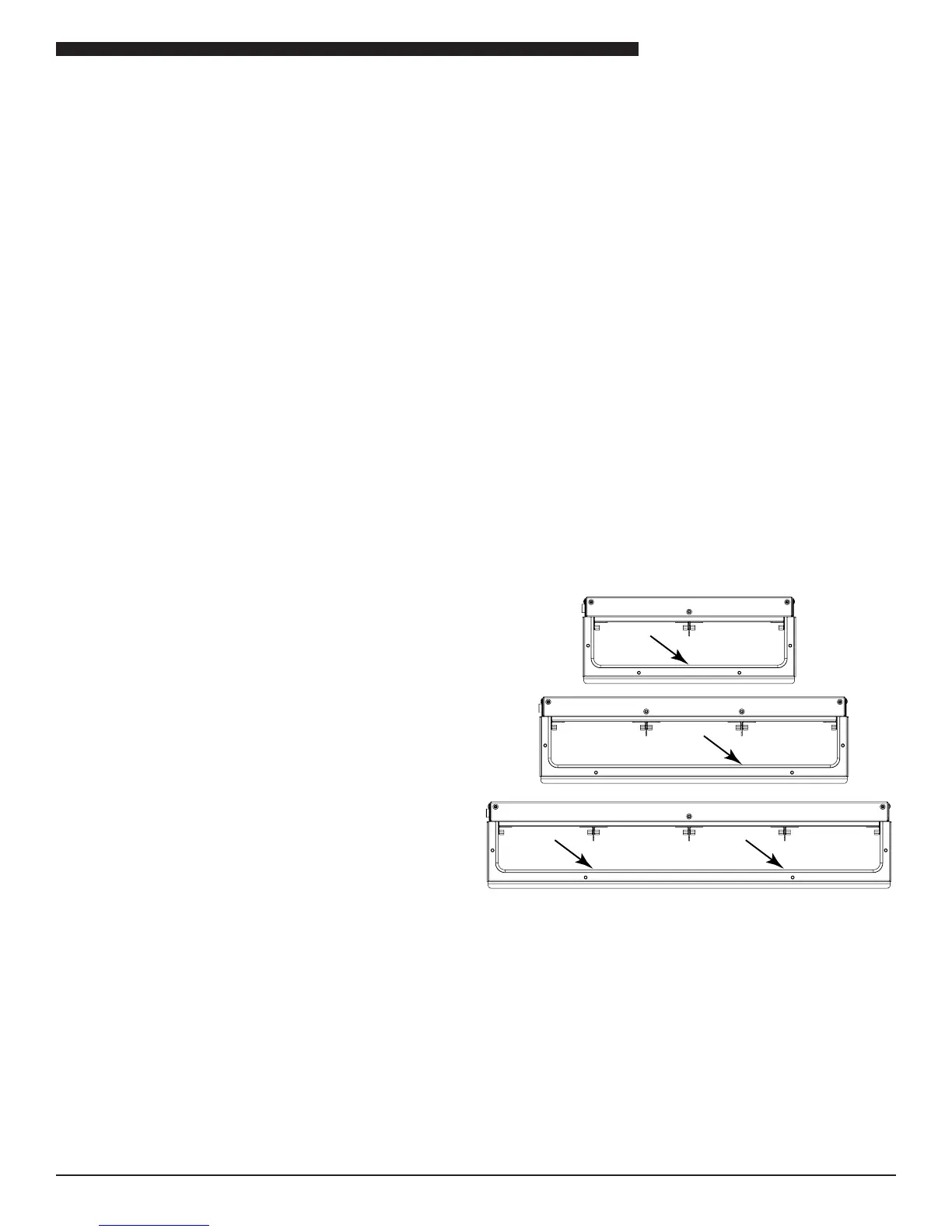
4. Locate the surface temperature probe on the
bottom of the rst cavity. Temperature readings
should be taken in the middle of the heat sink
beneath the rail as shown. Four wide units
require 2 readings, left and right side.
5. All temperature controls exhibit a swing in
temperature as the control cycles on and off while
regulating to the set point. For instantaneous
readings, the temperature should be ± 15°F(±
8.3°C) from the set point.
The correct calibration temperature is the average
of several readings taken over a period of 20
minutes after the warmer has been pre-heated.
The average temperature should be ± 10°F(±
5.5°C) from the set point.


 To Next Page