Need help?
Do you have a question about the Duncan BLACKOUTS AHB-2 and is the answer not in the manual?
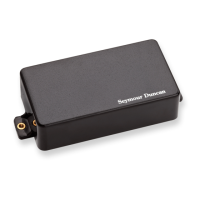
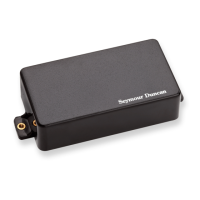
Wiring diagram specific to the BLACKOUTSTM HEAVY METAL AHB-2 Active Humbuckers model.
Step-by-step instructions for installing Seymour Duncan pickups, including removal and connection.
Diagram illustrating the wiring configuration for a 2-volume, 2-tone guitar setup.
Information regarding the availability of long-shaft potentiometers for specific guitar requirements.
Instructions for using the quick connector system for active pickups for high-output mode.
Diagram illustrating the wiring configuration for a 2-volume, 1-tone guitar setup.
Diagram illustrating the wiring configuration for a 1-volume, 1-tone guitar setup.
Advisory against combining active and passive pickups due to potential compatibility issues.
Guidance on potential issues with stereo output jacks contacting guitar shielding.
This manual describes the installation and wiring of Seymour Duncan electric guitar pickups, specifically focusing on the BLACKOUTS™ HEAVY METAL AHB-2 Active Humbuckers. The document provides detailed instructions for both initial setup and various wiring configurations, ensuring optimal performance for the user.
The primary function of these pickups is to convert string vibrations into electrical signals, which are then amplified to produce the sound of an electric guitar. As active humbuckers, they are designed to deliver a high-output, low-noise signal, making them particularly suitable for heavy metal and other high-gain genres. The active nature of these pickups means they require a power source, typically a 9-volt battery, to operate. This power source drives an onboard preamp that shapes the tone and boosts the signal, providing a consistent and powerful output regardless of cable length or amplifier input impedance.
One of the key usage features is the straightforward installation process, even for those with basic tool-handling skills. The manual begins by congratulating the user on their purchase and assures them that installing the pickup is not "rocket science." However, it also wisely advises consulting a qualified guitar technician if one is not comfortable with soldering or handling hot tools, emphasizing safety and proper installation.
The basic installation steps are clearly outlined, starting with the removal of strings, pickguard/mounting ring, and control plate cover. Users are instructed to de-solder the original pickup's wires, carefully noting their connections. The original pickup is then removed, and the Seymour Duncan pickup is installed in its place. A crucial step for guitars previously equipped with passive pickups is to replace the original pots and output jack with the provided 25k pots and stereo output jack. The manual explicitly states that the capacitor from the original tone control can be reused.
For guitars already equipped with 25k pots and active pickups using quick connector cables, the installation is even simpler. The user can merely unplug the original active pickup and plug in the new active Blackout using its quick connector plug. In this scenario, the standard output cable coming from the bottom of the Blackout is not used; it should be wound up, insulated, and stored in the pickup cavity, or cut shorter and insulated if space is limited.
The wiring instructions detail how to tin the pickup wires and solder them in place. All red wires from the pickups must be connected to the red wire from the battery clip, while the black wire from the battery clip connects to the ring terminal of the output jack. After wiring, the pickguard/mounting ring and control panel plates are re-attached.
A critical usage feature involves adjusting the pickup height for optimal balance. The manual recommends setting the bridge pickup between 1/8" and 1/16" from the strings when pressed down at the highest fret. The neck (and middle, if applicable) pickups are then adjusted to achieve an even output balance with the bridge pickup. This fine-tuning ensures a consistent volume and tone across all pickup selections.
The manual also highlights the "quick connector system" as a versatile usage feature. This system allows users to switch between high-output mode (connector in place) and normal output mode (connector removed), offering flexibility in tone and output level. It explicitly states that the RED wire must be on the LEFT when using this system, ensuring correct polarity and function.
Several wiring diagrams are provided to cover different control configurations: "2 Volumes, 2 Tones" and "1 Volume, 1 Tone." These diagrams are essential for proper installation, illustrating the connections between pickups, potentiometers, switches, output jack, and battery. Grounding connections are clearly marked with a "Solder =" symbol, indicating where wires should be soldered to ground (earth) connections.
A significant maintenance feature, or rather a preventative measure, is the warning regarding stereo output jacks. The manual notes that stereo output jacks are often wider than mono jacks and can potentially contact the inside of a guitar's control cavity, especially if the guitar is shielded with paint or copper tape. Such contact can cause the guitar's output to diminish greatly or short out completely. While this won't harm the pickups, it will prevent the guitar from working properly. Therefore, users are advised to ensure the stereo output jack does not touch the inside of the guitar.
Another important usage consideration is the recommendation against combining active and passive pickups in the same guitar. The manual explains that the differences in how they work and the components they use typically lead to problematic results, emphasizing the importance of using either all active or all passive pickups for optimal performance.
For users with guitars requiring long-shaft potentiometers, Seymour Duncan offers a customer-centric maintenance feature: they will gladly send four long-shaft pots (with all nuts & washers) free of charge. U.S. customers can email their shipping address to wiring@seymourduncan.com or call a specified extension. Non-U.S. customers are directed to the Seymour Duncan website to find contact information for their local distributor. This demonstrates a commitment to customer support and ensuring users have the correct components for their specific guitar models.
The manual also includes contact information for Seymour Duncan, including their address, phone, and fax numbers, and website, providing avenues for further support and information. The inclusion of a revision number (P/N 501020-130 Rev. A) indicates that the document is updated and maintained, reflecting ongoing product development and support.
In summary, the Seymour Duncan BLACKOUTS™ HEAVY METAL AHB-2 Active Humbuckers are designed for high-performance electric guitar applications, particularly in genres requiring powerful, clear, and low-noise signals. The manual provides comprehensive, user-friendly instructions for installation, wiring, and setup, supported by clear diagrams and helpful tips. It emphasizes proper grounding, pickup height adjustment, and compatibility considerations (active vs. passive pickups), all contributing to optimal sound quality and longevity of the device. The availability of long-shaft pots and the quick connector system further enhance the user experience, offering customization and ease of use. The overall tone of the manual is encouraging and supportive, guiding users through the process to achieve the best possible results from their new pickups.
 General
| Type | Humbucker |
|---|---|
| Active/Passive | Active |
| Magnet Material | Ceramic |
| Position | Bridge |
| Output | High |
| Color | Black |

 To Next Page