exceed 3 mW/cm
2
of UVA light, and also include the more dangerous UVB light (primarily responsible for
suntans, sun burns, and skin cancer) as well.
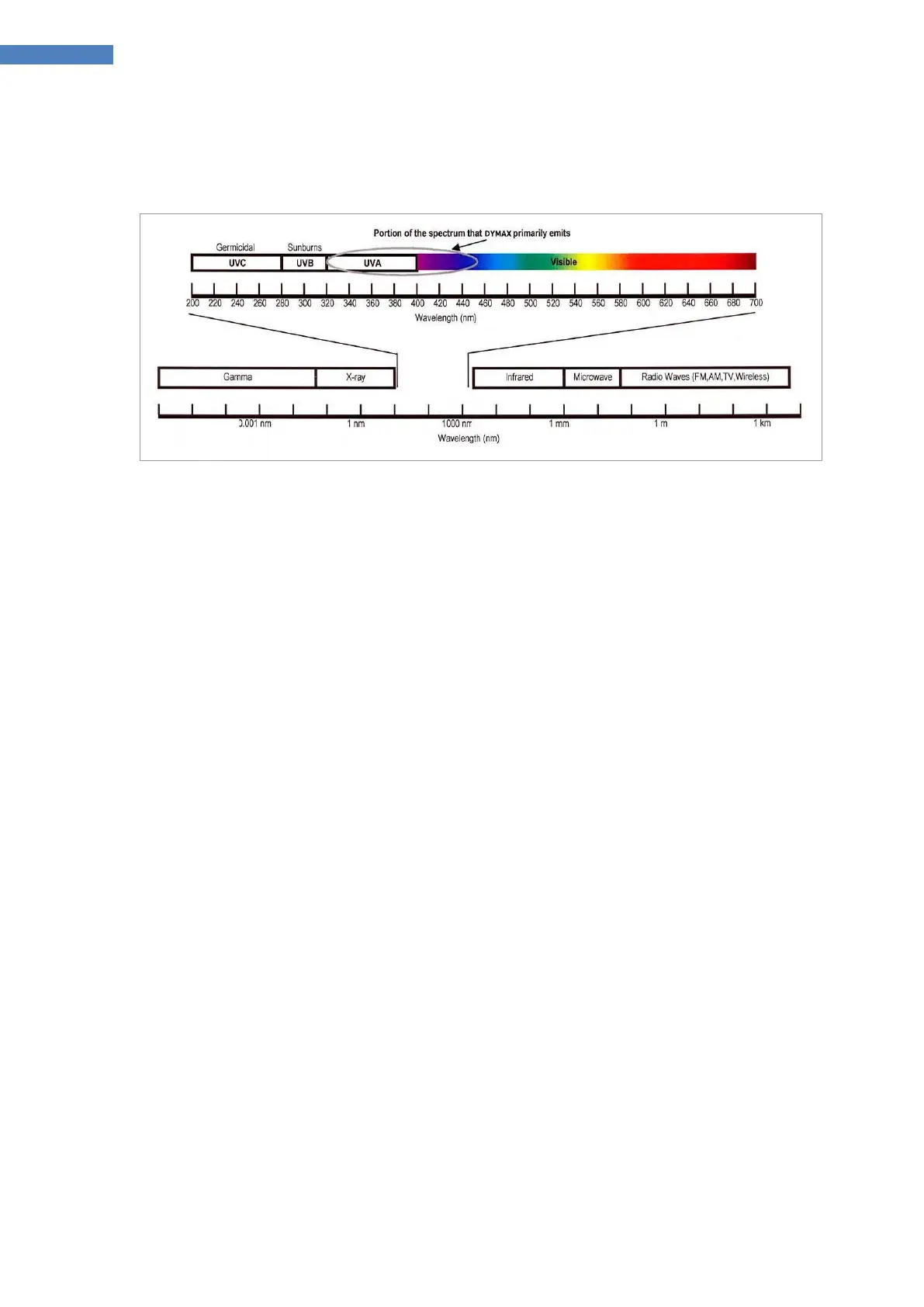
Figure 1. UV Spectrum
Checking the Workstation
The human eye cannot detect "pure" UV light, only visible light. A radiometer should be used to measure
stray UV light to confirm the safety of a UV light-curing process. A workstation that exposes an operator to
more than 1 mW/cm
2
of UVA continuously should be redesigned.
Protecting Operators
Light-curing technology can be a regulatory compliant, "worker-friendly" manufacturing process when the
proper safety equipment and operator training is utilized. There are two ways to protect operators from
UV exposure: shield the operator and/or shield the source.
UV-Blocking Eye Protection — UV-blocking eye protection is recommended when operating UV light-
curing systems. Both clear and tinted UV-blocking eye protection is available from Dymax.
UV-Blocking Skin Protection — Where the potential exists for UV exposure upon skin, opaque, UV-
blocking clothing, gloves, and full-face shields are recommended.
Shield the Source of UV
Any substrate that blocks UV light can be used as a shield to protect workers from stray UV light. The
following materials can be used to create simple shielding structures:
Rigid Plastic Film — Transparent or translucent/UV-blocking plastics (typically polycarbonate or acrylic)
are commonly used to create shielding where some level of transparency is also desired.
Flexible Film — Translucent UV-blocking, flexible urethane films can be used to quickly create
workstation shielding.
Ozone
Standard Dymax bulbs (UVA type) generate an insignificant amount of UVC and therefore essentially no
ozone. Some UV light-curing systems, like those used to cure UV inks, emit primarily “shortwave” (UVB
and UVC) energy. Upon exposure to UVC light (specifically <240 nm), oxygen molecules (O
2
) split into
oxygen atoms (O) and recombine with O
2
to create ozone O
3
.



 To Next Page