EasyManua.ls Logo

DYU C6 - User Manual

DYU C6
7 pages
Print Icon
To Next Page IconTo Next Page
Loading...
MADE BY DYU
C6
DYU ELECTRIC BIKE
USER MANUAL
(Please read the instruction manual carefully and understand the perfor-
mance of the electric bicycle before using. Please keep the instruction manual
properly)
Question and Answer IconNeed help?

Do you have a question about the DYU C6 and is the answer not in the manual?

Summary

Bike Function Overview

Charging and Power Management

Covers charging the e-bike, turning it on/off, and regenerative braking features for power recovery.

Bike Controls and Safety Features

Details the operation of the horn, front light, and understanding brake-related safety functions.

Riding Modes and Booting Procedures

Explains ECO mode, zero-speed booting, and non-zero-speed booting options for riding.

Meter Interface and Battery Status

Battery Status Definitions

Explains PUSH LOCK, OFF, and ON states for battery locking and power status indication.

Power Level Indication

Describes how the power range is visually displayed on the e-bike's meter interface.

Button and Electric Instructions

Power Button Operation

Instructions on how to turn the e-bike's display and battery on or off using the power button.

Electric Power Indicators

Details the display of battery power percentage and low-voltage warnings.

Gear System and Derailleur

E-Bike Gear Components

Lists the components of the gear system, including freewheel, derailleur, chain, and sprockets.

Derailleur System Adjustment

Provides instructions on how to adjust the rear derailleur for smooth gear shifting.

Technical Specifications

Bike Size and Dimensions

Details the spread size, folding size, center distance, and hub size of the e-bike.

Performance Metrics

Lists key performance data including weight, max load, speeds, and mileage estimates.

Electrical Standards and Features

Outlines battery specifications, power ratings, charging details, and available features like App and Cruise.

Safety Precautions and Maintenance

Charging and Battery Safety

Important warnings regarding battery charging environment, voltage, and charger safety.

Riding Safety Guidelines

Provides essential advice for safe riding, including brake checks, speed limits, and traffic rules.

Maintenance and Responsibility

Covers basic maintenance checks, recommended torque, and responsibility announcements for users.

Overview

This document serves as the user manual for the DYU Electric Bike, model C6, providing essential information for its operation, maintenance, and safe use. It is designed to guide users through understanding the bike's performance and ensuring its proper care.

Function Description

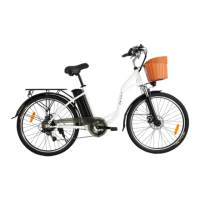
The DYU Electric Bike C6 is a personal electric transportation device designed for urban and recreational use. It combines traditional bicycle components with an electric motor and battery to offer both pedal-assisted and purely electric riding modes. The bike features a comprehensive set of components for safe and efficient operation, including a front derailleur, brake levers, throttle, front basket, front light, front fork, front fender, front tire, spoke, rear carrier, rear light, rear fender, rear brake, hub motor, freewheel, rear derailleur, controller box, chain, chain cover, pedal, reflector, and front hub. The electric system is managed by a controller box and powered by a battery, allowing for various riding experiences.

The bike supports both electric and assistant modes. By default, it operates in ECO economy gear when turned on, allowing for direct acceleration or power-assisted riding via sensors. It supports both zero-speed booting, where acceleration is possible from a standstill using the speeding bar, and non-zero speed booting, where the bike only starts when already in motion. A regenerative braking feature allows for partial power recovery and battery charging when braking gently downhill.

Usage Features

Operating the DYU Electric Bike involves several key steps and features:

  • Charging: To charge the bike, connect the charger to a power plug and then to the E-bike. The charger indicator will turn green from red when the battery is fully charged. It is crucial to charge the battery between 0°C and 45°C, keep it dry, and avoid exposure to acid, alkalinity, rain, fire, or heat. Ensure the battery's positive and negative terminals are not connected incorrectly, and do not disassemble the battery or use an incorrect adapter. Charging should not exceed 6 hours or a current of 2A. For long-term storage, charge the battery for 2 hours every two months in a dry and cool place. When charging, always place the battery first, then connect the electricity. After charging, disconnect the electricity, then the battery plug. If the charging indicator malfunctions, or if there's a strange smell or overheating, stop charging immediately and inspect or replace the charger.
  • Turning On/Off: The E-bike is turned on by pushing the boot button forward, which illuminates the dashboard. Pushing the boot button backward turns the E-bike off.
  • Power On/Off Display: A dedicated switch button controls the power display. Pressing it shows the power status, and pressing it again turns off the display.
  • Horn: The horn button activates the horn. It is recommended to click the button for activation. If pressed for over 10 seconds, the horn stops and needs to be repressed.
  • Front Light: The front light is operated by a switch. Pushing it forward turns the light on, and pushing it backward turns it off.
  • Braking: The brake handle must be fully rebounded during use; otherwise, the bike will remain in a power-off state and cannot be powered up. Always check the brakes before riding and brake the rear wheel first. Ensure the brake tightness is correct, adjusting with a hexagon wrench if loose. Be aware that rainy and snowy days require longer braking distances.
  • Pedal Installation: The right pedal should be rotated clockwise for installation, and the left pedal should be rotated anticlockwise.
  • Folding: The manual includes instructions for quick start unfolded folding, indicating the bike's portability.
  • Gears (if applicable): Some DYU E-bikes come with gears, consisting of a rear sprocket cluster (freewheel or cog set), a rear derailleur, a shifter, a control cable, a front sprocket (chaining), and a drive chain. Shifting to a lower gear (downshift) makes pedaling easier, while shifting to a higher gear (upshift) makes it faster. The derailleur system requires the drive chain to be moving forward and under tension to shift properly. Never shift gears while pedaling backward, as this can jam the chain and damage the E-bike.
  • Derailleur System Adjustment: The front and rear derailleurs are factory-adjusted but may require inspection and readjustment. To adjust the rear derailleur, shift to the largest number indicated, loosen the cable from the rear derailleur cable anchor bolt, and place the chain on the smallest sprocket. Adjust the high limit screw to align the guide pulley and the smallest sprocket vertically. Re-tighten the cable, remove slack, and re-tighten the anchor bolt. Shift through the gears to ensure smooth and quiet operation. Use the barrel adjuster to fine-tune cable tension: clockwise loosens tension and moves the chain away from the wheel, while counter-clockwise tightens tension and directs the chain to the wheel.
  • Battery Status Display: The meter interface provides a clear indication of the battery's charge level through a series of icons. A full battery is indicated by all segments lit, while decreasing segments show lower charge levels (100%, 55%-75%, 25%-50%, and <25%). If the battery power drops below 1%, the power meter monitors for low-voltage protection. If the power level falls below the standard, the icon will flash, warning of a low battery voltage.
  • Riding Safety: Always read the instruction manual to understand the product's performance. Do not lend the bike to unfamiliar users. Wear a helmet while riding and obey traffic rules. Avoid riding on car roads or in crowded areas. Maintain speeds under 15 km/h when going downhill or on slippery roads. Inspect tire pressure before riding, ensuring it is between 35-45 PSI. Avoid excessive impact on the motor and keep the axle smooth. Do not overload the bike (maximum load is 120 kg). Be cautious of increased braking distances in rainy and snowy conditions. Single-handed riding is prohibited.

Maintenance Features

Proper maintenance is crucial for the longevity and performance of the DYU Electric Bike:

  • Wheel Alignment: Ensure the front and back wheels are centered within the frame.
  • Storage: After riding, store the E-bike in a cool and dry place.
  • Motor and Brake Inspection: Regularly check the motor and brakes. Do not inject oil onto the brake components.
  • Fastener Inspection: Frequently check the E-bike and all screws and fasteners, tightening them as needed.
  • Recommended Torque: Adhere to specified torque values for various fasteners: bar screws (60-80 kgf.cm), bar stand screws (175-200 kgf.cm), and wheel screws (320-450 kgf.cm).
  • Tire Maintenance: If a tire is pierced or leaks air, contact a professional technician for repair or replacement.

The manufacturer reserves the right to update product models, types, and related information without prior notice. This instruction manual is specifically for the denoted models. Any unauthorized copying, modification, propaganda, or publication is prohibited. Users are responsible for damages resulting from not following the instructions. The manufacturer is not liable for injuries, casualties, or property damages. For more information, users can visit www.dyucycle.com.

DYU C6 Specifications

General IconGeneral
Motor Power350W
Max Speed25 km/h
Max Load120 kg
FoldableYes
BrakesDisc brakes
Charging Time4-6 hours

Related product manuals