
 Need help?
Do you have a question about the ebm-papst R3G560-RB32-01 and is the answer not in the manual?
Explains hazard level indicators like DANGER, WARNING, CAUTION, NOTE.
Specifies that only qualified and trained personnel should operate or maintain the device.
Outlines general safety rules to follow when working on the unit and modifications.
Warns about electrical voltage presence even when the unit is shut off and safety precautions.
Details dangers of missing or malfunctioning safety devices and required protection.
Discusses potential interference and EMC compliance for electromagnetic radiation.
Covers hazards related to rotating parts and flying parts due to mechanical movement.
Addresses potential noise levels and necessary precautions for hearing protection.
Warns about high temperatures and the risk of burn injuries from the electronics enclosure.
Provides guidelines for storing the device in a dry, weatherproof, and clean environment.
Instructs to comply with national regulations when disposing of the device.
Lists prohibited uses that may cause hazards, like operating with imbalance or in explosive atmospheres.
Presents a detailed technical drawing of the product with dimensions and specifications.
Provides detailed technical specifications for the motor, including voltage, frequency, power, and temperature limits.
Lists efficiency data and power consumption figures according to the ErP directive.
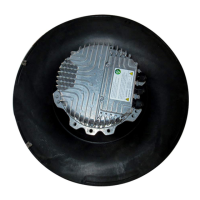
Details the physical and electrical characteristics of the device, such as mass, material, and protection type.
Specifies requirements for mounting screws and general mounting advice.
Outlines the permissible ambient temperatures for transport and storage.
States compliance with EMC standards for immunity and emission.
Provides safety precautions for handling and connecting the mechanical parts of the device.
Details electrical connection safety, insulation requirements, and wiring precautions.
Checks for connection, supply voltage, and fuse protection requirements.
Details idle current, RCD, leakage, and locked-rotor protection notes.
Guides on preparing and connecting lines within the terminal box, including stripping lengths.
Guides on connecting cables to terminals, emphasizing safety precautions like waiting for voltage discharge.
Provides instructions on routing cables to prevent water penetration and ensure proper gland arrangement.
Lists the default factory settings for control modes, parameters, and functions.
Details the connection terminals, their designations, and functions for mains supply, status relay, and control interfaces.
Outlines steps for checking connections, ensuring power is off, and securing the terminal box.
Provides instructions and warnings for switching on the device after installation and connection.
Explains procedures for switching off the device during operation and for maintenance.
Describes malfunctions like rotor errors or phase failure and their protective functions.
Lists common malfunctions, their possible causes, and recommended remedies.
Explains how to address insufficient cooling and reset error messages.
Describes how to manage high ambient temperatures and reset associated errors.
Guides on correcting operating points and resetting errors related to excessive counterpressure.
Provides instructions and warnings for cleaning the device safely, avoiding water jets and harsh chemicals.
This document provides operating instructions for the R3G560-RB32-01 device, a built-in component designed for conveying air. It emphasizes safety regulations, proper use, technical specifications, connection procedures, integrated protective functions, and maintenance guidelines.
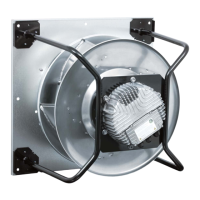
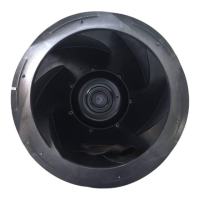
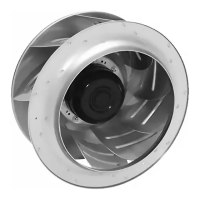
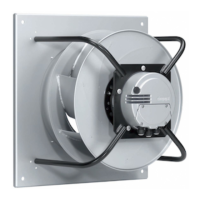
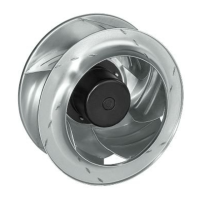
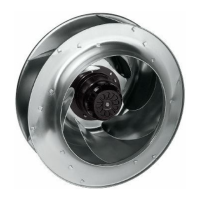
The R3G560-RB32-01 is an EC centrifugal fan with a backward-curved impeller, designed for use as a built-in component in systems for conveying air. It operates as a variable speed drive, offering PWM controlling capabilities. The device is intended for stationary systems and moves air with a density of 1.2 kg/m³. It features an integrated PID controller, soft start functionality, and various protective features to ensure safe and reliable operation. The fan is equipped with an RS485 MODBUS RTU interface for communication and control, allowing for integration into broader control systems. It also includes an alarm relay and outputs for operation and alarm display, as well as inputs for sensors and external release.
Motor: M3G150-IF Phase: 3~ Nominal Voltage: 400 VAC (range 380-480 VAC) Frequency: 50/60 Hz Speed: 1650 min⁻¹ Power Input: 2900 W Current Draw: 4.43 A Min. Ambient Temperature: -25 °C Max. Ambient Temperature: 50 °C Mass: 27.8 kg Size: 560 mm Surface of Rotor: Coated in black Material of Electronics Housing: Die-cast aluminium Material of Impeller: PP plastic Number of Blades: 6 Direction of Rotation: Clockwise, seen on rotor Type of Protection: IP 54 Insulation Class: "F" Humidity Class: F4-1 Mounting Position: Shaft horizontal or rotor on bottom; rotor on top on request Condensate Discharge Holes: Rotor-side Operation Mode: S1 Motor Bearing: Ball bearing Overall Efficiency (nes): 66.9% Efficiency Grade (N): 72.5 Power Input (Ped): 2.93 kW Air Flow (qv): 9440 m³/h Pressure Increase Total (psf): 710 Pa Speed (n): 1655 min⁻¹ Output 10 VDC: max. 10 mA Output 20 VDC: max. 50 mA Output for slave: 0-10 V Input for sensor: 0-10 V or 4-20 mA External 24 V Input: (programming) Motor Current Limit: Yes PFC: Passive Touch Current (IEC 60990): <= 3.5 mA Electrical Leads: Via terminal box Motor Protection: Reverse polarity and locked-rotor protection Protection Class: I (if protective earth is connected by customer) Product Conforming to Standard: EN 61800-5-1; CE Approval: C22.2 Nr.77 + CAN/CSA-E60730-1; UL 1004-7 + 60730 EMC Interference Immunity: Acc. to EN 61000-6-2 (industrial environment) EMC Interference Emission: Acc. to EN 61000-6-4 (industrial environment)
The device is designed for proper use in power systems with earthed neutral (TN/TT power systems). It must be operated with all protective features in place and in accordance with the permitted ambient temperature. The control mode is pre-set to PWM controlling, with parameter sets configurable for specific applications. The device offers analogue inputs (0-10 V or 4-20 mA) for set value control and actual value feedback, as well as digital inputs for enabling electronics, parameter set switching, and controller function selection. A fixed voltage output of 10 VDC and 20 VDC is available for external devices or sensors. The device incorporates integrated protective functions that automatically switch off the motor in case of rotor position detection error, locked rotor, line under-voltage, or phase failure, with automatic restart capabilities once the fault is cleared or conditions return to normal. For cyclic speed loads, the rotating parts are designed for a maximum of one million load cycles. When installing, it is crucial to secure mounting screws against accidental loosening and ensure proper cable routing to prevent water penetration into the cable gland. The terminal box connections must be made carefully, ensuring correct wiring and proper sealing of the box.
Maintenance involves regular checks and cleaning to ensure optimal performance and safety. Cleaning:


 To Next Page
 General