Need help?
Do you have a question about the Ebyte E108-GN02D and is the answer not in the manual?
High-performance, multi-mode satellite positioning module with low power consumption for GNSS applications.
Supports multi-system positioning, D-GNSS, 32-bit processor, PPS output, and ultra-low power consumption.
Details usage in vehicles, wearables, UAVs, and industrial equipment requiring GNSS positioning.
Covers positioning time, sensitivity, precision, and power consumption under various test conditions.
Outlines communication agreement, supported systems, interfaces, power, size, and certification.
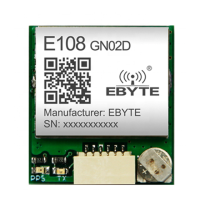
The E108-GN02D is a high-performance, highly integrated, low-power, and cost-effective multi-mode satellite positioning and navigation module. Its compact size and minimal power consumption make it suitable for a wide range of GNSS positioning applications, including car navigation, smart wearables, and drone flight control. The module provides a hardware interface and supports UART communication, along with a low-power consumption mode. It is designed to support multiple satellite positioning systems, including BDS, GPS, GLONASS, GALILEO, QZSS, and SBAS.
The module integrates a radio frequency baseband antenna, DC/DC converter, LDO, radio frequency front end, a low-power application processor, RAM, Flash storage, RTC, and power management. This integrated design contributes to its small footprint and efficient operation. The inclusion of a button battery for the RTC and backup RAM helps reduce the initial positioning time, ensuring quicker startup. The module is designed for ease of use, supporting serial port connections to other peripherals and automatically starting operation after power-on, allowing users to get started quickly with minimal configuration.
One of the key usage features of the E108-GN02D is its multi-system joint positioning and single-system independent positioning capabilities, supporting BDS, GPS, GLONASS, GALILEO, QZSS, and SBAS. This broad compatibility enhances its accuracy and reliability in various environments. It also supports D-GNSS differential positioning, A-GNSS assisted positioning, ephemeris prediction, and DR integrated navigation applications, with a fast data update rate of up to 10Hz. The module incorporates a 32-bit application processor with a maximum frequency of 133MHz, which supports dynamic frequency adjustment for optimized performance and power efficiency.
For precise timing, the module offers PPS (Pulse Per Second) output, with a default period of 1s, which is crucial for applications requiring accurate time synchronization. A built-in reset controller ensures stable operation. Communication is facilitated through UART, making it easy to interface with other systems. The RTC (Real-Time Clock) supports a 32.768 KHz ± 20 ppm crystal oscillator and provides a 1.1V RTC clock output, with support for external signal wake-up, further enhancing its power management capabilities. The output format supports NMEA0183 V4.1 and previous versions, with a maximum fixed update frequency of 10Hz. The module boasts high sensitivity, with a cold start capture sensitivity of -149dBm, hot start at -162dBm, and tracking at -166dBm, allowing it to acquire and maintain satellite signals even in challenging conditions. Its ultra-low power consumption, with 35mA during capture, and the ability to enter a low-power consumption mode via an interface, make it suitable for battery-powered devices.
In terms of maintenance and hardware design considerations, it is recommended to power the module with a DC stabilized power supply, ensuring the power supply ripple does not exceed 30mV, and that the module is reliably grounded. Correct polarity for the power supply is critical, as reverse connection can cause permanent damage. Users should verify that the power supply voltage is within the recommended range to prevent damage. The serial ports (TXD and RXD) operate at LVTTL levels, requiring an RS232 level conversion if connected to a PC. These serial ports are used for receiving positioning information data and for software upgrades.
The module is sensitive to temperature changes, and drastic fluctuations can reduce its performance. Therefore, it should be kept away from high-temperature airflow and high-power heating devices during use. When designing the power supply circuit for the module, it is advisable to reserve more than 30% margin to ensure long-term stable operation of the entire system. To minimize electromagnetic interference, the module should be placed as far as possible from power supplies, transformers, high-frequency wiring, and other components that generate significant electromagnetic noise. If devices with strong electromagnetic interference are present near the module, it is recommended to increase the distance or implement proper isolation and shielding to maintain optimal performance.
The E108-GN02D also supports AGPS settings, with detailed methods available in the "Goke AGPS User Manual" provided in the information package. For command formats related to software functions, users can refer to the "GK9501 Input and Output Format" document. The module's functionality can be tested and monitored using tools like naviTrack, which allows users to view data reported by the serial port, including NMEA sentences, and obtain latitude and longitude information from the $GPRMC field. This facilitates debugging and verification of positioning data.
 General
| Modulation | BPSK |
|---|---|
| Interface | UART |
| Operating Temperature | -40°C to +85°C |
| Channels | 72 |
| Positioning Accuracy | 2.5 m CEP |
| Weight | 1.5g |
| Frequency | 1575.42 MHz |
| Time to First Fix | 30s |
| Operating Current | 25mA |
| Baud Rate | 115200 bps |
| Antenna Type | External |
| Storage Temperature | -40°C to +125°C |

 To Next Page