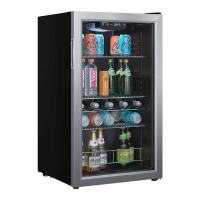
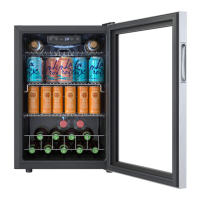
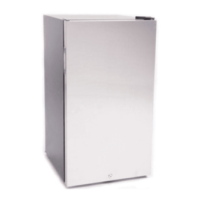
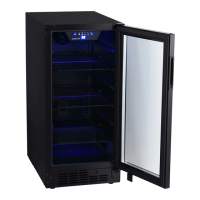
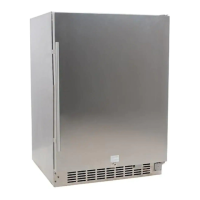
This document is an owner's manual for an EdgeStar beverage refrigerator, model BWC121SSLT. It provides comprehensive instructions for the safe installation, operation, and maintenance of the appliance, designed for domestic indoor use.
The manual begins with crucial safety information, emphasizing that improper handling can lead to serious damage or injury. It states that the refrigerator is not intended for industrial or commercial use, and any deviation from its intended purpose may void the warranty. Users are advised to review the ratings label on the rear panel for electrical and technical data and to ensure the unit is connected to a properly grounded wall outlet.
Electrical safety is a significant focus, with warnings against exceeding power outlet ratings, using extension cords or power strips, and operating the unit with a damaged cord or loose socket. It recommends connecting the refrigerator to its own dedicated circuit and ensuring it is properly grounded according to the National Electrical Code and local ordinances. The manual also cautions against installing the unit in high humidity environments, as this can cause condensation and affect performance. Users are instructed to always unplug the unit before cleaning or if it will not be used for an extended period. Crucially, it warns against touching the power plug with wet hands, bypassing the grounding plug, or attempting repairs while the unit is plugged in. In case of strange sounds, smells, or smoke, users should immediately unplug the unit and contact customer service. A specific danger warning highlights the use of flammable refrigerant and the need to avoid damaging the refrigerant tubing to prevent leaks.
General safety guidelines advise using at least two people for moving and installing the refrigerator to prevent injuries. The unit should be installed in a well-ventilated area with ambient temperatures between 50°F and 90°F, as this range is optimized for beverage storage. It explicitly states that perishable food items may require a different storage environment. Users are warned not to place hot or warm items into the refrigerator before they cool down and that the unit is designed for indoor use, protected from elements like rain, sleet, snow, or moisture. The appliance is not intended for use by children, and children should be supervised to prevent them from playing with or crawling inside the refrigerator. If disposing of the unit, the door should be removed. The manual prohibits using the appliance near flammable gases or combustibles and storing explosive substances within it. It also advises against placing the unit near heat sources or in direct sunlight. Proper ventilation and an upright, level surface are essential for operation. Users should not pinch or kink the power supply line, leave cleaning solutions inside, or use solvent-based or abrasive cleaners. Placing other appliances on top of the unit or turning it upside down or on its side is also prohibited. For models with a lock, keys should be kept away from children. The unit should not be moved without emptying its contents and securing the door. The appliance is not intended for use by individuals with reduced physical, sensory, or mental capabilities unless supervised. All ventilation openings must remain clear, and mechanical devices or other means should not be used to accelerate defrosting. Damaging the refrigerant circuit or using other appliances inside the refrigerator (unless recommended by the manufacturer) is forbidden. If the power cord is damaged, it must be replaced by a qualified technician. A disposal warning indicates that the appliance should not be treated as regular household waste but taken to an appropriate collection facility.
The "First-Time Operating Instructions" section advises removing all packaging materials and labels before use and keeping the original packaging for future transport. It recommends letting the unit stand for at least 24 hours to allow cooling components to settle after transit.
The "Introduction" thanks the user for purchasing the EdgeStar beverage refrigerator and highlights the importance of the manual for proper installation, use, and maintenance to ensure peak performance. It also provides space for recording the model number, serial number, and date of purchase for warranty service. Before contacting customer service, users are encouraged to read the manual, especially the troubleshooting section, and visit the EdgeStar website for additional resources.
"Parts Identification" includes diagrams of the front and rear views of the refrigerator, labeling key components such as the top right hinge, control panel, internal fan, shelf, stainless steel door, lock, leveling foot, product label, power cord, and power plug. Users are reminded to gather the model and serial number from the product label before installation.
The "Installation" section details the requirements for setting up the beverage refrigerator. It reiterates that the unit should be installed according to local electrical codes and on a surface strong enough to support its full weight. The 24-hour waiting period before plugging in is repeated to allow compressor oils to settle.
Unpacking instructions advise using two or more people to move and install the unit to prevent injury. It warns against using sharp instruments, rubbing alcohol, flammable fluids, or abrasive cleaners to remove tape or glue, as these can damage the surface. Users are also told not to remove any safety, warning, or product information labels.
For "Types of Installation," the manual states the refrigerator is designed for both freestanding and built-in installations, requiring adequate ventilation and service access in both cases. A freestanding installation offers flexibility in placement, provided electrical requirements and leveling instructions are followed. A warning explicitly prohibits installing the unit behind a closed cabinet door. A note emphasizes that the unit must be installed on a firm, level surface capable of supporting its full weight, and the height can be adjusted by rotating the leveling feet. The requirement for a standard 115V AC, 60Hz, properly grounded electrical supply is reiterated.
"Clearance Requirements" provides notes on ambient temperature, stating that operation outside 50°F to 90°F may reduce efficiency. The unit must be protected from elements like wind, rain, water spray, or drips and should not be placed near heat sources. It also warns against kinking or pinching the power supply cord. When installing under a counter, specific spacing dimensions are provided: at least 5 inches at the back, 3 inches at the top, and 3 inches at the sides for proper ventilation. The importance of a firm, level surface and adjusting leveling feet is repeated, along with the electrical supply requirements.
"Electrical Requirements" includes an "ELECTRIC SHOCK HAZARD!" warning, instructing users to plug into a grounded 3-prong outlet, never remove the grounding prong, avoid adapters, and not use extension cords. Failure to follow these instructions can result in fire, electrical shock, or death. It emphasizes the need for a proper electrical connection before moving the refrigerator to its final location, specifying a 115V, 60Hz, properly grounded supply. A separate circuit for the refrigerator is recommended, and the fuse or circuit breaker size should be 15 Amps.
The "Recommended Grounding Method" section explains that for personal safety, the appliance must be grounded with its 3-pronged plug inserted into a mating 3-pronged wall socket. If such a socket is unavailable, the customer is responsible for having one installed by a qualified electrician.
"Leveling the Beverage Refrigerator" provides instructions for ensuring the unit is level using a carpenter's level. It explains how to rotate the leveling feet to raise or lower each side of the refrigerator. A note advises adjusting the feet to level the unit whether it's installed in a cabinet or directly on the floor.
"Reversing the Door Swing" provides step-by-step instructions for changing the door's opening direction. It starts with a warning to unplug the refrigerator before beginning. To remove the door, users are guided to pry off the top hinge cover with a flathead screwdriver, remove screws and the top hinge with a Philips screwdriver, lift the door, and remove the bottom hinge. To install the door in the reversed position, users must remove decorative plugs from the opposite cabinet top corner and door, install the bottom hinge on the opposite side, position the door, install the top hinge, and insert decorative plugs into the corresponding holes.
The "Operation" section begins with an "Installation Checklist before Operation," ensuring all packing materials are removed, electrical connections and grounding are correct, the machine is level, ambient temperature is within range (50°F to 90°F), and proper air circulation clearances (1-2 inches at the rear, 1/4 inch at the top and sides) are maintained.
"Using the Temperature Control Panel" describes the functions of the control buttons. The beverage refrigerator has a temperature range of 32°F to 50°F. Buttons include:
- Temp Down Button: Decreases temperature by 1 degree.
- Temp Up Button: Increases temperature by 1 degree.
- Celsius / Fahrenheit Button: Switches the digital display between Celsius and Fahrenheit.
- Light Button: Turns interior lighting on or off.
- Digital Display: Shows the current set temperature.
A note explains the temperature memory function, where the previously set temperature is saved and restored after a power loss. It advises allowing 24 hours for the setting temperature to be reached. A caution warns to wait at least 5 minutes before turning the unit back on if it was previously turned off.
"Normal Sounds" explains that the refrigerator may make various noises during operation, which are typically normal. Hard surfaces can amplify these sounds. It describes common sounds: rattling from refrigerant flow or water lines, pulsating or high-pitched sounds from the compressor, splashing sounds from water running to the water bin, gurgling sounds from refrigerant flow at the end of cycles, and air being forced over the condenser by the fan. A warning in this section advises against touching the power plug with wet hands and never unplugging the unit by pulling on the cord.
"Defrosting" explains that the unit automatically defrosts in most ambient conditions, but frost may build up in colder or more humid environments. Users are advised to keep the door closed to minimize frost. If frost prevents the door from closing, the unit should be powered off until the frost melts, and then dried with a soft towel. A warning prohibits using sharp objects to remove frost.
"Preparing the Beverage Refrigerator for Storage" provides instructions for long-term storage or moving the unit. This involves disconnecting power, removing the plug, and leaving the door open to allow air circulation and prevent mold, mildew, and odors. A caution advises storing the unit out of reach of children and removing the door if children are present to prevent entrapment.
"Cleaning and Maintenance" covers both exterior and interior cleaning.
"Exterior Cleaning" recommends using a mild detergent or hand soap with warm water and a soft sponge, then rinsing with clean water and wiping with a soft towel to prevent water spotting. For stainless steel door panels, a cloth dampened with a mild detergent and warm water solution should be used, avoiding abrasive or caustic cleaning agents, as chlorine gas and moisture can cause discoloration.
"Interior Cleaning" advises occasional cleaning by disconnecting power, opening the door, removing contents and shelves, waiting for defrosting, wiping the interior with a clean cloth, reinserting shelves and items, and finally reconnecting power.
"Troubleshooting" provides a guide for common issues before calling for help. It lists symptoms, possible causes, and solutions.
Symptoms and Solutions include:
- Beverage refrigerator turns on and off frequently: Possible causes include high room temperature, frequent door opening, door not completely closed, improper door gasket seal, or insufficient ventilation. Solutions involve running the unit at appropriate ambient temperatures, minimizing door openings, ensuring the door is closed and gasket seals properly, and following ventilation requirements.
- Beverage refrigerator does not turn on: Possible causes are power failure, unit not plugged in, or a blown fuse/tripped circuit breaker. Solutions include ensuring the unit is plugged in and the outlet has power, plugging into an outlet with sufficient amperage, and replacing the fuse or resetting the breaker.
- Beverage refrigerator will not reach desired temperature: Possible causes include placement too close to a heat source, insufficient ventilation, or frequent/long door openings. Solutions involve moving the unit away from heat sources, ensuring proper ventilation, and closing the door tightly and less frequently.
- Beverage refrigerator is making strange noises: Possible causes are normal sounds, an unlevel unit, or contact with another appliance. Solutions involve reading the "Normal Sounds" section and checking that the refrigerator is level and not touching other objects.
- Body of the beverage refrigerator is electrified: The unit is not grounded properly. Solution: Contact a local electrician to test the grounding system.
- Frost is forming in the beverage refrigerator: Possible causes include humid environment, low ambient temperature, improper door gasket installation, or frequent door openings. Solutions involve manual defrosting, moving the unit to a warmer location, minimizing door openings, and checking the door gasket for a good seal.
- Door will not shut properly: Possible causes are an unlevel refrigerator, dirty door gasket, improperly installed door gasket, or incorrectly installed shelves. Solutions include ensuring the refrigerator is level, cleaning the door gasket, correctly installing the door gasket, and correctly installing the shelves.
The manual concludes with a "Specifications" table (which I will not include as per instructions) and the "EdgeStar Limited Warranty" information.
The "EdgeStar Limited Warranty" outlines a "One (1) Year Parts & Ninety (90) Days Labor" warranty.
What is Covered:
- Labor: For 90 days from the original purchase date, labor will be performed free of charge at an authorized EdgeStar repair facility. EdgeStar may repair or exchange defective products with new, refurbished, or remanufactured parts/products. Replaced products retain the remaining warranty of the original. After 90 days, labor charges are the user's responsibility. All defective products and parts covered by warranty will be repaired or replaced on a mail-in basis.
- Parts: For one year from the original purchase date, EdgeStar will supply new, rebuilt, or refurbished parts free of charge. Defective parts may be requested for return in exchange for replacements. All replacement parts or products become EdgeStar property.
- This warranty applies only to the original purchaser and covers defects in workmanship under normal service, maintenance, and usage conditions in residential settings within the contiguous United States.
What is Not Covered:
The warranty does not cover:
- Labor charges for installation, setup, or training.
- Shipping damage, damage from improper packaging for shipment, damage from improper voltage, or other misuse (abnormal service, handling, usage).
- Cosmetic damage (scratches, dents).
- Normal wear and tear on parts designed to be replaced (filters, cartridges, batteries).
- Service trips for delivery, pick-up, repair, installation, or instruction on product usage.
- Damages or operating problems from misuse, abuse, operation outside environmental specifications, uses contrary to the owner's manual, accidents, acts of God, vermin, fire, flood, improper installation, unauthorized service, maintenance negligence, unauthorized installation or modification, or rental/commercial use.
- Labor, service transportation, and shipping charges incurred 91 days or more after the original purchase date.
- Use of EdgeStar products in commercial or rental settings.
- Optional accessories, attachments, and appearance items.
- Products modified to perform outside specifications without prior written permission from EdgeStar.
- Products lost in shipment or theft.
- Products sold "AS IS" or from an unauthorized reseller.
- Products with removed or defaced serial numbers, or invalidated serial numbers.
- Damage to personal property from product use.
- Replacement or repair of household fuses, circuit breakers, wiring, or plumbing.
Obtaining Warranty Service:
Users should contact EdgeStar Customer Support for troubleshooting and warranty service. Before contacting, the model number, serial number, and proof of purchase are required. Once a representative confirms the product is defective and eligible, it must be returned to an authorized repair facility. EdgeStar is not responsible for damage from shipper mishandling or improper packaging. Products received without a return authorization number will be refused.
The warranty statement concludes by clarifying that it is in lieu of any other express or implied warranty, including merchantability or fitness for a particular purpose. Any implied warranty is limited to the express warranty period. Neither the manufacturer nor distributors are liable for incidental, consequential, indirect, special, or punitive damages, including lost revenues or profits. The seller, manufacturer, and/or distributor's liability will not exceed the basic cost of the product. Some states do not allow the exclusion of incidental or consequential damages, so these limitations may not apply to all users. The warranty provides specific legal rights, and users may have other rights that vary by state.


 To Next Page
 General