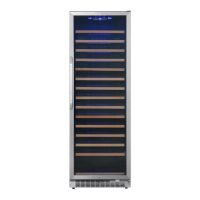
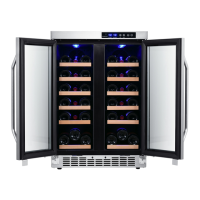
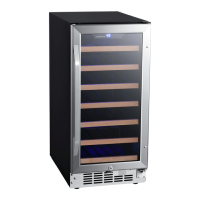
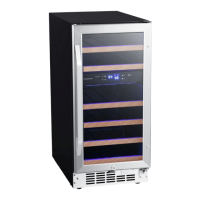
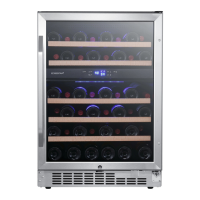
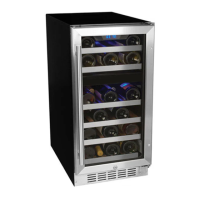
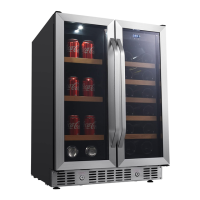
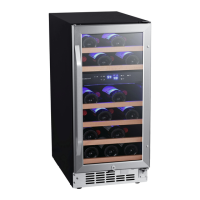
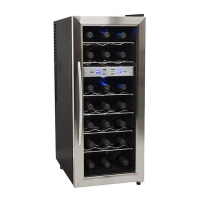
This document provides the owner's manual for the EdgeStar Wine Cooler, model CWR182SZ. It outlines important safety information, installation instructions, operational guidelines, and maintenance procedures to ensure proper and efficient use of the appliance.
Function Description
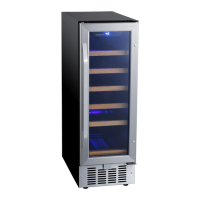
The EdgeStar Wine Cooler is designed for domestic indoor use to store wine at optimal temperatures. It features a single cooling zone with a temperature range of 40°F to 65°F (4°C to 18°C), which can be adjusted in 1-degree increments. The unit is equipped with an internal fan to maintain consistent internal temperatures and a built-in carbon filter to protect beverages from harmful odors. It can store up to 18 standard 750 ml wine bottles. The cooler is designed for both free-standing and built-in installations, offering flexibility in placement within your home.
Usage Features
The wine cooler's control panel allows for easy temperature adjustment using "Up" and "Down" buttons. Users can switch between Celsius and Fahrenheit display by simultaneously pressing and holding both temperature adjustment buttons for approximately 3 seconds. A "RUN LIGHT" indicates when the unit is in cooling mode, and a "Light Button" controls the internal light. The unit also features a "Power Button" to turn it on and off, requiring a 3-second press and hold.
For safety and convenience, the wine cooler includes several alarm features:
- Temperature Alarm: If the interior temperature rises above 73°F (23°C) or drops below 32°F (0°C) for more than an hour, "HI" or "LO" will be displayed on the control panel, and an alarm will sound continuously. This alerts the user to potential issues that may require troubleshooting or customer support.
- Door Ajar Alarm: If the door remains open for more than five minutes, an alarm will sound. This feature helps prevent poor cooling performance and potential shortening of the refrigerator's life by reminding users to keep the door closed.
The unit is equipped with shelves designed for easy installation and removal. To install shelves, the door must be fully open. Shelves slide onto tracks and are secured by plastic posts. To remove them, the process is reversed, ensuring all contents are taken off first.
The door swing of the wine cooler can be reversed from right to left, providing adaptability to different kitchen or room layouts. This process involves carefully removing the door and hinges, rotating the door 180 degrees, and then reattaching the hinges and door in the new configuration. Decorative plugs are also managed during this process to maintain the unit's aesthetic.
Maintenance Features
Regular cleaning and maintenance are crucial for the wine cooler's efficiency, performance, and longevity.
- Exterior Cleaning: The exterior, including the door and cabinet, should be cleaned with a mild detergent and lukewarm water solution (e.g., 2 tablespoons of baking soda to 1 quart of water). A soft sponge and clean water should be used, followed by a soft, clean towel to prevent water spotting. For stainless steel panels, a cloth dampened with a mild detergent and warm water solution is recommended. Abrasive or caustic cleaning agents should be avoided as they can damage the surface.
- Interior Cleaning: The interior should be cleaned occasionally. This involves disconnecting power, opening the door, removing contents and shelves, and allowing the unit to defrost. Once defrosted, the interior can be wiped down with a clean cloth. After cleaning, the shelves and wine are reinserted, and power is reconnected.
- Defrosting: The unit automatically defrosts under most refrigerating settings. However, in colder settings or humid ambient conditions, frost may build up. If frost prevents the door from closing properly, the unit should be powered off to allow the frost to melt, and then dried with a soft absorbent towel. Sharp objects should never be used to remove frost.
- Carbon Filter Replacement: The built-in carbon filter, which protects against harmful odors, should be replaced every 3 to 6 months. For units placed in a kitchen, replacement every 3 months is ideal due to higher odor exposure.
- Storage Preparation: If the wine cooler will be stored for an extended period or moved, it should be defrosted and dried. This involves disconnecting the power, removing the power plug, and leaving the door open to allow air circulation and prevent mold, mildew, and unpleasant smells. When storing, it is important to keep the unit out of reach of children, and if children are present, removing the door is recommended to prevent accidental entrapment.
- Leveling: The wine cooler must be level for proper operation. The height can be adjusted by rotating the plastic sheaths around the feet at the bottom of the unit. A carpenter's level can be used to check if the unit is level from front to back and side to side. Adjusting the feet involves turning them right to lower that side or left to raise it.


 To Next Page
 General