Need help?
Do you have a question about the Edwards EOSi Series and is the answer not in the manual?
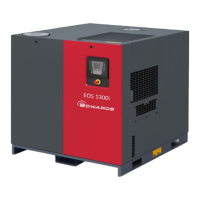
The Edwards EOSi series comprises oil-sealed rotary screw vacuum pumps, designed for industrial applications requiring reliable vacuum generation. These pumps utilize Variable Speed Drive (VSD) technology, allowing the motor speed to adjust automatically to meet vacuum pressure demands, thereby optimizing power consumption. The pumps are available in air-cooled versions and feature a sound-insulated canopy for quieter operation.
The EOSi pumps operate by drawing air through an intake filter and a control valve, then displacing it using a screw element. A mixture of air and oil flows into an oil separator tank, where centrifugal action removes most of the oil. The remaining oil is filtered by an air/oil separator filter, and clean air, conditioned to a few parts per million, is released through the outlet. The oil system incorporates a thermostatic bypass valve that regulates oil flow to the oil cooler based on temperature, ensuring optimal operating conditions. When the oil temperature is below 80 °C (176 °F) (or 87 °C (189 °F) for high-water handling capacity versions), the bypass valve restricts oil flow to the cooler, allowing the oil to warm up quickly. As the temperature rises, the valve opens, directing oil through the cooler. At approximately 95 °C (203 °F) (or 104 °C (219 °F) for high-water handling capacity versions), all oil flows through the cooler for maximum heat exchange.
The pumps are controlled by an Airlogic graphic regulator, which automatically adjusts motor speed to maintain pressure within programmable limits. The controller also protects the pump by monitoring performance parameters and initiating a shutdown if any parameter exceeds programmed limits. A fault code is displayed, and a general alarm LED flashes to indicate a shutdown. A shutdown warning is triggered if a measurement approaches the shutdown limit. The controller also features an Automatic Restart After Voltage Failure (ARAVF) function, which can automatically restart the pump after a power interruption if activated. High water-handling capability pumps include a purge cycle to remove condensed water from the sealing oil, extending oil life.
The EOSi series offers various models, including EOS 1300(W)i, EOS 1300Q(W)i, EOS 1600(W)i, EOS 1600Q(W)i, and EOS 1900(W)i. Reference conditions for operation include 0% relative humidity, 20 °C (68 °F) air inlet temperature, 0 mbar(g) (0 psig) exhaust back pressure, and 1013 mbar(a) (14.7 psia) ambient barometric pressure. Limitations for operation include a minimum ambient temperature of 0 °C (32 °F) and a maximum of 46 °C (115 °F). Minimum permitted inlet temperature is -10 °C (14 °F), and maximum is 70 °C (158 °F). Maximum absolute inlet pressure is 1050 mbar(a) (15.2 psia), and maximum vessel pressure is 1500 mbar(a) (21.8 psia). Common pump data includes 1 compression stage, an ultimate pressure of 0.35 mbar(a) (0.4 Torr), and a maximum exhaust back pressure of 100 mbar(g) (1.45 psig). The approximate temperature of air leaving the discharge is 83 °C (181 °F). The maximum allowed inlet pressure is 200 mbar(g). Nominal motor power varies by model: EOS 1300(W)i is 22 kW (30 HP), EOS 1300Q(W)i and EOS 1600(W)i are 30 kW (41 HP), and EOS 1600Q(W)i and EOS 1900(W)i are 37 kW (50 HP). Maximum motor shaft speed ranges from 4500 rpm to 6200 rpm, and minimum motor shaft speed from 600 rpm to 4300 rpm, depending on the model. Oil capacity for all models is 40 L (10.5 US GAL, 8.7 Imp. GAL, 1.41 cu. ft.). Sound pressure levels (according to ISO 2151 (2004)) are 75 dB(A) (±3) for EOS 1300(W)i, 79 dB(A) (±3) for EOS 1600(W)i, and 81 dB(A) (±3) for EOS 1300Q(W)i, EOS 1600Q(W)i, and EOS 1900(W)i. Maximum inlet pressure for water vapor is 9 mbar(a) (standard) or 39 mbar(a) (high water handling capacity) for EOS 1300(W)i, and 8 mbar(a) (standard) or 35 mbar(a) (high water handling capacity) for EOS 1600(W)i. Maximum water vapor pumping rate is 7 kg/hr (standard) or 32-34 kg/hr (high water handling capacity).
The controller data includes a supply voltage of 24 V a.c./16 VA 50/60 Hz (+40%/-30%) or 24 V d.c./0.7 A. It has an IP54 (front) and IP21 (back) type of protection. Operating temperature range is -10 °C to +60 °C (14 °F to 140 °F). It has 9 digital outputs (relay, voltage-free contacts, 250 V a.c./10 A max, 30 V d.c./10 A max), 10 digital inputs (24 V d.c. supply by regulator, short circuit protected to ground, not isolated), 2 pressure inputs, and 5 temperature inputs.
The Airlogic graphic regulator provides a user-friendly interface for monitoring and controlling the pump. The main screen offers different views, including two or four value lines for displaying parameters like inlet pressure, flow, pump discharge, and element outlet temperature. Chart views (high, medium, and low resolution) allow users to visualize input signal changes over time. Users can navigate through menus to access inputs, outputs, counters (running hours, motor starts, regulator power-up hours, fan starts, emergency stops), control mode selection (local, remote, LAN), service information, event history, general settings (language, date, time, runtime at minimum pressure, gas ballast, pre-purge time, post-purge time, manual purge time, fan motor starts per day, ES post-purge time), and an info menu. The controller allows for modification of setpoints, including two different setpoints for frequency converter-driven main motors, and indirect stop levels. Password protection can be activated to prevent unauthorized changes to settings. The week timer menu enables programming time-based start/stop commands and change-over commands for the net pressure band, with up to four different week schemes and a 10-week cycle.
The EOSi pumps are designed for ease of maintenance, with a preventive maintenance schedule outlined in the manual. This schedule includes daily checks of oil level and condition, draining the outlet collector, and checking display readings. Monthly tasks involve removing and inspecting air filter elements, replacing damaged or contaminated elements, and checking for oil leakages. Every three months, coolers should be cleaned, and electric cabinet filter elements and the vacuum control valve silencer should be checked and replaced if necessary. Every 4000 hours of operation (or yearly, whichever comes first), the air filter elements should be replaced, the scavenge line and restriction nozzle cleaned, coolers cleaned, pressure and temperature readings checked, cooling fans and heat sink cleaned, and vacuum control and gas ballast solenoid valves checked. Motor bearings require regreasing. Oil and oil filter changes are recommended every 8000 hours (or every 2 years, whichever comes first). Oil separator elements, electric cabinet filter elements, and thermostatic valves should also be replaced at this interval. The pressure switch should be tested. Motor overhaul is recommended every 24000 hours, along with replacement of the vacuum control valve membrane, lip seal assembly, and tubes. Element overhaul intervals vary based on operating pressure: 96000 hours for P ≥ 300 mbar(a), 72000 hours for 300 mbar(a) > P ≥ 200 mbar(a), and 64000 hours for P < 200 mbar(a). The manual provides detailed instructions for tasks such as air filter replacement, oil and oil filter change, cooler cleaning, and oil separator change. It emphasizes the use of genuine spare parts and approved lubricants to maintain warranty and product liability. Service kits are available for overhaul and preventive maintenance. For energy recovery systems, maintenance includes draining oil from the heat exchanger and changing the thermostat at the same interval as the unit's thermostat. Heat exchangers should be examined and cleaned if temperature increase declines over time. The controller's service menu allows users to reset completed service plans, check service intervals, view past service plans, and modify programmed service intervals.
 General
| Brand | Edwards |
|---|---|
| Model | EOSi Series |
| Category | Water Pump |
| Language | English |

 To Next Page