Need help?
Do you have a question about the Eickemeyer LIFEVET PT and is the answer not in the manual?
Details Eickemeyer's responsibility for product safety, reliability, and performance.
Outlines free and chargeable service scope and return policy.
Explains the procedure and requirements for returning the product for service.
Defines safety terms used in the manual for hazards and important notes.
Lists critical warnings regarding intended use, personnel, electrical surgery, anesthetics, MRI, and contamination.
Provides cautions about keeping the device dry, placement, maintenance, and user familiarity.
Emphasizes the importance of reading the manual, safety information, and specifications before use.
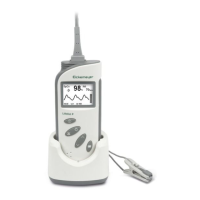
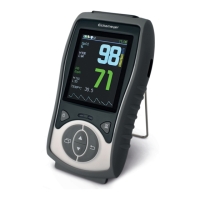
Overview of the LifeVet PT as a handheld oximeter for animal monitoring.
Lists key features including portability, protection, sensor compatibility, display, alarms, and power.
Visual overview of the device's front and back panels.
Instructions for unpacking, checking for damage, and verifying contents against the packing list.
Guides on connecting the SpO2 sensor to the device's top side panel.
Guides on connecting the temperature sensor to the device's top side panel.
Explains how to turn on the LifeVet PT by pressing and holding the power button.
Procedure for turning the device on and off via the power button.
Details the main screen displaying SpO2, PR, temperature, and system information.
Explains how the device provides audio and visual alarms when parameters exceed limits.
Guides on how to adjust device settings like sound, alarms, time, and system preferences.
Explains how SpO2 and PR are measured using pulse oximetry and light transmission.
Guides on selecting the appropriate SpO2 sensor based on animal size and attachment procedure.
Lists factors that can cause inaccurate SpO2 measurements and loss of pulse signal.
Provides a specific precaution about performing SpO2 monitoring simultaneously with NIBP.
Details how to connect the temperature probe and start measurement.
Important warnings regarding probe cable verification and calibration requirements.
Outlines steps for pre-use and routine checks of the device for proper function.
Provides instructions and recommendations for cleaning the device exterior surfaces.
Recommends disinfection procedures and materials for the device and probes.
Instructs on proper disinfection and disposal of the device according to regulations.
Lists all items included in the product package.
Lists optional accessories with item numbers and descriptions.
Warns that using unauthorized accessories may damage the device.
Details general device specs like parameters, sockets, display, dimensions, and weight.
Lists electrical parameters including voltage, battery, run time, and power consumption.
Specifies operating, transportation, and storage conditions for temperature, humidity, and altitude.
Provides detailed ranges, resolutions, and accuracies for SpO2, PR, and Temperature.
 General
| Category | Medical Equipment |
|---|---|
| Wavelength | 810 nm |
| Average Power | Up to 15 W |
| Laser Type | Diode Laser |
| Frequency | Up to 20, 000 Hz |
| Application Areas | wound healing, inflammation reduction |
| Power Supply | 100-240 V, 50/60 Hz |
| Type | Veterinary Laser Therapy Device |

 To Next Page