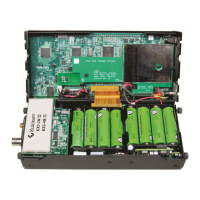
ELECRAFT 93
Basic CW Setup
Mode Selection: To place the rig in CW mode, tap the M O D E
switch until the mode indicator changes to C.
Filter Selection: You can select one of the filters using the
X F I L
switch. FL1 is typically configured as the widest filter. If you have
the SSB adapter installed, you'll probably want to use C A L F I L
configure FL1 as OP1 (SSB option filter) in CW and CW reverse
modes, and leave FL2-4 at the narrower factory defaults (0.7, 0.4,
and 0.1). Details on how to do this setup can be found in the SSB
adapter manual.
CW Frequency Display: In CW mode, the frequency shown on
the LCD takes into account an offset equal to your sidetone pitch.
This allows you to determine a station's actual carrier frequency by
matching their pitch to your sidetone, rather than by zero-beating
the signal. The
S P O T switch can be used for this purpose.
Operate vs. Test mode: If you want to try out the keying
without actually transmitting, hold the
V O X switch until the display
shows T E S T . The mode letter C on the LCD will flash to remind
you that you have disabled transmit. Holding the
V O X switch in
again returns to O P E R a t e .
Sidetone Setup: Key the rig in T E S T mode and listen to the
sidetone volume and pitch. To change the volume, use the menu’s
S T L entry (sidetone level). The pitch can be changed using the
S T P entry (sidetone pitch). S T L is used often, so you might
want to assign it to
P F 1 or P F 2 (see Advanced Operating Features).
Break-in (QSK) delay: The QSK delay is set using the T - R menu
option. A setting of 0 . 0 0 is fastest but some operators may find
the keying harsh, in which case 0 . 0 1 is a good compromise. 0 . 0 5
is about right for casual operation. You can select a longer delay (up
to 2.5 seconds) for slower CW work or to prevent un-muting when
sending a repeating beacon message.
The SPOT Switch
The S P O T switch can be used to zero-in on received signals or to
test your sidetone pitch quickly, without having to key the
transmitter or enter the menu. It’s important to use
S P O T before
using CW reverse. Once a signal has been SPOTted, you’ll only
hear a slight change in pitch when you use the
C W R V switch.
When you use
S P O T , the receiver audio will not be muted. This
allows you to listen to another station and turn the VFO knob until
the pitch of the received signal matches that of the sidetone. Once
the two match, you’ll be very close to the station’s frequency if
you call. (Exception: If you’re using
R I T , X I T , or S P L I T , your
transmit and receive frequencies will differ by more than just the
normal transmit/receive offset. Turn off these features when using
S P O T .)
Unfortunately, matching audio pitch is a little tricky for some
operators. Basically, you’ll need to tune the VFO up and down until
the station you’re hearing seems to "disappear" under the sidetone-
-that is, until you can’t hear any difference between the two. When
this happens, you’ll know the two pitches are matched.
Using the Internal Keyer
Two menu entries are provided to set up the keyer:
I A B allows you to select Iambic mode A or B . (Mode A is
similar to Curtis mode A; mode B is similar to Super CMOS
Keyer III mode B. If you aren't sure which to use, start with
mode A, which has less critical timing requirements.)
I N P selects paddle normal (P D L n ), paddle reverse (P D L r ), or
hand key/ext. keyer (H A N D )
These settings are stored in EEPROM, so you won’t lose them
when you turn power off.
Use the KEYER control to select the desired CW speed. The
display shows the speed in WPM as soon as you start turning the
knob. You can adjust the keyer speed even while transmitting.


 To Next Page
 Loading...