This document describes a ceramic glass induction hob, designed for domestic cooking and frying. It emphasizes safety, proper usage, and maintenance to ensure longevity and optimal performance.
Function Description
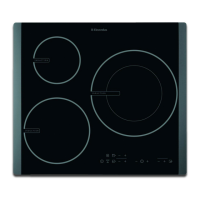
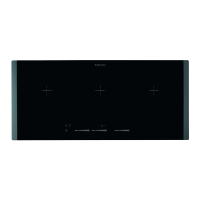
The induction hob operates using Touch Control sensor fields, allowing for intuitive control of its various functions. It features three induction cooking zones, each with a power function that can temporarily increase power for tasks like boiling large quantities of water quickly. The cooking zones are designed to heat cookware directly, with the glass ceramic surface only becoming hot from residual heat.
Key functions include:
- On/Off: Switches the appliance on and off.
- Lock: Locks/unlocks the control panel to prevent accidental changes, useful during cleaning or to prevent children from operating it.
- STOP+GO: This function simultaneously switches all active cooking zones to a "keep warm" setting and then back to their previously set heat settings. It's important to note that STOP+GO does not stop the Timer function.
- Cooking zone Off: Switches off individual cooking zones.
- Heat settings: Allows users to set desired heat levels for cooking.
- Power function: Provides a temporary boost of power to an induction cooking zone for up to 10 minutes, after which it automatically reverts to heat setting 9.
- Timer: Enables setting a countdown timer for cooking, with an acoustic signal and visual indicator when the time elapses. It can also switch off a cooking zone after the set time.
- Automatic warm-up function: All cooking zones are equipped with this feature. When a heat setting is selected using this function, the cooking zone operates at full power for a certain duration before automatically switching back to the set heat setting. The duration of the warm-up depends on the selected heat setting.
- Power Management: The hob has a maximum power limit. When the power function is activated on one cooking zone, the power management system may reduce the power of a corresponding cooking zone in the same pair to stay within the overall power limit.
- Automatic Cut-out: If a heat setting is not adjusted or a cooking zone is left on for an extended period, it will automatically switch off after a predefined time, depending on the heat setting.
- Pan Recognition and Automatic Switch-off: The hob detects if suitable cookware is present on the cooking zone. If unsuitable or no cookware is detected, a visual indicator appears, and the cooking zone will switch off after a few minutes.
Usage Features
The appliance is designed for ease of use with its Touch Control sensor fields. Users simply touch the relevant fields to activate functions or adjust settings. Visual indicators and acoustic signals provide feedback on the appliance's status.
- Child Safety Device: This feature prevents unintentional use of the appliance, particularly by children. It can be switched on or temporarily overridden for a single cooking session.
- Cookware Suitability: The hob requires suitable cookware for induction heating, typically made of steel, enamelled steel, cast iron, or stainless steel with a magnetic bottom. Cookware with a bottom diameter of less than 12 cm is not suitable.
- Energy Saving Tips: Users are advised to place cookware on the cooking zone before switching it on and to always use a lid on cookware to conserve energy.
- Cooking Applications: The manual provides a table with recommended heat settings, cooking processes, suitable foods, cook times, and tips for various dishes, including keeping food warm, melting, solidifying, simmering, steaming, boiling, and frying.
- Acrylamide Information: Recommendations are provided to cook at low temperatures and avoid excessive browning, especially for starchy foods, to mitigate potential health risks associated with acrylamides.
- Operating Noises: The manual acknowledges that certain noises (cracking, whistling, humming, clicking) may occur during operation due to the nature of induction technology and cookware materials. These are considered normal and not indicative of defects.
Maintenance Features
Regular cleaning and care are essential for maintaining the appliance's appearance and functionality.
- Cleaning the Glass Ceramic: The glass ceramic surface should be cleaned after each use. Food residues containing sugar, plastics, or tin foil should be removed immediately with a scraper. Limescale rings, water rings, fat splashes, and metallic discolorations should be removed after the appliance has cooled down, using a cleaner for glass ceramic or stainless steel.
- Safety during Cleaning: The appliance must be switched off and cooled down before cleaning. Steam jet or high-pressure cleaning equipment is explicitly prohibited.
- Avoiding Damage: Users are warned against placing metal objects on the hot cooking surface to prevent burns. Cookware with damaged bottoms or made of cast iron/aluminum can scratch the glass ceramic if dragged. Spillage should be removed promptly. Using empty cookware or allowing pans to boil dry should be avoided to prevent damage to both cookware and the glass ceramic.
- Ventilation: A 5 mm ventilation gap between the worktop and the front of the unit underneath must not be covered to ensure proper cooling.
- Troubleshooting: The manual includes a comprehensive "What to do if..." section, providing common problems, possible causes, and remedies. This helps users resolve minor issues themselves before contacting service.
- Professional Service: For issues that cannot be resolved by the user, contact with a qualified service engineer or the Customer Care Department is recommended. Repairs should only be carried out by trained professionals to avoid danger and ensure proper functioning. Incorrect operation may result in chargeable service visits, even within the warranty period.

 Need help?
 General



 To Next Page