Channel information
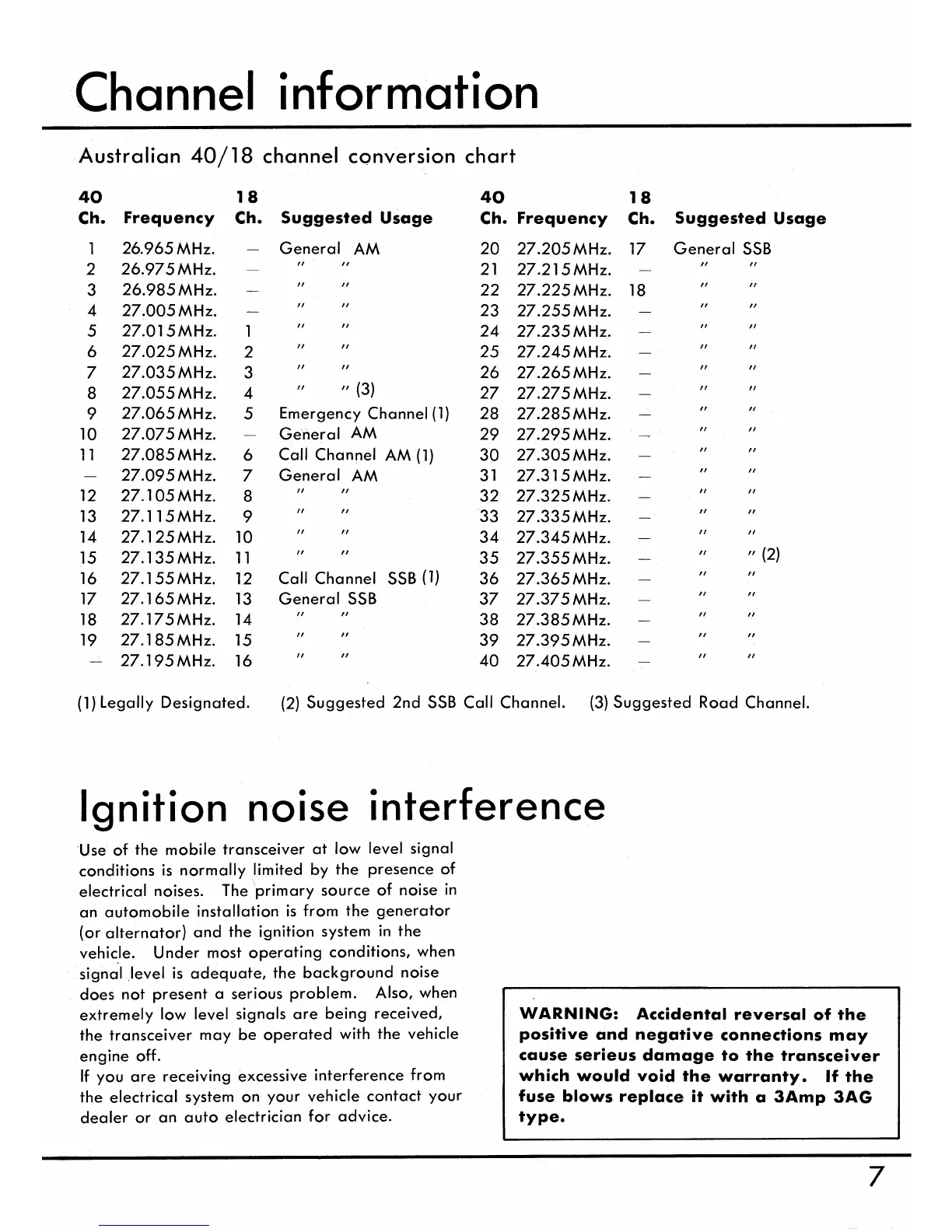
Australian 40/18 channel conversion chart
40
18
Ch. Frequency Ch. Suggested Usage
1 26.965MHz.
General AM
2 26.975MHz.
3 26.985MHz.
// I/
4 27.005MHz.
5 27.015MHz. 1
6 27.025MHz. 2
7 27.035MHz. 3
8
27.055MHz. 4
"
(3)
9
27.065MHz.
5
Emergency Channel (1)
10 27.075MHz.
General AM
11
27.085MHz.
6
Call Channel AM (1)
27.095MHz. 7 General AM
12 27.105MHz. 8
I/
I/
13 27.115MHz. 9
14 27.125MHz. 10
15 27.135MHz. 11
16
27.155MHz. 12
Call Channel SSB (
1
)
17
27.165MHz. 13
General SSB
18 27.175MHz. 14
II II
19 27.185MHz. 15
27.195MHz. 16
40
18
Ch. Frequency Ch. Suggested Usage
20 27.205MHz. 17 General SSB
21 27.215MHz.
22 27.225MHz. 18
23
27.255 MHz.
24
27.235 MHz.
25
27.245 MHz.
I/
26
27.265 MHz.
27
27.275 MHz.
28
27.285 MHz.
29
27.295 MHz.
30
27.305 MHz.
31 27.315MHz.
32
27.325 MHz.
33
27.335 MHz.
34
27.345 MHz.
35
27.355 MHz.
(2)
36
27.365 MHz.
37
27.375 MHz.
38
27.385 MHz.
39
27.395 MHz.
/I
40 27.405MHz.
/I
(1) Legally Designated.
(2) Suggested 2nd SSB Call Channel.
(3) Suggested Road Channel.
Ignition noise interference
Use of the mobile transceiver at low level signal
conditions is normally limited by the presence of
electrical noises. The primary source of noise in
an automobile installation is from the generator
(or alternator) and the ignition system in the
vehicle. Under most operating conditions, when
signal level is adequate, the background noise
does not present a serious problem. Also, when
extremely low level signals are being received,
the transceiver may be operated with the vehicle
engine off.
If you are receiving excessive interference from
the electrical system on your vehicle contact your
dealer or an auto electrician for advice.
WARNING: Accidental reversal of the
positive and negative connections may
cause serieus damage to the transceiver
which would void the warranty. If the
fuse blows replace it with a 3Amp 3AG
type.
7



 To Next Page