-38-
Recall that capacitors blocked direct current (DC) but
passed alternating current (AC). Take a look at
Experiment 7 again and remember that it took time to
light the LED because you had to charge the capacitor
first; the capacitor passed the initial current surge through
to ground (the negative side of the battery) but blocked
the current once it stabilized, forcing it to go through the
LED. The inductor is the counterpart to this - it blocks
current surges (AC) but passes stable currents (DC).
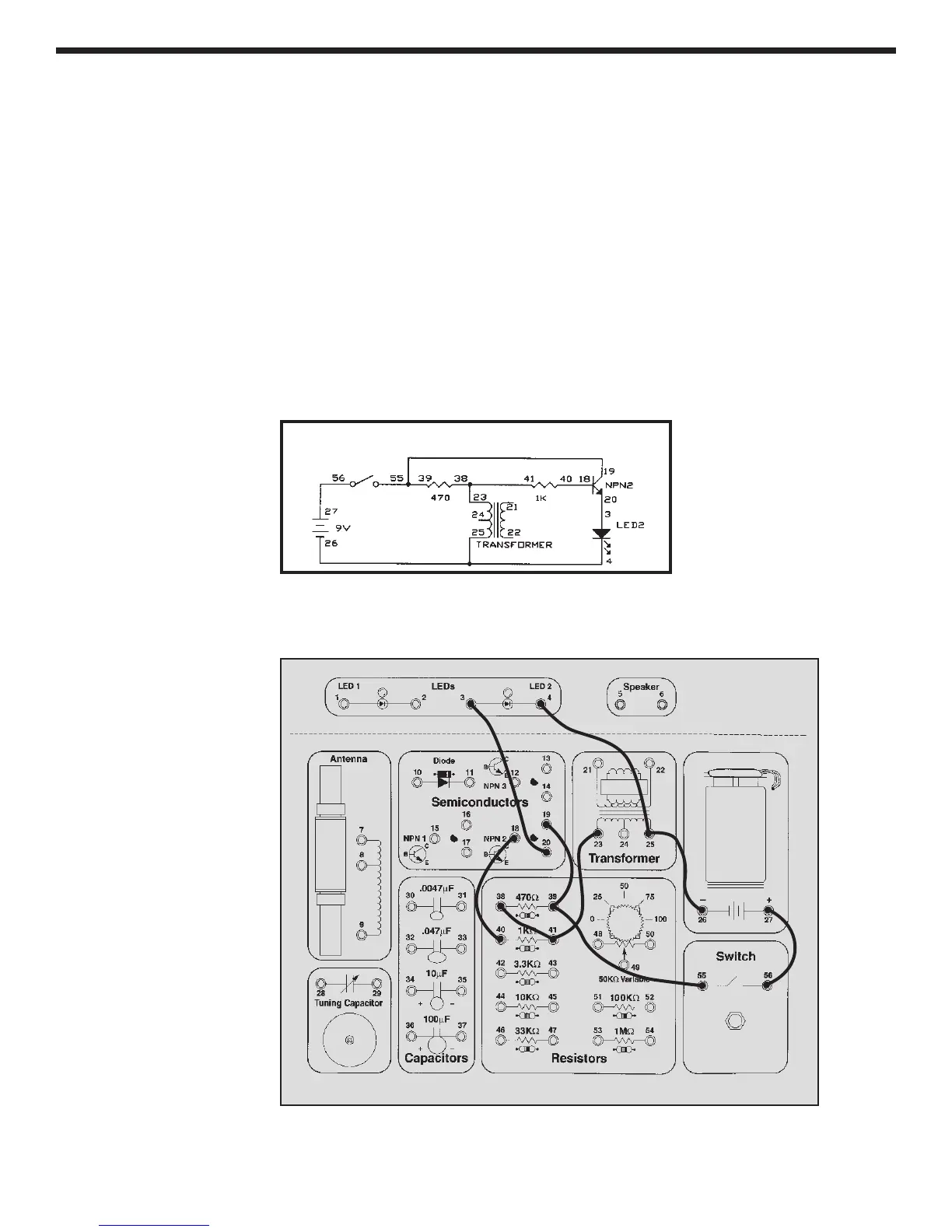
Before explaining the inductor further, let’s demonstrate it
using almost the same circuit as in Experiment 7.
We will be using an inductor that is part of the
transformer, we’ll explain more about this later. Connect
the wires according to the Wiring Checklist and press the
switch several times. The LED will blink once when the
switch is pressed and again when it is released. Note
how this is different from the capacitor, when the LED
became bright when the switch was pressed and stayed
bright until the switch was released. The inductor effects
are brief, so we are using the transistor to amplify the
current to the LED and make the inductor’s effects easier
to see.
Now remove the wire from spring 23 (on the transformer),
connect it to spring 24, and press the switch a few more
times. The LED will not blink as brightly now, because we
are using less inductance.
EXPERIMENT #24: The Anti-Capacitor
Wiring Checklist:
o 27-to-56
o 55-to-39-to-19
o 38-to-41-to-23
o 40-to-18
o 20-to-3
o 4-to-25-to-26
Schematic





 To Next Page