30 31
3. SLEEP STAGES
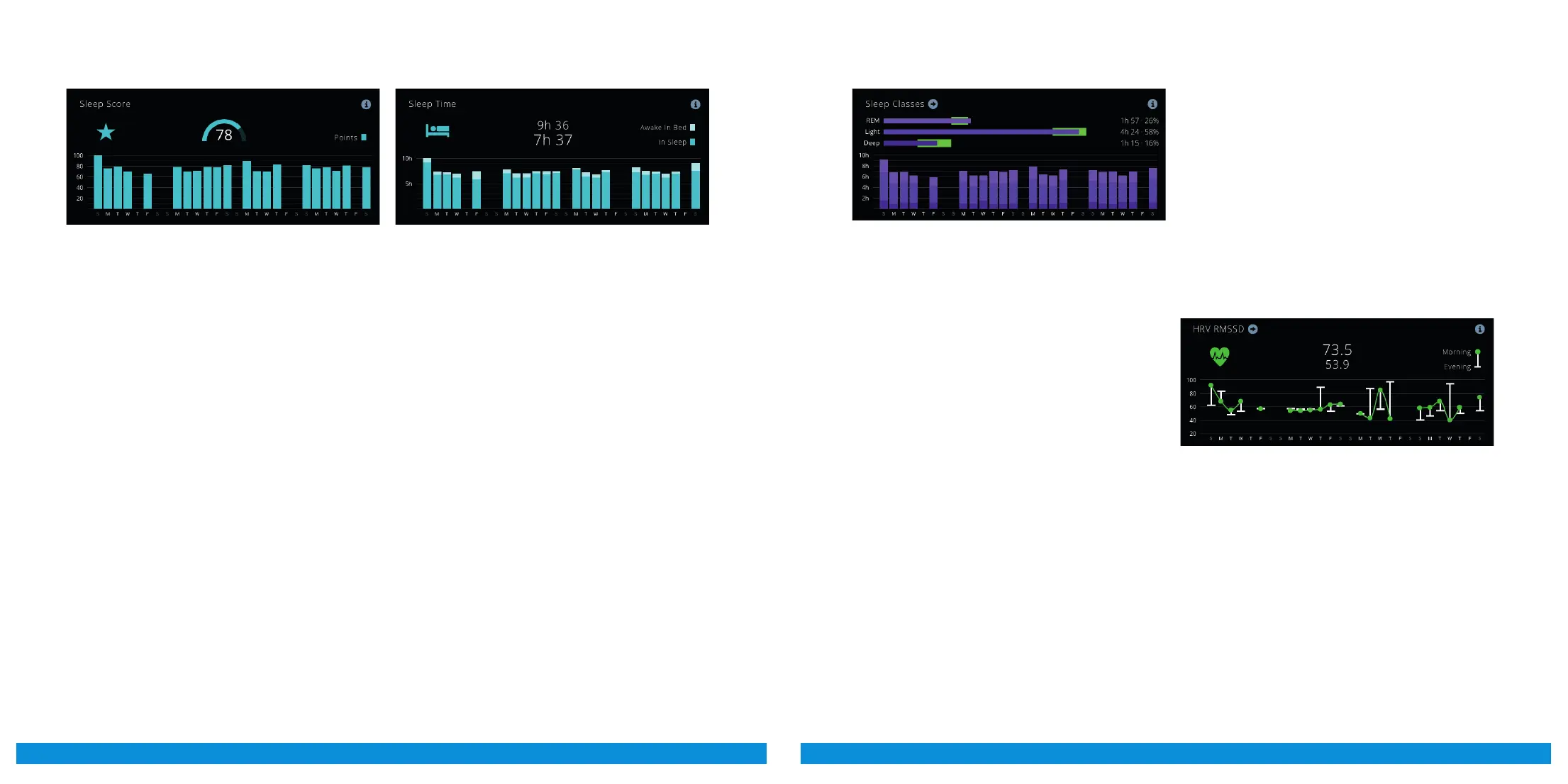
Here you see breakdown of sleep in to three stages:
Light, REM and Deep sleep.
Green brackets indicate optimal range for each of the
stages, and total durations and percentages are also
given in numerical format.
All three stages have different physiological character-
istics, and their meaning to your body is different.
• LIGHT sleep is transitionary state from awake state
to DEEP sleep. Eyes are not moving, and muscle tone
is decreased.
• In DEEP sleep physical movement and muscle tone is
almost non-existent. Breathing rate is slow and steady,
heart rate is slow and blood pressure low. DEEP sleep
is essential for physical recovery and most physiolog-
ical systems in you are in a heightened anabolic state,
showing increased production of proteins, the essen-
tial building blocks needed for cell growth and repair
and rejuvenation of the immune, nervous, skeletal and
muscular systems.
• REM sleep is dreaming phase, characterized by rap-
id eye movements, paralyzed muscles, and variable
blood pressure and heart rate. REM sleep is needed
for mental recovery; during this sleep stage synaptic
connections can be re-organized, which enables learn-
ing, storage of memories, and forgetting unnecessary
things.
For complete recovery of your body and mind you
need to have sucient amount sleep in general, but
also enough both REM and DEEP sleep.
REM sleep should constitute 20-25 % of your total
sleep, and DEEP sleep 10-20 %. This leaves some 50-
60 % for LIGHT sleep.
4. HRV RMSSD
RMSSD, “Root Mean Square of Successive Differenc-
es”, is one of the most widely used time domain heart
rate variability values. It tells about the activity of our
central nervous system, higher number indicates bet-
ter recovery, lower stress, etc.
We show both evening and morning values. Low
evening value tells that the day has been heavy, either
due to mental stress, or due to physical exercise. With
evening value athletes can see whether their training
has been effective.
Morning value should usually be higher than evening
value, indicating that there has been ecient recovery
and resting during the night. Mathematically, RMSSD
1. SLEEP SCORE
This is single number indicating how well slept night
was. Number consists of total sleep time, amount of
REM and DEEP sleep, and number of wakenings. Sleep
Score breakup: Sleep Score= (total_duration_of_sleep
+ (duration_of_REM_sleep) *0.5 + (duration_of_
DEEP_sleep) *1.5) - ((duration awake/3600) *0.5 +
number_of_wakenings/15) ) * 8.5
Simply said, this means that the more you sleep, the
more you have REM sleep, and the more you have
DEEP sleep, and the better your Sleep Score is. On the
other hand, the more you are awake and the more of-
ten you wake up during the night, the worse your Sleep
Score is.
By this formulation Sleep Score can reach values
over 100, but in this case the value is truncated to
a maximum of 100, which is indication of very good
sleep.Usually values around 80 and higher can be
regarded as good.
2. SLEEP TIME
Here you see both time spent in bed and amount of
sleep.
For adults, 7-8 hours of sleep is considered optimal,
of course there are individual differences — some can
manage with less sleep and some require more.
In one study it was found that people who sleep less
than 6 hours perform worse in cognitive tests than
those who sleep 7-8 hours, but people who sleep more
than 9 hours also perform worse.
The need for sleep also changes according to a per-
son’s age. Infants may require up to 14 hours of sleep,
whereas elderly people may be fine even with 5 hours
of sleep.
With athletes, the research has shown that in several
different sports, including swimming, tennis, football
and basketball, increasing sleeping time to 10 hours
per night resulted in improved speed, reaction time,
sprint time and accuracy.



 To Next Page