Need help?
Do you have a question about the EMG SPC and is the answer not in the manual?
Technical details including input impedance, noise, output impedance, current, battery life, and max supply voltage.
Explains the SPC mid-range boost and RPC low-cut/high-boost functions and wiring in the signal path.
Details pin assignments for connecting EMG Active Tone controls and accessories, including input and output.
Outlines the terms and conditions of the product warranty, including coverage and exclusions.
Wiring diagram for a single pickup guitar with a volume control and the SPC or RPC.
Wiring for a single pickup guitar with volume, passive tone control, and the SPC or RPC.
Wiring for 2 pickups with a toggle switch, independent volumes, and the SPC or RPC control.
Wiring for 2 pickups with toggle switch, independent volumes, passive tone, and the SPC or RPC.
Typical installation wiring for three pickups with volume, passive tone, and SPC in series.
Wiring for three pickups with passive tone, SPC, and volume control in a series configuration.
Wiring for guitars with two active controls: volume and an active tone (VLPF), plus the SPC.
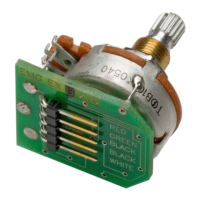
The EMG SPC/RPC is an active EQ circuit designed for guitar, offering distinct tonal shaping capabilities. The SPC functions as a mid-range boost, while the RPC provides a low cut and high boost. These controls are continuously variable, allowing users to dial in their desired effect from a flat bypass mode to maximum impact. The SPC/RPC units are wired in series with the signal path, featuring both an input and an output, and are equipped with buffered inputs, making them suitable for use with passive pickups.
The core function of the SPC/RPC is to modify the frequency response of a guitar's signal. The SPC specifically targets the mid-range frequencies, allowing guitarists to enhance their presence and punch in a mix. This can be particularly useful for solos or for cutting through a dense band arrangement. By boosting the mid-range, the SPC can give a guitar a more focused and articulate sound, preventing it from getting lost in the lower or higher frequencies. The continuous variability means that the degree of mid-range boost can be precisely adjusted, from a subtle enhancement to a more pronounced effect. When the control is set all the way down (counter-clockwise), the circuit operates in bypass mode, providing a flat frequency response, effectively removing its influence from the signal. As the control is turned up (clockwise), the mid-range boost gradually increases, reaching its maximum effect at the fully clockwise position.
In contrast, the RPC offers a different approach to tonal shaping by providing a low cut and a high boost. The low cut aspect can be beneficial for tightening up the low end of a guitar's sound, preventing muddiness, especially with humbucking pickups or in situations where bass frequencies are already well-represented by other instruments. By reducing the low frequencies, the RPC can help to clarify the overall tone and improve articulation. Simultaneously, the high boost feature enhances the treble frequencies, adding sparkle, clarity, and definition to the sound. This can be particularly effective for clean tones, intricate fingerpicking, or for giving a lead tone more cut and brilliance. Similar to the SPC, the RPC's controls are continuously variable, allowing users to fine-tune the balance between the low cut and high boost effects. When the control is set to its minimum, the circuit is in bypass mode, offering a flat response. As the control is increased, the low cut becomes more pronounced, and the high boost becomes more significant, reaching its peak effect at the maximum setting.
Both the SPC and RPC are active EQ circuits, meaning they require power to operate. This active design allows for greater control over the frequency response and can help maintain signal integrity over longer cable runs. The buffered inputs are a significant feature, as they ensure that the guitar's signal is consistently strong and clear before it enters the EQ circuit. This buffering also makes the SPC/RPC highly compatible with passive pickups, which typically have higher output impedances. By buffering the signal, the SPC/RPC minimizes the impact of cable capacitance and subsequent tone degradation, ensuring that the EQ effect is applied to a clean and robust signal. The series wiring means that the signal flows directly through the SPC/RPC unit, allowing it to directly modify the tone before it reaches other components in the signal chain, such as an amplifier or other effects pedals.
The EMG SPC/RPC units are designed for straightforward integration into a guitar's electronics. They utilize a 5-pin connector system, which is standard across many EMG accessory products, simplifying installation and allowing for easy interchangeability with other EMG controls. The installation process involves connecting the SPC/RPC in series within the guitar's signal path, typically after the pickups and before the output jack. The input connector is specifically designed to be reversed, which is a crucial detail for proper functionality, ensuring that pins 1 and 2 are correctly aligned. This attention to detail in the connector design helps prevent incorrect wiring and ensures optimal performance.
The versatility of the SPC/RPC is highlighted by its compatibility with various guitar setups. It can be installed in guitars with a single pickup, multiple pickups, and with or without selection switches. For simpler configurations, such as a single pickup with a volume control, the SPC/RPC can be easily integrated to provide immediate tonal enhancement. In more complex setups involving multiple pickups and selection switches, the SPC/RPC can be placed strategically in the signal chain to affect the overall output or specific pickup combinations. For instance, it can follow a pickup buss system, allowing it to modify the combined signal from multiple pickups before it reaches the output. This flexibility allows guitarists to tailor their tone shaping to their specific instrument and playing style.
A key usage feature is the ability to substitute the SPC/RPC with other EMG accessory controls. Since all EMG accessory controls share the same 5-pin connector and buffered input design, a user can easily swap an SPC for an EXG (an expander/gate control) or another EMG tone control without extensive rewiring. This modularity provides a high degree of customization and allows guitarists to experiment with different tonal options without permanent modifications. For example, if a player initially installs an SPC but later decides they prefer a different type of tone shaping, they can simply unplug the SPC and plug in another compatible EMG control. This "plug-and-play" aspect significantly enhances the user experience and encourages exploration of different sounds.
The continuous variability of the controls is a practical usage feature, offering fine-tuning capabilities. Unlike stepped switches, the smooth rotation of the control knob allows for nuanced adjustments to the EQ effect. This means that a guitarist can precisely dial in the desired amount of mid-range boost or low cut/high boost, rather than being limited to predefined settings. This level of control is invaluable for achieving specific tones, adapting to different musical genres, or compensating for the acoustic properties of various performance environments. The clear distinction between the "all the way up" (maximum effect) and "all the way down" (bypass mode) positions makes it easy for users to understand the range of the control and quickly return to a neutral setting if needed.
The EMG SPC/RPC units are designed for reliability and minimal maintenance, reflecting the robust engineering typical of EMG products. As active circuits, their primary maintenance consideration revolves around power supply. They require a 9V DC power source, typically provided by a standard 9V battery within the guitar. The battery life is substantial, ensuring many hours of operation before a replacement is needed. The inclusion of a stereo output jack with battery switching functionality is a key maintenance feature. This design automatically disconnects the battery when the guitar cable is unplugged from the output jack, preventing unnecessary battery drain. This simple yet effective mechanism significantly extends battery life, reducing the frequency of battery replacements and ensuring that the unit is ready for use when needed.
The interconnect cables provided with the SPC/RPC are designed for durability and ease of connection. These cables facilitate the internal wiring of the guitar, connecting the SPC/RPC to other components such as volume controls, output jacks, and pickup buss systems. The use of high-quality connectors and cables minimizes the risk of signal loss or intermittent connections, which are common issues in guitar electronics. Should a cable or connector ever need replacement, the modular nature of the EMG system allows for individual components to be swapped out, rather than requiring a complete overhaul of the guitar's wiring.
The overall construction of the SPC/RPC units is robust, designed to withstand the rigors of regular use. The components are housed in a compact and durable enclosure, protecting the sensitive electronic circuitry from physical damage and environmental factors. This durability contributes to the long-term reliability of the device, reducing the need for repairs or replacements. The simplicity of the installation, with clear diagrams and instructions, also contributes to ease of maintenance. Proper initial installation minimizes the likelihood of future issues related to wiring or component placement.
In the event of a malfunction, EMG provides a warranty for its pickups and accessories, including the SPC/RPC, for a period of two years. This warranty covers failures due to manufacturing defects, ensuring that users are protected against faulty products. While the warranty does not cover issues arising from improper installation, abuse, or damage, it provides peace of mind regarding the inherent quality of the product. If a unit is determined to be defective upon examination, a replacement will be provided, and the replacement product will also be covered by the same warranty. This commitment to product support underscores the manufacturer's confidence in the reliability and longevity of the SPC/RPC. The warranty is applicable only to products sold by authorized EMG Dealers, encouraging users to purchase from reputable sources to ensure authenticity and eligibility for support.
 General
| Model | SPC |
|---|---|
| Brand | EMG |
| Technology | Active |
| Color | Black |
| Compatibility | Electric guitars |

 To Next Page