2
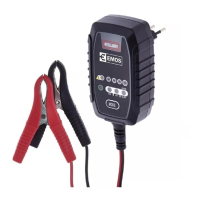
GB | Intelligent Charger for 6 V/12 V Lead-Acid Accumulators
and Lithium LiFePO₄ 12.8 V Accumulators
User Manual
Safety Instructions
Read the manual before using the charger. Failing to do so or operating the device without understanding the
instructions may cause injury or death. Do not remove or cover up this warning.
Follow the safety instructions stated in this manual.
• The charger is an electrical device which may cause injury by electrical current. Be careful that the power lead does not
become damaged. Do not use a damaged charger.
• Check the cables before using the charger. Make sure the cables are not partially broken and that their insulation or
protection against excessive bending does not have cracks. Charger with a damaged cable must be returned to the
retailer. A damaged power cable may only be replaced by the company selling the device.
• Ensure the cable is not constricted or touching hot surfaces or sharp edges.
• Connection to the power grid must correspond to regulations and standards for electrical installations valid in the
country of use.
• Do not leave the charger unattended when in use.
• All accumulators lose capacity sooner or later. Thanks to the advanced control system, the charger usually recogni-
ses if the charger is in poor condition or at the end of its service life and will adjust the charging process to this fact.
However, there is always a chance of unusual defects. Do not leave the charging accumulator without supervision for
an extended period of time.
• Before you leave the charger unattended and plugged in for an extended period, always check that it is switched to
maintenance charging mode. If the charger does not switch to STAGE 7 within 40 hours, it is a sign of a problem. Disco-
nnect the charger manually.
• The charger is not designed for use by children or persons incapable of reading this manual and understanding it; these
persons must not use the device without being supervised by a person who can ensure the charger is used safely. Store
and use the charger out of reach of children and ensure they cannot play with the device.
• Do not smoke or use other sources of electrical sparks or re when working with the charger. Place the charger away
from ammable materials. The charger is an electrical device which heats up and can cause a re.
• Explosive gasses may be released from the accumulator when charging. Prevent formation of sparks in the vicinity of
the accumulator. When accumulators reach the end of their service life, internal sparking may occur.
• Risk of damage to the eyes. The accumulator may explode and its parts may cause damage. The electrolyte from the
accumulator may irritate the eyes. Protect your eyes when working with the charger. Do not touch your eyes and wash
your hands after using the charger. Rinse the aected area with water in case of contact with the eyes.
• The electrolyte inside the accumulator is an acid (H2SO4 solution). If the electrolyte comes into contact with skin or the
eyes, immediately rinse with large amount of water and seek medical assistance.
• The charger is designed for charging only accumulators which meet the technical specications.
• Do not use it for any other purposes. Always follow the recommendations of the manufacturer of the accumulator.
• Never attempt to charge non-rechargeable accumulators.
• The charger is not designed for charging lithium-ion accumulators.
• Never charge a damaged accumulator.
• Never charge a frozen accumulator.
• Never place the charger on top of the accumulator when charging.
• Always ensure proper ventilation while charging.
• Do not cover the charger with anything.
• Do not expose the charger to rain, snow or excessive humidity. Use indoors only.
• Use or recharging consume water inside the accumulator. Regularly check the electrolyte level in accumulators where
water can be relled. If the electrolyte level is low, add distilled water.
Specications:
Input voltage: 220–240 V AC 50 Hz 300 mA
Input current: max. 0.8 A
Charging voltage: 7.3 V/14.5 V DC
Charging current tolerance: 0.8 A ±10 %
Charging voltage tolerance: ±0.2 V
Accumulator types: All types of 6/12 V lead-acid accumulators (with liquid electrolyte (WET),
maintenance-free (MF), Ca/Ca, AGM and GEL).
Lithium: 12.8 V; 4-cell LiFePO₄
Accumulator capacity: Lead-acid accumulators 6/12 V: 1.2 Ah to 30 Ah
Lithium 12.8 V; 4-cell LiFePO₄: 2 to 15 Ah


 To Next Page