Need help?
Do you have a question about the ENC EDS800-2S0015 and is the answer not in the manual?
Details three kinds of safe relevant warnings and numbered safety precautions for inverter operation.
Provides important operational notes and considerations for using the inverter safely and effectively.
Lists the technical specifications, including input/output voltage, frequency, and performance characteristics.
Specifies environmental conditions such as temperature, humidity, and dust for inverter installation.
Lists essential safety and technical precautions to follow during wiring procedures.
Provides a table detailing the main loop input/output terminal configurations for different inverter models.
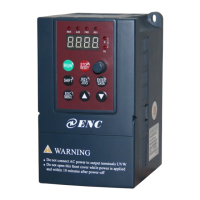
The EDS800 series is a mini universal inverter designed to meet a wide range of general-purpose inverter demands. It utilizes advanced control methods to achieve high torque, high precision, and wide-range speed regulation, making it suitable for various industrial applications. The inverter integrates practical PID adjustment, simple PLC functionality, programmable input/output terminal control, long-distance synchronous control, and impulse frequency provision. This comprehensive feature set provides a highly integrated solution aimed at reducing system costs and enhancing system reliability for device manufacturing and automation engineering customers.
The EDS800 series inverter operates as a voltage-type inverter, capable of driving three-phase AC asynchronous motors. It offers a broad speed regulation range and delivers 100% of its rating torque at low frequencies, ensuring robust performance even under demanding conditions. The device supports various running order and frequency provision channels, including keypad, control terminal, and serial port specifications, offering flexibility in operation.
For speed control, the EDS800 provides multiple options. It can achieve precise speed regulation with a stable state precision of ≤±0.5% of the rating synchronous speed. Frequency precision is high, with digital settings achieving max. frequency × ±0.01% and analog settings achieving max. frequency × ±0.5%. The frequency resolution is fine-tuned to 0.01Hz for digital settings and 0.1% of max. frequency for analog settings. An exterior pulse input also allows for 0.5% of max. frequency control.
The inverter features automatic and manual torque boost capabilities, ranging from 0.1% to 20.0%, to enhance starting performance. It offers four types of V/F curves (constant torque, degressive torque 1, 2, and 3) that can be set randomly within a frequency range of 5-400Hz, allowing for optimization based on the load characteristics.
Acceleration and deceleration are highly configurable, with two modes: straight-line and S-curve. Users can set seven different accelerating/decelerating times, with units selectable between minutes and seconds, up to a maximum of 6000 minutes. This flexibility allows for smooth and controlled motor transitions.
Braking functionalities include power consumption braking with optional exterior brake resistance, and DC braking. DC braking parameters such as start-up/stop options, action frequency (0-15Hz), action voltage (0-15%), and action time (0-20.0s) are adjustable.
The EDS800 supports multi-section speed running, which can be realized through its interior PLC or control terminal, enabling complex motion profiles. An interior PID controller simplifies the creation of closed-loop systems. The automatic energy-saving running feature optimizes the V/F curve based on the load to conserve power. Automatic voltage regulation (AVR) maintains a constant output voltage even when the power source voltage varies. An automatic current limiting function prevents frequent over-current trips by limiting the running current.
Output capabilities include a pulse output channel for square wave signals (0-20KHz), which can output physical parameters like setting frequency or output frequency. An analog output channel (AO) provides a 4-20mA or 0-10V signal, also capable of outputting physical parameters such as setting frequency or output frequency.
The inverter incorporates comprehensive protection functions, including over-current, over-voltage, lack-voltage, over-heat, over-load, and missing phase protection (optional).
The EDS800 series is designed for ease of use and installation. It comes with a keypad for local operation, featuring an LED display that can show 14 different parameters, including setting frequency, output frequency, output voltage, and output current. The keypad buttons can be locked, either entirely or partially, though the analog potentiometer cannot be locked.
For installation, the inverter should be mounted vertically in a drafty indoor location, with an ambient temperature between -10°C and 40°C. If temperatures exceed 40°C, external compulsory heat dissipation or volume reduction is necessary. It is crucial to avoid direct sunlight, excessive dust, floating fibers, metal powder, corrosive or explosive gases, and condensation water. The installation location should also be free from significant vibration (smaller than 5.9m/s² or 0.6g) and electromagnetic disturbance sources. When installing multiple inverters, a leading divider should be applied between them to ensure proper heat dissipation.
Wiring is made convenient with clearly labeled main loop terminals and control loop terminals. The manual provides detailed diagrams for basic running wiring, control loop collocation, and communication wiring. It emphasizes the importance of proper grounding and recommends using appropriate wire diameters and lengths to minimize resistance and ensure safety.
The EDS800 series is suitable for use in altitudes below 1000m. If used at higher altitudes, the output current should be reduced by 10% for every 1500m increase in height.
The EDS800 series is built for reliability, but proper maintenance is essential for optimal performance and longevity. The manual provides guidelines for routine maintenance, inspection, and replacement of damageable parts.
Before initial use or after extended storage, an insulation check of the motor is recommended using a 500V voltage-type megohm meter. The insulation resistance should not be less than 5 MΩ to prevent damage to the inverter.
For safety, it is critical to ensure the power supply is completely cut off for at least 10 minutes before any wiring or maintenance work, and all LED indicators must be extinguished. Internal wiring should only be performed by qualified personnel, and the DC voltage between the main loop ends P+ and P- must fall below DC36V before proceeding.
The manual explicitly prohibits connecting the U, V, W output terminals to an AC power supply, short-circuiting P- and P+, or installing the inverter on flammable materials or in environments with explosive gases. It also warns against operating the inverter with moist hands when connected to power.
To protect the inverter, it is forbidden to assemble capacitors for power factor improvement or lightning-proof voltage-sensible resistance at the output side, as this can cause malfunction trips or damage.
The EDS800 series includes a cooling fan with automatic temperature control, which aids in maintaining optimal operating temperatures. The device is designed for wall hanging, facilitating installation and access for maintenance.
In case of failures, the manual provides a troubleshooting guide with common failure types and corresponding countermeasures. It also includes instructions for looking up failure records and resetting failures, which helps in diagnosing and resolving issues efficiently. The storage guidelines ensure that the inverter is kept in conditions that prevent degradation over time.


 To Next Page
 General