VLT-MAN-ESO-14650-4942
P96
24.06.2015
33 of 161
ESO, Karl-Schwarzschild-Str. 2, 85748 Garching bei München, Germany
0
20
40
60
80
100
120
140
160
180
0 1 2 3 4 5 6
R e l a ti v e p a r a ll a c ti c a n g le v a r ia ti o n ( d e g r e e s )
40
30
20
10
0
-1 0
-2 0
-3 0
-4 0
-5 0
-6 0
-7 0
-8 0
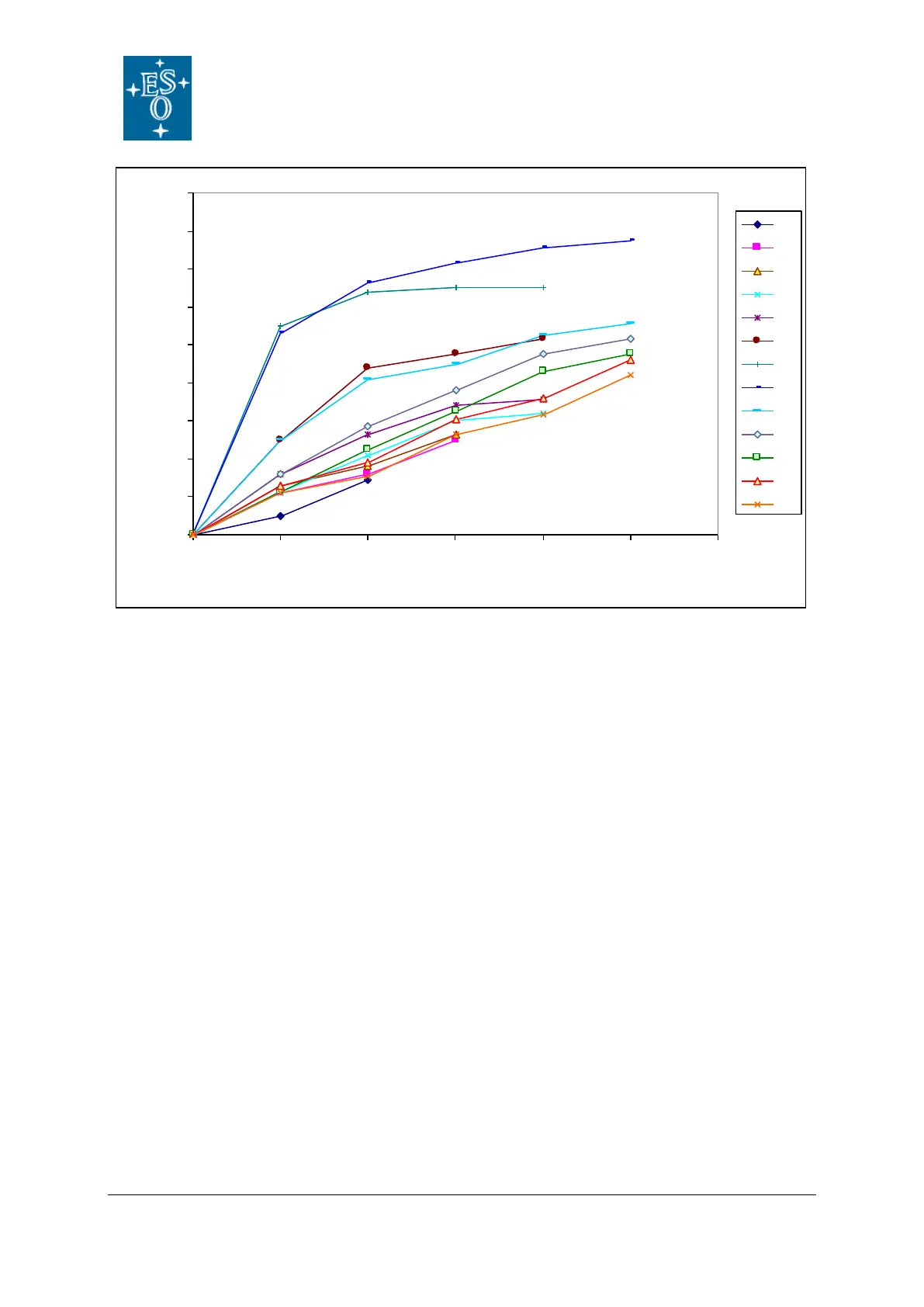
For example, the parallactic angle changes by ~110 degrees in 1h (1 HA) for declination
equals to -30 degrees (at Paranal). For declination –50 degrees, in 1h (1 HA) the parallactic
angle will change by ~35 degrees.
In the case of declination of -30 degrees at the start of the observation the slit angle is set at
0 degree for relative reference, and then in less than 1 h the atmospheric dispersion is
perpendicular to the slit.
With the ADCs such evolution was not a problem but without ADCs, one has to take this
evolution into account and the airmass values + its evolution.
Of course the full dispersion between the blue and the red also depends on the airmass.
The airmass evolution is shown in the following figure depending on the declination of the
target. One can see that for HA=2, the values correspond to those reported in the figure
above for VIMOS.


 To Next Page