VLT-MAN-ESO-14650-4942
P96
24.06.2015
48 of 161
ESO, Karl-Schwarzschild-Str. 2, 85748 Garching bei München, Germany
2.2.6.5 Detector
The NIR detector is a Teledyne substrate-removed HgCdTe, 2k2k, 18µm pixel Hawaii 2RG
from of which only 1k2k is used. It is operated at 81K. Measured characteristics and
performances are given in Table 6. Sample-up-the-ramp (non-destructive) readout is always
used. This means that during integration, the detector is continuously read out without
resetting it and counts in each pixel are computed by fitting the slope of the signal vs. time.
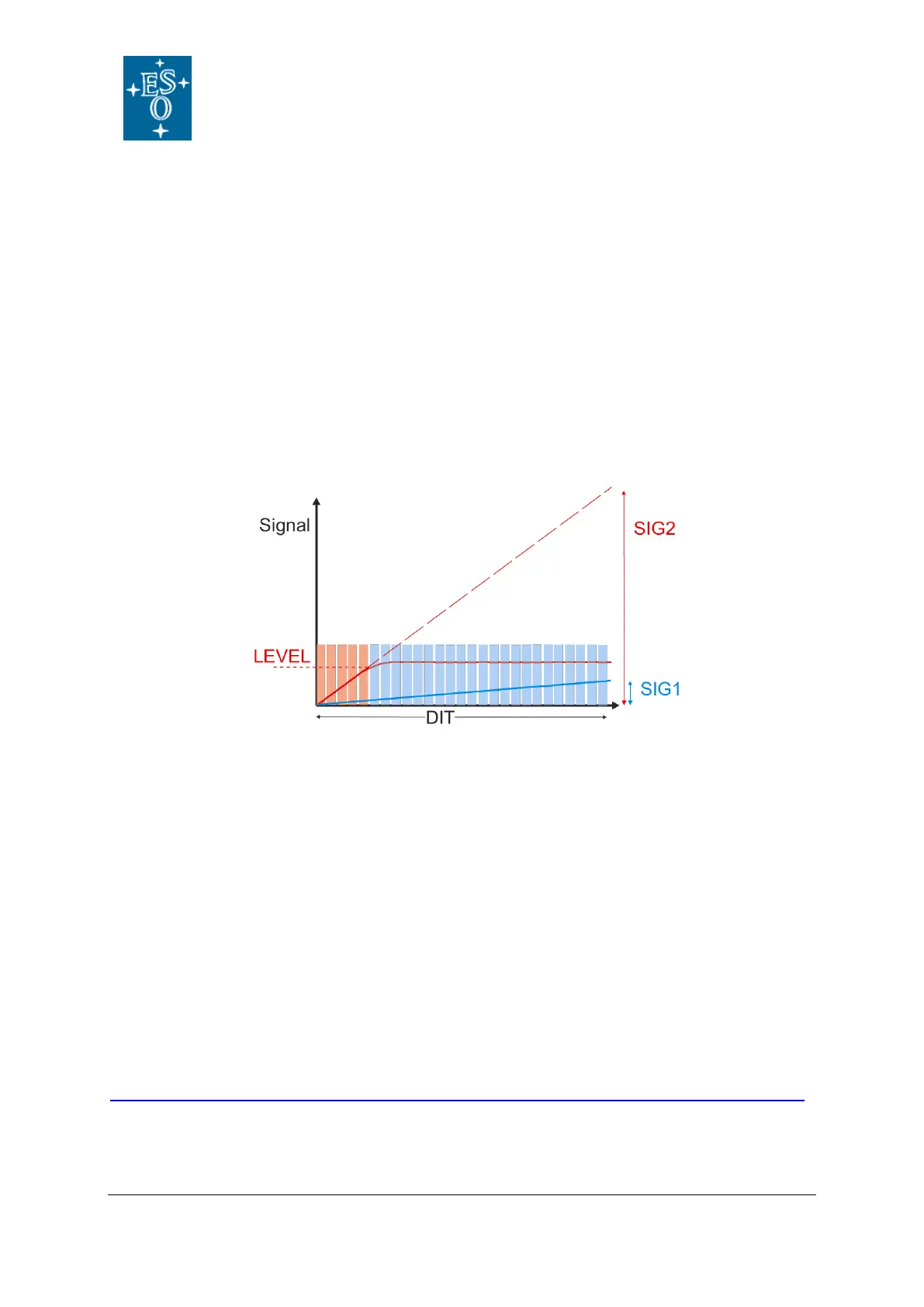
In addition, Threshold Limited Integration (TLI) mode is used to extend the dynamical range
for long exposure times: if one pixel is illuminated by a bright source and reaches an
absolute value above a certain threshold (close to detector saturation), only detector
readouts before the threshold is reached are used to compute the slope and the counts
written in the FITS image for this pixel are extrapolated to the entire exposure time (see
Finger et al. 2008, Proc. SPIE, Vol. 7021 for a more detailed description).
Note that for operational reasons only a limited number of DITs is offered to the user in case
of exposures longer than 300s (see section 3.4.1.3).
Important Warning: adjacent pixels can follow different regimes by using this readout mode,
one can follow the normal regime and its neighbor can follow and extrapolated regime (if the
counts reach the extrapolation threshold). This may lead to bad line profile and then to affect
for example the chemical abundances determination, etc. Therefore we strongly recommend
doing as short as possible DIT and that the counts never reached 89000e- (or 42000 ADUs)
in the ETC (meaning that the count will not be extrapolated).
A document explaining in details this readout mode and its different regimes with their
consequences is available at:
http://www.eso.org/sci/facilities/paranal/instruments/xshooter/doc/reportNDreadoutpublic.pdf
Figure 9: Extrapolation threshold for nondestructive sampling and extrapolation of
detector signal for high flux levels. For pixels with high flux (red) only readout values
below EXTLEVEL (orange rectangles) are taken into account in the calculation of the
slope and values written in the FITS files are extrapolated to the full DIT (SIG2). For
low flux pixels (blue) all nondestructive readouts are used (light blue rectangles).
Modified figure coming from Finger at al. (2008).


 To Next Page