Need help?
Do you have a question about the Epson VR43B and is the answer not in the manual?
Watch converts light to electrical energy and stores it in a secondary battery for operation.
Eliminates the need for battery replacement by using a solar cell and secondary battery.
Dial allows light transmission (>30%) for solar cell, enabling design variety.
Expected running time from full charge to stoppage is approximately 4 months.
Second hand moves at 2-second intervals to signal low energy.
Prevents secondary battery deterioration and breakage from overcharging.
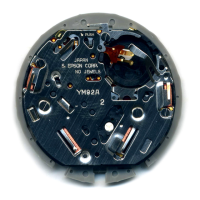
Diagram showing key components like solar cell unit, movement, and battery.
Specifies outside diameter, casing diameter, and total height of the movement.
Details quartz oscillator type, frequency, accuracy, and operating temperature range.
Lists hands, calendar, reset switch, power depletion warning, and setting mechanism.
Details jewels, anti-magnetism, driving current, stopping voltage, and solar cell type.
Information on battery type, size, nominal voltage, and capacity.
Lists part numbers for hand setting stem, secondary battery, and solar cell units.
Specifies equipment and method for testing movement accuracy.
Specifies different hand types (M, LL) with corresponding marks for identification.
Provides detailed dimensions for casing parts and overall structure.
Illustrates casing structure with various views, including heights H1 and H2.
Specifies unbalance limits (μ N·m and μ g·m) for various hands.
Lists moment of inertia values (μg·m²) for second and chronograph hands.
Lists part numbers for hour, center, fourth, and counting wheels for Type M.
Provides detailed dimensions for wheels used in hand fitting for Type M.
Specifies unbalance limits for various hands for Type LL.
Lists moment of inertia values for hands for Type LL.
Lists part numbers for wheels used in hand fitting for Type LL.
Provides detailed dimensions for wheels used in hand fitting for Type LL.
Provides dimensions and part numbers for Type-1 and Type-2 hand setting stems.
Specifies the material as Steel and its Vickers hardness.
Detailed dimensions and layout of the dial, including markers and sub-dials.
Requirement for dial transparency rate (>30%) for solar cell function.
Provides detailed dimensions and various views of the casing ring.
Top view diagram of the solar cell unit showing sections and terminals.
Detailed sectional views (A-A', B-B', etc.) of the solar cell unit components.
Caution to avoid touching or scratching the solar cell surface.
Maintain dial transparency rate (>30%) for effective solar cell function.
Guideline for charging time based on illumination level and environment.
Instructions for installing the secondary battery and warnings about silver oxide batteries.
Procedure for removing the setting stem using tweezers and a setting lever.
Use of holding ring and metal case to ensure stability and prevent static issues.
How to set hands correctly and avoid forcing them.
Precautions when removing hands, especially the hour hand due to plastic material.
Avoid placing watch too close to light sources to prevent overheating during charging.
Instructions for setting the two solar cell lead terminals.
How to push the hooks of the solar cell unit into the main plate securely.
How the dial is held by guide poles on the solar cell unit.
Maintain clearance between movement and button tip for smooth casing.
Details functions of the crown at 0, 1st, and 2nd click positions (date, time setting).
Operation of 2H and 4H buttons for chronograph start, stop, reset, and split functions.
Explanation of chronograph measurement up to 30 minutes in 1/1 second increments.
Steps for starting, stopping, and resetting standard chronograph measurement.
Steps for measuring accumulated elapsed time using start, stop, and reset functions.
Steps for measuring split times using start, split, and stop functions.
Steps for timing two competitors using start, finish time, and reset functions.
How to check battery capacity using the 4H button and its status indication.
Displays battery levels (High, Middle, Low) and corresponding power reserve durations.
This document describes the Epson VR43B Solar Series watch movement, a solar-powered chronograph movement designed for reliability and convenience.
The VR43B is a solar-powered watch movement that converts light into electrical energy using a solar cell located beneath the dial. This energy is then stored in a secondary battery. This design eliminates the need for conventional battery replacement, offering a more sustainable and low-maintenance timepiece.
The movement features a power depletion warning function, indicated by the second hand moving at two-second intervals when energy is low. In this state, the watch can continue running for approximately two weeks. An overcharge prevention function is also integrated to protect the secondary battery from deterioration and breakage by stopping charging once a predetermined voltage is reached.
The chronograph function allows for precise time measurement up to 30 minutes in 1/1 second increments. Once the measurement reaches 30 minutes, the chronograph automatically stops counting. It supports standard measurement, accumulated elapsed time measurement, split time measurement, and measurement of two competitors.
Movement Dimensions:
Time Standard:
Indicator/Functions:
Running Time:
Chronograph:
Features:
Maximum Unbalance of Hands:
Moment of Inertia:
Secondary Battery:
Separated Parts (Parts code):
Test of Accuracy:
The VR43B movement allows for the use of dials with a light transmittance of more than 30%, enabling a variety of dial colors while ensuring efficient charging of the solar cell.
Setting Mechanism:
Chronograph Operation:
Charging Guidelines (Dial transparency rate = 30%):
| Illumination (Lx) | Source of light | Environment | A (Approx. Hours for full charge) | B (Approx. Hours for steady operation) | C (Approx. Minutes to charge 1 day of power) |
|---|---|---|---|---|---|
| 700 | A fluorescent lamp | Inside the office | - | 18 | 69 |
| 3,000 | 30W 20cm | 52 | 4 | 15 | |
| 10,000 | Sun light | Cloudy | 16 | 1.5 | 5 |
| 100,000 | Fine weather | 5.3 | 0.5 | 2 |
Solar Cell Unit:
Secondary Battery Unit:
Hand Setting Stem:
Casing Part Structure:
Hand Setting:
Charging Caution:
Solar Cell Lead Terminal:
Solar Cell Unit Installation:
Dial Setting:
Button Position:

 To Next Page
 General