
 Need help?
Do you have a question about the ESAB Origo A32 and is the answer not in the manual?
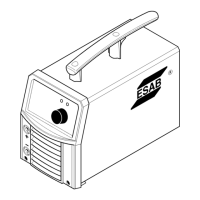
The ESAB Arc 150i / Arc 200i is a welding current power source designed for use with coated electrodes (MMA welding). This instruction manual provides essential information for the safe and effective operation, maintenance, and troubleshooting of the device.
The Arc 150i / Arc 200i provides direct current, enabling the welding of most metals, including alloy and non-alloy steel, stainless steel, and cast iron. The MMA (Manual Metal Arc) welding method, also known as shielded metal arc welding, involves striking an arc that melts the electrode, with its coating forming a protective slag.
The Arc 150i is capable of welding with coated electrodes ranging from Ø 1.6 to Ø 3.25, while the Arc 200i supports electrodes from Ø 1.6 to Ø 4.0.
Mains Voltage: Both models operate on 230 V, 1-phase, 50/60 Hz.
Fuse (delayed-action):
Primary Current:
Voltage/Current Range (DC):
Maximum Permissible Load at Duty Cycle:
Power Factor at Maximum Current:
Efficiency at Maximum Current:
Open-Circuit Voltage: 58-75 V for both models.
Operating Temperature: -10°C to +40°C for both models.
Constant A-weighted Sound Pressure: < 70 dB for both models.
Dimensions (l x b x h): 380 x 180 x 300 mm for both models.
Weight: 8 kg for both models.
Enclosure Class: IP 23C for both models, indicating protection against solid objects and water, suitable for indoor and outdoor use.
Application Class: Both models are marked with 'S', signifying that the power source is designed for use in areas with increased electrical hazard.
Duty Cycle: Refers to the percentage of a ten-minute period during which welding can be performed at a specified load without overloading.
Installation and Placement: The device comes with a 3-meter mains cable. It should be placed so that its cooling air inlets and outlets are not obstructed. The rating plate, containing important technical information, is located on the rear or bottom plate of the power source.
Mains Power Supply: Ensure the welding power source is connected to the correct supply voltage and protected by the appropriate fuse rating. Cable cross-sectional areas must comply with national standards, and a protective earth connection is mandatory.
Connections: The welding power source has two terminals: one positive (+) for the welding cable and one negative (-) for the return cable. The welding cable should be connected to the terminal corresponding to the polarity indicated on the electrode package. The return cable's earth clamp must be securely fitted to the workpiece, ensuring good contact.
Control Panel A32: The control panel features:
Overheating Protection: The device is equipped with a thermal overload trip that activates if the temperature becomes too high, interrupting the welding current and illuminating the yellow indicator lamp. This trip automatically resets once the temperature has fallen to a safe level.
Welding Technique:
Regular Maintenance: Regular maintenance is crucial for safe and reliable operation. The Arc 150i / Arc 200i requires minimal maintenance. Under normal conditions, it is sufficient to clean the unit once a year by blowing it with dry compressed air. However, if the device is used in a dusty or dirty environment, cleaning should be performed more frequently.
Warranty: The manufacturer's warranty becomes void if the customer attempts to repair any faults on the product during the warranty period.
Repair and Spare Parts: All repair and electrical work must be performed by an authorized ESAB serviceman. Only original ESAB spare and wear parts should be used. Spare parts can be ordered through the nearest ESAB dealer.
Fault Tracing: Before contacting an authorized service technician, users are advised to perform basic checks:
The Arc 150i / Arc 200i is designed and tested in accordance with international and European standards IEC/EN 60974-1 and EN 60974-10. The service unit performing repairs is responsible for ensuring the product continues to conform to these standards.
 General
| Brand | ESAB |
|---|---|
| Model | Origo A32 |
| Category | Welding System |
| Language | English |



 To Next Page