Need help?
Do you have a question about the Escea IB850 and is the answer not in the manual?
Instructions for attaching the log template to the left and right sides using screws and washers.
Guidance on correctly positioning logs to avoid blocking burner holes and ensure optimal flame efficiency.
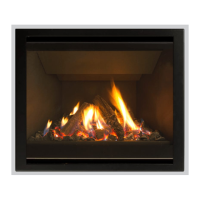
This document outlines the procedure for installing an IB850 Log Template, specifically for the G0200 model, and provides instructions for removing and reinstalling the log set and glass components of the fireplace. The primary function of the log template is to ensure proper positioning of the decorative logs within the fireplace, which is crucial for optimal flame efficiency and airflow.
The IB850 Log Template serves as a guide for correctly arranging the ceramic logs within the fireplace's burner area. Its installation is a key step in maintaining the aesthetic appeal of the flame display while ensuring the fireplace operates efficiently. The template helps prevent the logs from obstructing the burner holes, which could lead to reduced flame quality and efficiency. The instructions detail a step-by-step process for both disassembly and reassembly, emphasizing careful handling of delicate components like the glass and logs.
The installation process begins with the removal of the inner fascia, which is achieved by pulling its base outwards and then lifting it up and off. This initial step provides access to the internal components. Following this, the top glass retainer needs to be unscrewed and removed, with a cautionary note to prevent the glass from falling forward. The glass itself is then carefully lifted out and set aside.
The log set is subsequently removed. The document suggests gently brushing any soot from the logs using a soft hearth brush. The burner tops can also be vacuumed to remove any excess material, which is a maintenance feature ensuring clean operation.
The log template is then installed. For the left-hand side attachment, an existing screw that holds the middle burner in place is utilized. This screw is removed and then re-attached with the log bracket in place. For the right-hand side, a supplied screw and brass washer are used. In some instances, it may be necessary to drill a 1/8” (3.3mm) hole in the lower baffle to secure the template.
Once the template is in place, the logs are positioned according to the provided diagrams. A critical instruction is to ensure that the logs do not block any of the holes on the top of the burners. The document explicitly states that "Blocked or covered holes on the burners may result in reduced flame efficiency." This highlights the importance of correct log placement for optimal performance. A specific note mentions that the front right-hand log should be raised slightly off the burners to improve airflow, indicating a design consideration for enhanced combustion.
The instructions incorporate several maintenance-related steps. The recommendation to gently brush soot from the logs and vacuum the burner tops during the log set removal process is a direct maintenance activity. This helps in keeping the fireplace clean and ensures that the burners are free from debris that could impede their function. The process of removing and reinstalling components also provides an opportunity for visual inspection and cleaning of the internal parts of the fireplace, contributing to its overall longevity and performance. The emphasis on careful handling of the glass and logs during removal and reinstallation also contributes to preventing damage, thereby reducing the need for replacement parts.
While explicit technical specifications like power output or dimensions are not provided in this document, several implied technical details are crucial for the installation and operation:
In summary, this document provides comprehensive instructions for installing the IB850 Log Template, focusing on careful disassembly, precise reassembly, and critical log positioning to ensure efficient and aesthetically pleasing operation of the G0200 fireplace. It integrates usage and maintenance features within the installation process, emphasizing the importance of proper handling and cleaning for optimal performance.
 General
| Brand | Escea |
|---|---|
| Model | IB850 |
| Category | Indoor Fireplace |
| Language | English |

 To Next Page