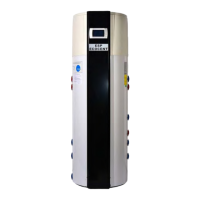
The attractive design allows the unit to be placed in the open in finished utility spaces and basements;
depending on ambient conditions, the cost of operation can be up to 75% less of that of an electric water
heater, and can be used in conjunction with solar hot water heating.
Environmentally friendly and safer
The unit produces no harmful emissions locally; there is no combustion of oil, coal, or natural gas. No
carbon monoxide is produced and there is no open flame.
Easy to operate and multiple heat sources
Although the Ecocent Maxi will run most efficiently if allowed to run continuously, it is equipped with a
timer for automatic start-up and stop and an adjustment for the easy setting of water temperature. The unit
can take heat from a number of sources in domestic installations, or from hot areas in light industrial
environments.
5.2 System Principles
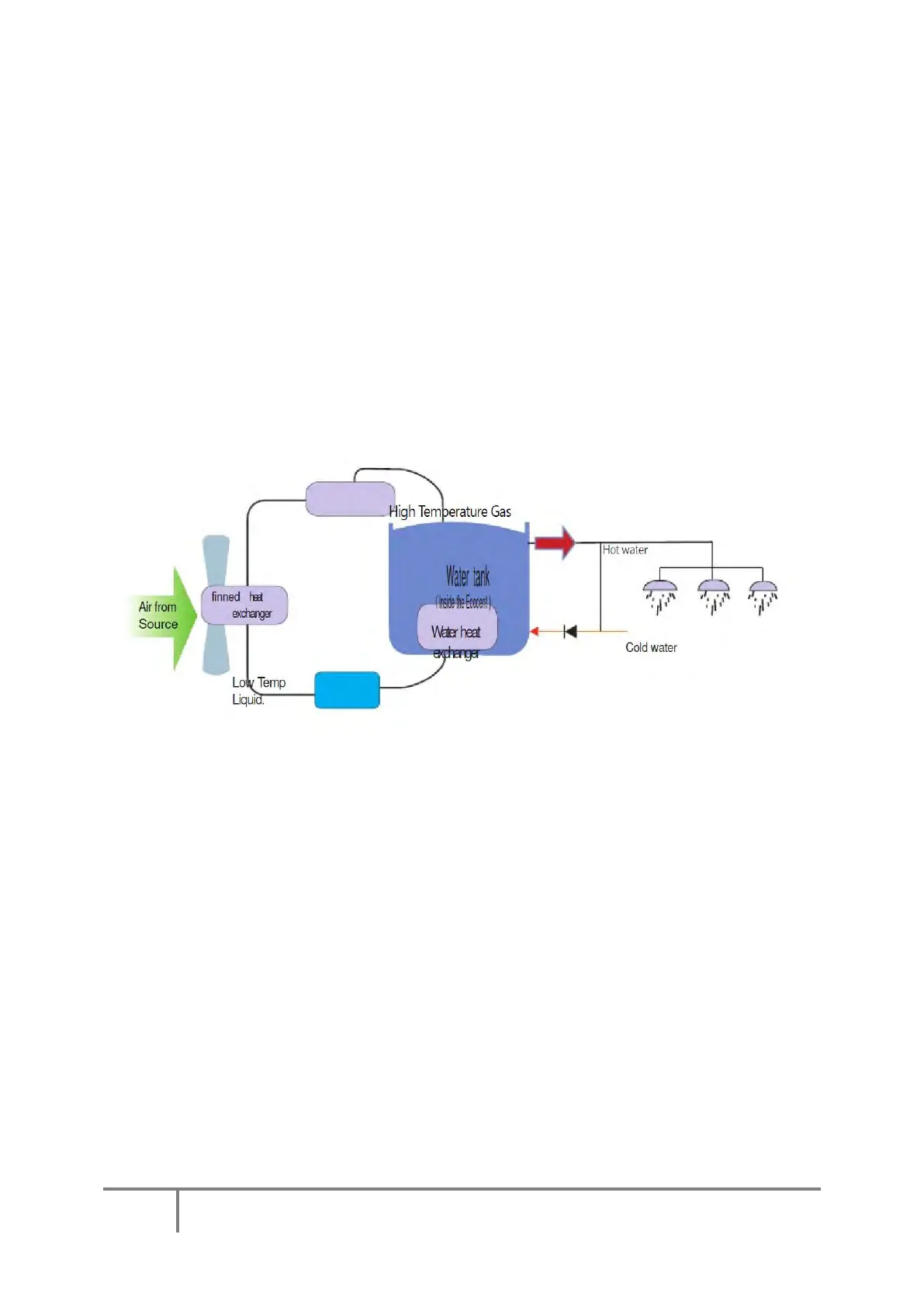
Picture 2
The Ecocent operating principles are simple:
(1) Using low power input to drive the motor, the input power is Q1.
(2) While the unit is running, it uses power Q2.
(3) The energy that the house gets from the unit in the form of hot water is Q3.
(4) According to the law of physics, the sum of input power = sum of output power i.e. Q1+Q2 =
Q3
In standard operating mode, the power that heat pump extracts from the environment is about 3.88
times the power input i.e. Q2 = 3.2 Q1 So: Q3 = Q1+Q2 = Q1+3.88Q1= 4.88Q1
Which means you can get 4.88 times more power output than you use as input power.
With an immersion heater, you will never get more than 1 times the input power as output power.


 To Next Page