ETAS 9 Appendix
9.2 Behavior of Calculated Signals depending on the
status flag
In an MDF measure file, for sample additionally two flags are available: One for
indication whether a value is available at a certain timestamp, and another
which indicates whether a recorded value is valid or not.
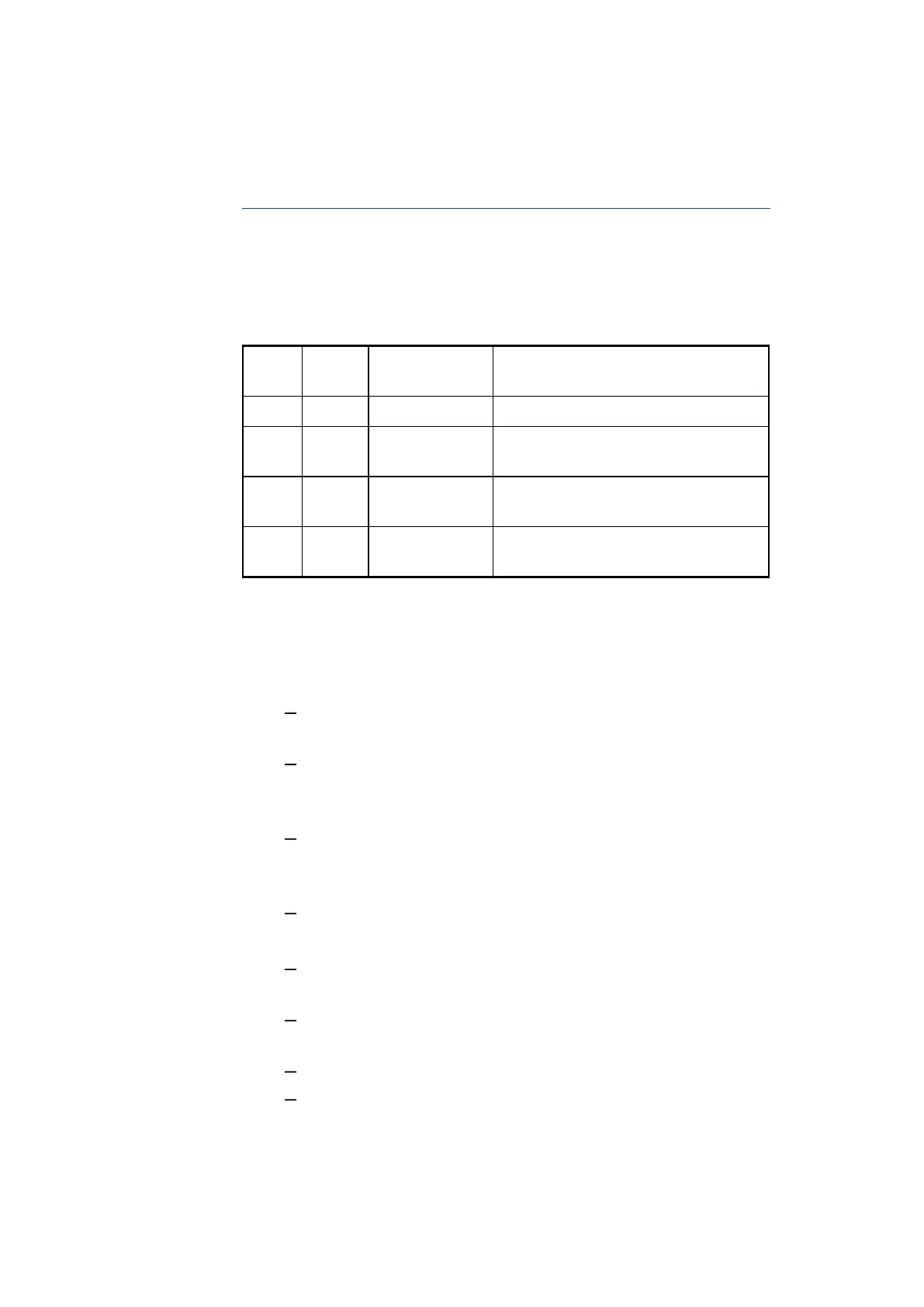
Each of the flags can be True or False, therefore the following four com-
binations are possible:
Has a
value
Value is
valid
Description Example
TRUE TRUE Regular sample
FALSE TRUE No sample at
this point
Timestamps before the first sample of
the signal is available
TRUE FALSE Error sample
with value
FALSE FALSE Error sample
with no value
Integer division by 0
For calculated signals the states of the flags of input signals are considered
for the calculation result.
This can be summarized as follows:
l
No value cases
The meaning is the same as if the sample (including timestamp)
were missing completely.
The advantage is that with this flag a No value of one signal can be
combined with other signals in the same group which still have a
sample at the same point.
The result of a calculation on No value will also be marked as No
value (unless the interpolation with other signals causes there to be
a sample).
The state of stateful operations (like integral) will not update.
l
Error cases (both with and without value)
If any input sample has an error (i.e. is invalid), the error is propag-
ated to the calculation result.
The only exception is if the input sample does not matter, e.g. true?
3: error results in 3.
Errors are also propagated into the state of stateful operations.
Thus accumulating operations (like e.g. Integral) will stay on error as
long as the error sample is part of the accumulation range.
MDA V8.6 – User Guide 136


 To Next Page