8
Helpful Hints
Although transparent materials pass vis ible light, many visible transparent
materials are opaque in the infrared and can be directly measured by the
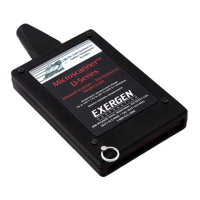
Microscanner™ D-Series.
To test for infrared transparency, touch the Microscanner™ to the surface
and pass a heat source, such as your hand, through the sensor’s field of
view on the other side of the material. If the Microscanner™ responds to the
heat source, the material is transparent in the infrared.
To measure a transparent surface, use one of the following techniques:
1. Mark the surface with an opaque nonmetal lic coating.
2. Put a shiny metallic surface such as alumi num foil behind the transpar-
ent material. The shiny metal will reflect the transparent materi al’s heat
back to the Microscanner™.
Wet or icy surfaces may interfere with the Microscanner’s readings. Water
and other liquids are good targets, but evaporation lowers their surface
temperatures.
Frost forms on a surface at the freezing point of water. Frozen foods or
similar targets will form frost unless the environment is controlled. If frost
forms, the Microscanner™ will read the temperature of the frost instead of
the subsur face (object’s) temperature.
Melting ice will read slightly higher than 32°F (0°C) because the instrument
actually measures the air condensing on the ice, a reaction which generates
a small amount of heat. As long as the ice is not melting, the Microscan-
ner™ will ac curately read its temperature. For true object temperature,
remove any ice or moisture before measuring.






 To Next Page