Need help?
Do you have a question about the Extech Instruments DV690 and is the answer not in the manual?
Overview of the Extech High Voltage Detector DV690's purpose and function.
Lists key features and capabilities of the DV690, including voltage range and alerts.
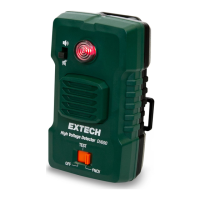
Details the physical components and labels on the front and back of the DV690 detector.
Explains the components of the hot stick adaptor and its universal spline connection.
Describes the function of each control switch on the DV690, including power and mode selection.
Step-by-step guide for installing the required AA batteries in the detector's rear compartment.
Procedure for performing the automatic self-test to ensure the detector is operating correctly.
Method for manually verifying the detector's voltage detection and alert functions using a live wire.
Guidance on testing the audible buzzer's audibility in noisy environments for effective alerts.
Outlines various methods for wearing the DV690, such as belt clip, neck strap, or arm strap.
Instructions for assembling and attaching the detector to a hot stick using the provided adaptor.
The Extech DV690 is a High Voltage Detector designed to sense the presence of AC voltage without contact, alerting users audibly and visibly when in close proximity to live equipment and dangerous voltages. Its non-contact sensor plate detects radiated electrical fields as it approaches a live conductor.
The primary function of the DV690 is to provide a safety alert when AC voltage is present. It detects electrical fields ranging from 100 V AC to 69 kV AC within a frequency bandwidth of 50 to 60 Hz. When voltage is detected, the device provides a bright red LED alert indicator and a loud buzzer alarm. The buzzer alarm has a maximum intensity of 106 dB, and its intensity varies based on the detected voltage, becoming more intense as the voltage increases. A mute switch is included for the buzzer alarm, allowing users to silence the audible alert while still relying on the visual LED indicator.
The device incorporates a built-in safety self-test function to ensure it is operating correctly before use. This automatic self-test is initiated by moving the function switch to the "TEST" position. If the detector is functioning normally, both the buzzer will sound and the alert LED will light. If either of these alerts fails to activate, the detector is not operating correctly and should not be used until it has been repaired or replaced.
In addition to the automatic self-test, a manual verification test can be performed. This involves moving the selector switch to the "NCV" (non-contact voltage) position and placing a small gauge live wire (100 to 240 V AC) across the detector's faceplate. The detector should then exhibit the expected audible and visual alerts, with the buzzer intensifying as the detected voltage increases. This manual test helps confirm the detector's ability to sense live voltage in a controlled environment.
An ambient noise buzzer test is also recommended to ensure the audible buzzer can be heard above the surrounding noise in the test area. If the buzzer is not audible, the visual LED alert will still provide a warning, but users should be aware of the limitations of the audible alarm in noisy environments.
The DV690 offers multiple options for carrying and deployment, making it versatile for various applications. It can be held in hand for direct use. For hands-free operation, it can be worn around the neck using the supplied breakaway lanyard, clipped to a front pocket or belt with the integrated clip, or strapped on an arm using the supplied elastic strap. When wearing the detector, it is recommended to position it on the outside of clothing to minimize false alarms caused by static electricity discharges. For optimal detection, the detector should be facing in the direction the user is facing or walking.
For extended reach and enhanced safety in hazardous areas, the DV690 can be attached to a universal 'hot stick' (not supplied) using the provided adaptor. This adaptor utilizes an industry-standard universal spline, allowing compatibility with various hot stick models. The process involves attaching a cylinder to the detector, sliding the universal spline neck into the cylinder, securing it with a screw, and then attaching the hot stick to the universal spline connector using a wing-bolt fastener.
The detector is designed for durability with a rugged, textured hand grip, making it suitable for demanding environments. It is also supplied with a soft protective pouch for use in dusty or wet conditions, further enhancing its robustness.
The DV690 is battery-operated, using three 1.5 V 'AA' alkaline batteries. Battery installation is straightforward, requiring the removal of two screws to access the rear compartment. Correct battery polarity must be observed during installation. The detector should not be operated until the battery compartment cover is securely fastened.
The device provides guidelines on the approximate distances at which its alarms will trigger for various voltage sources. For residential meters (240 VAC), alarms typically trigger at 3.1 to 4 inches (8 to 10 cm). For medium voltage pad-mounted transformers (600 VAC), the distance is approximately 10 inches (25 cm). For distribution poles (7.2 to 14.4 kV AC), alarms trigger at about 2.6 to 5 feet (0.8 to 1.5 m). For transmission poles (69 kV AC or higher), the detection distance is approximately 10.8 feet (3.3 m). These distances are provided as general references and may vary.
The DV690 is designed for user-friendly maintenance, primarily focusing on battery management and proper storage. The battery compartment is easily accessible on the back of the detector, secured by two screws. Users are advised to install three new batteries of the same make and type and to replace them if the detector fails the automatic self-test. It is crucial not to operate the detector if the batteries appear damaged, leaking, or abnormal in any way.
For long-term storage (over 90 days), it is recommended to remove the batteries from the detector to prevent potential damage from battery leakage. The device should be stored in its supplied hard-shell carrying case to protect it from physical damage and environmental factors when not in use.
The DV690 complies with the EN 61326–1 safety standard, indicating its adherence to electromagnetic compatibility requirements for electrical equipment used in measurement, control, and laboratory applications. It also has an Ingress Protection rating of IP54, meaning it is protected against dust ingress and splashing water from any direction, contributing to its durability and reliability in various working conditions. The device has been tested for a drop resistance of 4 feet (1.2 m), further highlighting its robust design.
 General
| Type | Combustible Gas Leak Detector |
|---|---|
| Sensor Type | Semiconductor |
| Detectable Gases | Methane, propane, butane, natural gas |
| Alarm | Audible and Visual |
| Adjustable Sensitivity | Yes |
| Device Type | Handheld |
| Power Supply | 9V battery |
| Housing | Durable plastic |

 To Next Page