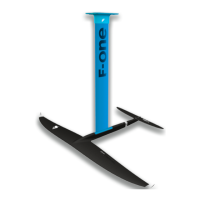
SAFETY GUIDELINES
FOR STAND UP PADDLING
BOARDS MEASURING LESS THAN 3.50M ARE CONSIDERED AS BEACH VESSELS AND THEIR
USE IS LIMITED WITHIN 300M OF THE COAST LINE. HERE ARE THE SAFETY GUIDLINES TO
USE FOR THE EACH KIND OF PRACTICE.
(Guidelines do not apply when using the product under supervision.)
The rider is connected to his board by a leash. The leash must be at least equal or longer than the length of
the board. No safety or security equipment is required for the beach vessels. For the board’s allowed to go
beyond 300 m, safety and basic security equipment is required, related to the characteristics of the vessel and
mandatory within 2 miles of shelter (art.240-3.07). An individual oating devise (art.240- 3.12) or a protective
suit (art.240- 3.13). A life jacket or a neoprene wetsuit. A personal strobe light (art.240-3.14) & a towing
apparatus.
1. FLAT WATER, OPEN WATER (OCEAN & SEA) / ENCLOSED BODIES
OF WATER WITHOUT CURRENTS (LAKES & CANALS)
∙ It is recommended that you do not go out with
an offshore wind that pushes you away from land
more than the equivalent of 1 hr of paddling (while
remaining in the allowed safety distances).
∙ The rider should inform the lifeguards or a third
party of his trajectory.
∙ The rider should carry a dry bag with a
communication devise, a rst aid kit and a towing
apparatus.
∙ It is recommended to use a life jacket and a wetsuit
when the water temperature is below 20°.
∙ When practicing long distance itineraries it is
recommended to always go with at least 2 people.
PRACTICING LONG DISTANCE
ITINERARIES
RECOMMENDATIONS
Navigation areas & local regulations
Foiling is normally practiced outside of the 300
m area and within one nautical mile from a safe
shore. When practiced within the 300 m area foiling
should be performed with care and with a maxi-
mum speed of 5 kts unless specically authorised
by the authorities.
Foiling is forbidden within the swimming areas and
more generally in any area dedicated to a specic
activity. Get some information from the local club,
authorities or from other users on the specic local
regulations.
What are the forecasts for wind and waves for the
day? You need to know how the strength and direc-
tion of the wind and waves will evolve along the day.
Check on the tide schedules and on the areas of rip
and strong currents.
When using a kite or another wind propelled device,
the foil can let you ride in marginal conditions. Keep
in mind the wind can quickly die completely. Do not
go out on the water during thunder and lightning.
Help out others
Always keep an eye on your surroundings, and pay
attention to others. Do not hesitate to help out or go
after a struggling kitesurfer.
Respect bystanders
Do not lend your equipment to somebody that has
never practiced before. When using a kite, inform the
spectators of the potential risk of staying downwind
from a kitesurfer.
RULE N°4 - CHECK THE WEATHER CONDITIONS
RULE N°5 - RESPECT & HELP OUT OTHERS
WARNING
Product presenting sharp areas - Risk of injuries
Protection helmet and impact vest are strongly
recommended during use.
When falling, the board and foil can keep their pace
for some time before stopping. Beware of impacts.
The board and foil can drift away at higher speed
than a normal single board. Do not leave your foil
unattended in the water for too long or it could
drift far away from you rapidly.
The foil modies the weight and size of the board.
When immerged, the foil generates more force op-
posing the drifting force of the kite. The board does
not slide on the water the same way as a single
board. Handling movements should be soft and
controlled. Beware any hasty or abrupt movement.
SAFETY GUIDELINES FOR FOILING
Stand up paddle boards are voluminous and heavy, it is paramount that every surfer must be in
control of his board and paddle at all times. The right of way rules of surfing and conviviality apply to
the practice of stand up paddle boarding in waves. The surfer is connected to his board by a leash.
The leash must be of equal or longer length than the board.
2. WAVES (SEA & OCEAN)
∙ Before using your stand up paddle board in
waves, it is advisable that you are able to control
it in calm waters (without waves) and have basic
knowledge of waves, due to having practiced a
surfing related activity.
∙ Every surfer should practice stand up paddle
boarding away from crowded areas.
RECOMMANDATIONS
14 15
ENGLISH


 To Next Page
 Loading...