Output voltage is determined by :
—
Vref (PI
+
P2)
R7
+
Tl
Overload protection is
provided
by VT4 and VT8. As output
current increases, the voltage drop across
R17 increases
until
the base of VT4 is sufficiently
positive
to turn it on. This diverts
current from the series regulator stage, thus
reducing the
output
voltage. On further increase in
load,
VT4
will
maintain a roughly
constant voltage drop across El 7 which gives
a
roughly
constant
current output. The point
at which
the initial current limit
occurs is set by P3 and the maximum
current
limit point is set
byT2.
OVERVOLTACE PROTECTION
On units fitted with overvoltage
protection, this is
provided
by
means
of a
Thyristor
"crowbar" connected
across the
output
terminals, and driven from a
voltage
comparator amplifier which
compares a fraction of the output
voltage with
a reference zener
diode. Rla,
Zla,
R7a
and
VTla,
comprise a
constant
current
source to feed the reference
zener
diode Z2a, Z9a and R10A feed
a fraction of this voltage to VT3a
base.
VT3a
and
VT4a
are the
comparator
transistors,
the base of VT4a being
fed from potential
divider Pla, R6a and R13a.
If
the output voltage
exceeds
a level
determined by this potential
divider VT4a
conducts, driving
VTZa on.
The
drive
then available
from.VT2a
collector then
fires SCRla which short
circuits
the output terminal.
)
SECTION IV
SPECIFICATION
Mains Supply
210, 220, 230 or
240 volts
50/60
Hz.
Alternatively,
instruments may
be
120 volts
50/60 Hz.
Output Voltage
and Current Ranges
SINGLE
UNITS
supplied for
105,
110,
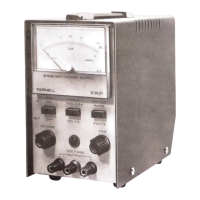
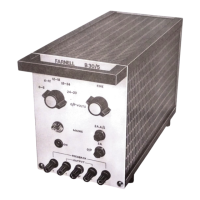
L30A
—
50V,
0.5A.
L30B
—
30V.
1A.
L30C
—
10V.
3A.*
L30D
—
30V.
2A.
L30E
—
30V. 5A.
L30F
—
12V. IDA.*
TWIN
UNITS
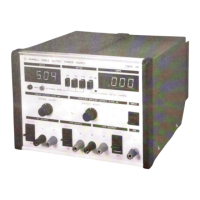
L30AT
2x0-
-
50V.
0.5A
L30BT
2x0-
-
30V.
1A.
L30DT
2x0-
-
30V. 2A.
Fitted with overvoltage
protection.
Mains
Variation
Tolerated
± 10%
of
Nominal.
Output Voltage
Variation
for ± 10%
Mains Change
Less
than
.01% or lmV
whichever
is the greater—short term.
Less than
.02%
or 2m
V
whichever
is
the
greater—long term.
Output Voltage Variation
for
Zero to
Full Load Change
Less than
.01%
or 2m
V
whichever is the
greater
—
-short term.
Less
than
.02%
or 4mV whichever is the greater—long term.


 To Next Page
 Loading...