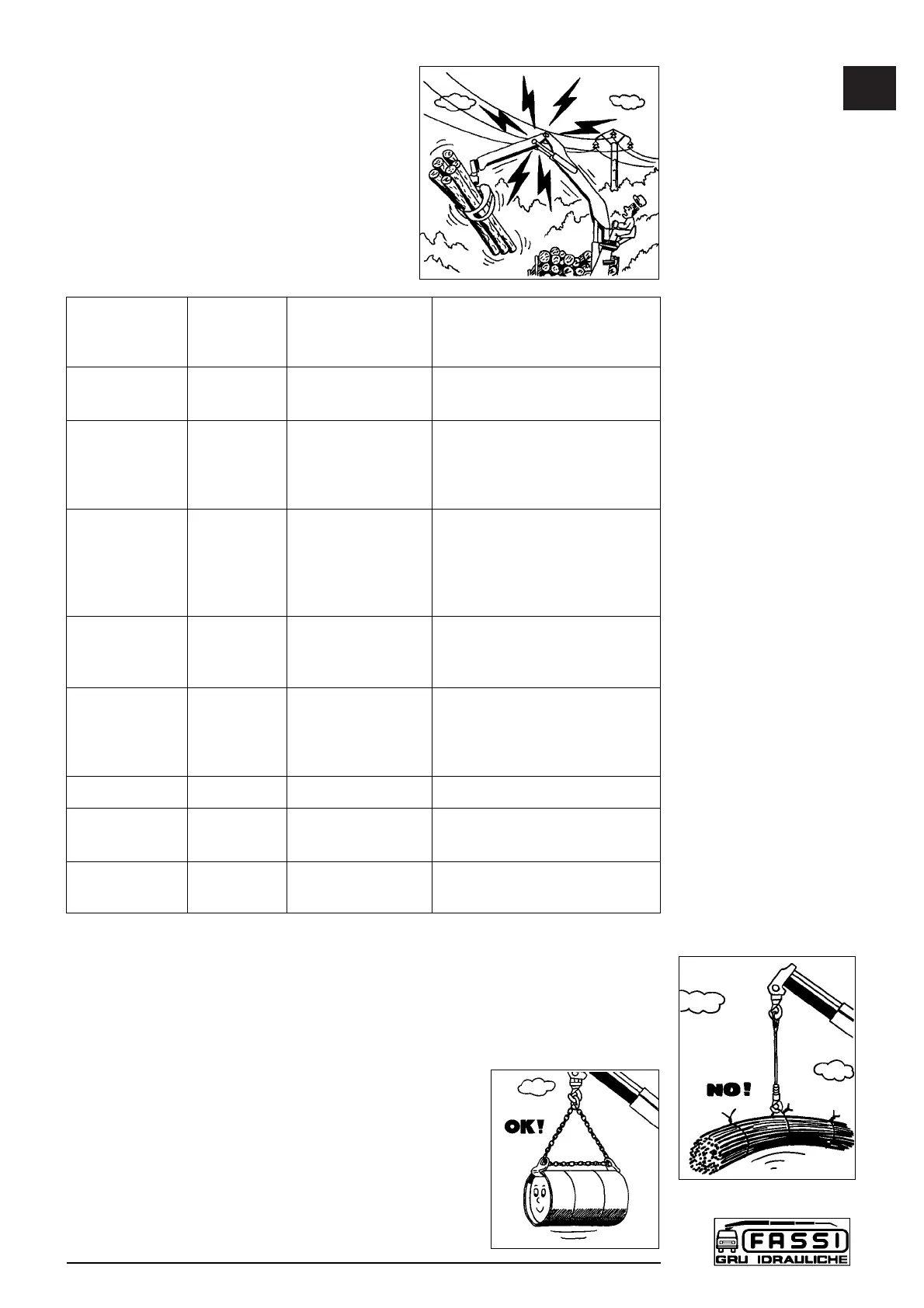
(!) ATTENTION (!)
Failure to respect the minimum safe distan-
ces may result in electrical hazards for the
operator and his assistants.
(!) ATTENTION (!)
Do not utilize the crane with wind speed
exceeding 12,5 m\s (value 6 of the Beaufort
scale).
Indications about wind speed
Force of the Wind speed Classification Characteristics
wind m/s
Beaufort scale
0 0,0 - 0,2
Calm
Calm wind, smoke goes up
quite vertically
1 0,3 - 1,5
Light breeze
Smoke reveals the direction
2 1,6 - 3,3 of the wind, one can feel the
wind blowing, leaves start
fluttering.
3 3,4 - 5,4 Moderate breeze Leaves and branches are
4 5,5 - 7,9 in constant motion, small
branches start fluttering.
Dust and papers dance on
the ground.
5 8,0 - 10,7 Fresh breeze Small green branches bend,
the surface of waterways and
lakes are wavy.
6 10,8 - 13,8 Near gale Big branches bend, wind
whistles through high-tension
cables, it's difficult to walk
keeping the umbrella open.
7 13,9 - 17,1 Moderate gale Trees sway, it's hard to walk.
8 17,2 - 20,7 Storm wind Branches get broken,
it's hard to walk.
9 20,8 - 24,4 Storm It damages houses (antennas
and roof tiles fall down)
(!) ATTENTION (!)
Carefully inspect the load rigging.
Hook up the load, checking that it does not exceed the capacity indicated on the
lifting diagram specific to each load configuration.
Make sure that the lifted load is balanced.
Avoid swinging the load above the control station; in
cases where the load is too close, the crane must be
operated from the opposite side.
When operating through a winch, lift the load vertically
using the cable and not the booms in order to avoid
swinging the load.
C0.2
WARNING AND
INSTRUCTIONS
F 170A
7


 To Next Page
 Loading...