
 Need help?
Do you have a question about the Fender 63 Reverb and is the answer not in the manual?
Turns the AC power ON and OFF. Unit shuts down completely when OFF.
Protects amplifier and operator from electrical faults. Replace only with specified rating.
Indicates when the unit's power is on.
Adjusts signal sent to reverb pan, controlling reverb intensity.
High impedance plug-in connection for instruments.
Blends 'wet' reverb signal with 'dry' instrument signal.
Affects only the 'wet' reverb signal, controlling treble frequencies.
Output jack for sending the signal to the amplifier.
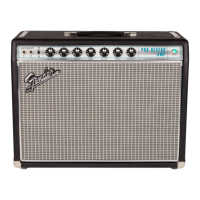
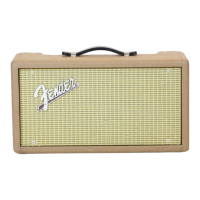
The '63 Fender Reverb is a faithful reproduction of an original 1963 Fender Reverb unit, designed to recreate the iconic "socking wet surf sound" of the early 1960s. This self-contained, tube-driven spring reverb device has established itself as an industry standard for effects, used on countless recordings and live performances across various instruments including guitar, keyboards, vocals, accordion, and electric violin. Its design prioritizes maintaining the original circuit for an authentic sonic experience, with minor updates for reliability and manufacturing efficiency, such as a printed circuit board replacing the original "Leo board" style phenolic parts panel. While some components may differ in size and shape from the original, their values are identical, and the power and reverb transformers are built to original specifications.
The '63 Fender Reverb is an effects unit that processes an input signal to add a reverberation effect, then mixes this "wet" signal with the original "dry" signal before sending it to an amplifier. It is designed to be placed between a low-level instrument, such as a guitar, and a high-input impedance amplifier, specifically a clean channel. The unit generates reverb using a spring reverb pan, driven by tubes, to create its distinctive sound. The amount of signal sent to the reverb pan, the mix of wet and dry signals, and the tone of the wet signal can all be adjusted by the user. The device is powered by AC electricity, with versions available for both 120V and 230V systems.
Before operating the '63 Fender Reverb, it is crucial to release the reverb pan's locking lever. This metal lever, located inside the back of the cabinet, is pushed forward and to the right for shipping or travel to protect the springs from damage. To prepare for use, the lever must be pushed slightly forward and then to the left to unlock it, allowing it to return to the playing position.
The top panel of the unit features several controls for shaping the reverb effect:
The '63 Fender Reverb is primarily intended for use with the clean channel of an amplifier, as distorted reverb can sound unnatural. For users wishing to incorporate high gain or distortion, it is recommended to either place a distortion pedal before the Reverb Unit or connect the Reverb Unit in the amplifier's effects loop. However, the manual notes that many sonic benefits of the '63 Fender Reverb come from the reverb signal being generated before the amplifier's tone controls and preamp gain circuitry, making its use in the effects loop less ideal for achieving its full sonic potential.
The '63 Fender Reverb is designed with reliability in mind, utilizing a printed circuit board for improved manufacturing efficiency. However, the manual explicitly states: "WARNING: No user serviceable parts inside. Refer servicing to qualified personnel only." This means that users should not attempt to open the unit or perform any internal repairs.
For troubleshooting common issues, a checklist is provided:
The only user-serviceable part mentioned is the fuse. If the fuse blows, it must be replaced with a fuse that matches the specifications listed on the fuse holder. Repeated fuse blowing indicates a more serious electrical fault that requires attention from a qualified technician. Under no circumstances should a fuse of a different type, higher current rating, or a fuse bypass be used, as this could damage the equipment and create a serious safety hazard.
The unit's internal components, such as the reverb pan and filter capacitors, are subject to aging, which can alter their performance over time. While the reissue aims for authenticity, slight differences in sound compared to a decades-old original model are to be expected due to the natural degradation of older components. The built-in quality reflects over four decades of dedication in Fender's research and development, aiming to provide a product that embodies the brand's legacy of creating legends.
 General
| Outputs | 1 x 1/4" |
|---|---|
| Reverb | Yes |
| Channels | 1 |
| Tremolo | Yes |
| Footswitch | No |
| Effects Loop | No |
| Cabinet Material | Pine |
| Rectifier | Tube |



 To Next Page