Need help?
Do you have a question about the Fender PA 1272X and is the answer not in the manual?
Explains how to calculate the combined impedance of speakers wired in parallel.
Explains how to calculate the combined impedance of speakers wired in series.
Provides guidance on selecting appropriate speaker wire gauge based on length and impedance.
Details on connecting multiple loudspeakers using 1/4" jacks for input and output.
Recommendations for minimum speaker wire gauge and potential impact on sound quality.
Instructions for cleaning the synthetic carpet covering on the loudspeaker cabinets.
Tips for minimizing feedback using microphone placement and type.
Guidance on selecting 30° or 60° angles for optimal performer monitoring.
Recommendations for using monitors as side fills for wide coverage and performer monitoring.
Lists the model names and corresponding part numbers for the systems.
Details on cabinet construction material and connection types.
Information on the low and high frequency drivers and the system's frequency response.
Specifies the sound pressure level sensitivity and coverage patterns.
Details on the power handling capacity and nominal impedance of the systems.
Provides the physical dimensions and weight for the loudspeaker systems.
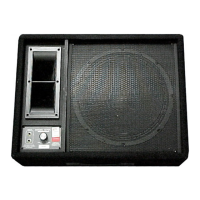
The Fender 1272X / 1275X Loudspeaker Monitor Systems are professional, full-range, two-way, compact loudspeaker monitors designed for both permanent installations and portable sound reinforcement requirements. These systems are crafted to provide a wide response, low distortion, and controlled directivity, making them suitable for a variety of audio applications, from small public address systems to the demanding rigors of a "working band's" sound system for nightly gigs.
One of the key usage features of these monitors is their versatility in placement. They offer three angles of orientation: 30°, 60°, and a vertical position for side fill use. This adaptability allows performers to optimize the sound projection based on their working distance from the monitor and their movement on stage. A 30-degree angle is ideal for performers who require a greater working distance and need to move around the stage while staying on axis with the monitor. Conversely, a 60-degree angle is better suited for performers with a shorter working distance who do not move as much. For larger movements or specific stage setups, the monitors can be used as side fill monitors, providing wide horizontal coverage. When used in the side fill position, elevating the speaker from the floor to aim it at the performer's ear level can be advantageous. This side fill position is particularly useful for drummers and keyboard players, typically placed 10 to 15 feet away, allowing for program monitoring while keeping the monitor area clear of equipment. In this setup, the drummer's or keyboardist's vocal microphone can be positioned to the side, ensuring the rear of the microphone faces the front of the monitor to minimize feedback.
The 1272X / 1275X monitors incorporate high-current 1/4" phone jacks, which are wired in parallel. This design allows any one of the jacks to be used as an input and the other as an output, facilitating "daisy chaining" of multiple loudspeakers. This eliminates the need for several long, cumbersome runs of speaker cable, simplifying setup and reducing clutter. A level control is also integrated into the cabinet, allowing for convenient adjustment of levels directly at the monitor. It is important to note that when operating with large amplifiers (greater than 150 watts at 4 ohms), the level control should always be set between the 3 o'clock and 5 o'clock positions to prevent overheating and potential damage to the control.
When connecting the amplifier to the loudspeaker, a minimum 16-gauge wire is recommended for lengths of no more than 100 feet. For multiple speakers daisy-chained together or longer cable runs, a larger gauge wire should be used. While using too small a gauge of wire will not cause harm, it may degrade sound quality and level. The manual also provides detailed guidance on speaker wiring and connections, explaining parallel and series impedance. It emphasizes that parallel connections are generally recommended because if one speaker fails, the others will continue to operate, and most speaker cabinets are already wired for parallel connections. The importance of well-made and carefully maintained cables is highlighted, as they are common sources of sound system failure. For long speaker cables, ensuring the cable's gauge is sufficient to transfer all available amplifier power to the speakers, rather than absorbing it, is crucial. Larger wires (smaller gauge numbers) are generally better for conducting more power.
The construction of the 1272X / 1275X monitors emphasizes durability and longevity. They feature all-wood construction with sturdy dado joints, which contribute to their robust build. Metal corners and rubber feet are included for added protection and stability, ensuring a longer life and lasting aesthetic appeal. The monitors are covered in a tough, black indoor/outdoor synthetic carpet, designed for long life and good looks. This carpet covering is applied after moisture sealing, further enhancing the durability of the enclosures.
Maintenance of these monitors is straightforward. For the carpet covering, simple vacuuming can remove smudges or dirt. For more stubborn stains, a light soapy solution or carpet shampoo can be used with a brush. It is important to avoid spilling liquids on the input panel, grille, and speakers to prevent damage.
Finally, a crucial consideration for usage is the presence of strong magnetic fields produced by almost all speakers. These fields can interfere with the normal operation of nearby electronic devices, such as televisions and computer video monitors. To mitigate this interference, it is recommended to increase the distance between the monitor and other nearby electronic devices. The Fender 1272X / 1275X Loudspeaker Monitor Systems are designed to be reliable and effective tools for sound reinforcement, built with attention to detail and quality components to provide years of trouble-free service.
 Drivers
| low frequency driver | 12" (30.5 cm) woofer |
|---|---|
| voice coil diameter | 2" (5.1 cm) |
| high frequency driver | Dual Piezoelectric |
Frequency and Sensitivity| frequency response | 60 Hz to 20kHz +/- 6 dB |
|---|---|
| sensitivity | 95 dB @ 1W/1m |
 Power
Power| power rating | 200W program |
|---|---|
| EIA power rating | 100W EIA RS 426A |
| nominal impedance | 16Ω |
 Weight and Dimensions
| height | 17.3" (43.9 cm) |
|---|---|
| width | 22.2" (56.4 cm) |
| depth | 13.8" (35.1 cm) |
| weight | 37 lbs. (16.8 kg) |
Drivers| low frequency driver | 15" (38 cm) woofer |
|---|---|
| voice coil diameter | 2" (5.1 cm) |
| high frequency driver | Dual Piezoelectric |
Frequency and Sensitivity| frequency response | 50 Hz to 20kHz +/- 6 dB |
|---|---|
| sensitivity | 95 dB @ 1W/1m |
Power| power rating | 200W program |
|---|---|
| EIA power rating | 100W EIA RS 426A |
| nominal impedance | 16Ω |
Weight and Dimensions| height | 19.2" (48.8 cm) |
|---|---|
| width | 25.2" (64.0 cm) |
| depth | 15.8" (40.1 cm) |
| weight | 47 lbs. (21.4 kg) |

 To Next Page