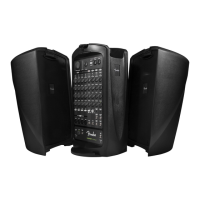
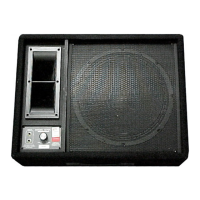
The Fender XP Series Loudspeaker Systems, including models XP 110, XP 112, and XP 115, are professional, full-range, two-way, compact loudspeakers designed for demanding permanent or portable sound reinforcement applications. These systems are built by Fender Musical Instruments Corporation, a company with extensive experience in creating quality musical instruments and sound reinforcement equipment. Fender emphasizes the importance of sound reinforcement in connecting performers with their audience and views the sound system as an integral part of the audio chain, deserving special care and attention.
Function Description:
The XP Series Loudspeaker Systems are designed to provide clear and effective sound reinforcement. They can be used as standalone two-way systems or as the mid/high pack in a three-way setup when combined with a Fender 115sA or 118sA subwoofer loudspeaker system. Their trapezoidal shapes make them suitable for various configurations, from small public address systems to the rigorous demands of a working band's sound system. The systems are equipped with 1/4" phone jacks wired in parallel, allowing for "daisy chaining" of multiple loudspeakers. This feature simplifies wiring by eliminating the need for multiple long speaker cables. For more complex setups, an external crossover can be used with two channels of power amplification—one for low frequencies and another for high frequencies—when the XP enclosures are used as the mid/high pack in a larger three-way loudspeaker array.
Important Technical Specifications:
General:
- Cabinet Construction: 3/4" Birch Plywood, covered in tough synthetic indoor/outdoor black carpet.
- Durability Features: Rugged metal grille, metal corners, and rubber feet for extended life and lasting appearance.
- Connections: (2) 1/4" Phone Jacks per model.
- Horizontal Coverage Angle: 70° (horn).
- Vertical Coverage Angle: 35° (horn).
- Nominal Impedance: 8Ω for all models.
XP 110-XP:
- Part Number: 071-1100-100
- Maximum dB SPL Output Long Term: 120 dB
- Low Driver: 10" (25.4 cm) woofer with a 2" (5 cm) voice coil.
- High Driver: 1" (2.5 cm) Exit Throat Polymer Diaphragm, Dual Piezoelectric Driver.
- Frequency Response (+/- 3 dB): 65 Hz to 20kHz
- Axial Sensitivity (1W/1m): 94 dB
- Power Rating: 100W
- Dimensions:
- Height: 20.25" (51 cm)
- Width (front): 14.6" (37 cm)
- Width (rear): 6.4" (16 cm)
- Depth: 15.6" (40 cm)
- Weight: 37 lbs. (16.7 kg)
XP 112-XP:
- Part Number: 071-1200-100
- Maximum dB SPL Output Long Term: 121 dB
- Low Driver: 12" (30.5 cm) woofer with a 2" (5 cm) voice coil.
- High Driver: 1" (2.5 cm) Exit Throat Polymer Diaphragm, Dual Piezoelectric Driver.
- Frequency Response (+/- 3 dB): 60 Hz to 20kHz
- Axial Sensitivity (1W/1m): 95 dB
- Power Rating: 100W
- Dimensions:
- Height: 21.25" (54 cm)
- Width (front): 18" (46 cm)
- Width (rear): 6.4" (16 cm)
- Depth: 18.4" (47 cm)
- Weight: 50 lbs. (22.7 kg)
XP 115-XP:
- Part Number: 071-1500-100
- Maximum dB SPL Output Long Term: 121 dB
- Low Driver: 15" (38.1 cm) woofer with a 2.5" (6.35 cm) voice coil.
- High Driver: 1" (2.5 cm) Exit Throat Polymer Diaphragm, Dual Piezoelectric Driver.
- Frequency Response (+/- 3 dB): 60 Hz to 20kHz
- Axial Sensitivity (1W/1m): 95 dB
- Power Rating: 150W
- Dimensions:
- Height: 23.8" (60 cm)
- Width (front): 20.9" (53 cm)
- Width (rear): 8.4" (21 cm)
- Depth: 19.6" (50 cm)
- Weight: 58 lbs. (26.3 kg)
Usage Features:
- Speaker Wiring: The manual details two basic ways to connect multiple speakers: parallel and series. Fender recommends parallel connections for several reasons: if one speaker fails, others continue to operate; it avoids unpredictable frequency response issues that can arise in series connections; and most speaker cabinets are already wired for parallel connections.
- Cable Recommendations: Emphasis is placed on using well-made and carefully maintained power and audio signal cables to ensure system reliability. For long speaker cable runs, it's crucial to use a sufficient gauge to transfer amplifier power effectively. Larger wires (smaller gauge numbers) are generally better. Charts are provided for recommended speaker wire gauges based on length and impedance.
- Setup Suggestions:
- Horizontal Coverage: The speaker's placement should optimize horizontal coverage, whether used as a single unit, a pair, or part of a widely spaced group. Examples of "loose pack" arrays are shown for maximum horizontal coverage.
- Minimizing Overlapping Patterns: When setting up, users should place cabinets to minimize overlapping radiating patterns.
- Feedback and Bass Performance: Placing a speaker near a large, flat wall can increase bass output by approximately 6 dB but may also cause feedback. If feedback occurs, the speaker should be moved.
- Aesthetics: For permanent installations, consideration should be given to how visible the speakers are, as placement affects both their tone and radiating patterns.
- "Daisy Chaining": The 1/4" jacks are wired in parallel, allowing one connector to serve as an input and another as an output. This enables "daisy chaining" multiple loudspeakers, reducing the need for numerous long speaker cables. Diagrams illustrate how to connect XP Series enclosures with Fender pole mounts and 115sA/118sA subwoofers.
- Electronic Crossover Use: Instructions and diagrams are provided for using an electronic crossover with XP Series enclosures, particularly when integrating them into a larger three-way system with subwoofers and separate amplification for low and high frequencies.
Maintenance Features:
- Carpet Covering Care: The XP Series cabinets are covered in a tough, soil-resistant synthetic indoor/outdoor carpet. To clean the carpeted cabinet, a brush can be used to wipe away smudges or dirt. For stubborn stains, a sponge with a light soapy solution may be used. Users are advised to avoid spilling liquids on the input panel, grille, and speakers.
- Magnetic Fields Caution: Almost all speakers produce strong magnetic fields that can interfere with nearby electronic devices like televisions and computer video monitors. To reduce or eliminate interference, users should increase the distance between the loudspeaker and other electronic devices.

 Need help?
 General

 To Next Page