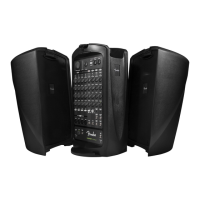
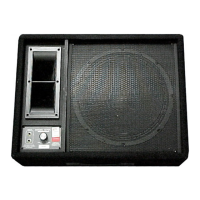
The Fender Tour Series Loudspeaker Systems, specifically models 2912(c) and 2915(c), are professional, full-range, two-way, compact loudspeakers designed for demanding concert sound and sound contracting requirements. These systems are part of Fender's Pro Audio line, emphasizing sound reinforcement for various musical applications, from small jams to full-size concert tours.
Function Description:
The 2912(c) and 2915(c) loudspeakers are designed to provide high-quality sound reinforcement. They can operate in a normal passive crossover mode or a bi-amp mode, offering flexibility for different sound system configurations. In passive mode, the internal 4th Order Linkwitz-Riley crossover manages the frequency division. In bi-amp mode, the internal crossover and high-frequency attenuator are bypassed, requiring an external electronic crossover and two channels of power amplification (one for low frequencies and one for high frequencies). For systems requiring a subwoofer, a three-way electronic crossover can be used, integrating the 2912(c)/2915(c) as the mid/high pack with a 118s(c) or 215s(c) subwoofer. The speakers feature a Controlled Dispersion™ horn, which allows for adjustable horizontal coverage patterns (60° or 90°) through the use of horn inserts. This adaptability makes them suitable for various array configurations, from single units to tightly packed multi-cabinet arrays. The "c" versions of these models are covered in a rugged black carpet with metal corners and feet, while the standard versions are painted with an environmentally friendly tough black finish and are reinforced for flying applications using Fender RigSafe™ rigging and flying hardware.
Important Technical Specifications:
- Models: 2912(c) and 2915(c)
- Cabinet Construction: 3/4" (1.9 cm) 13-ply Baltic birch
- Crossovers: 2000 Hz 4-pole low pass with phase compensation network, 2000 Hz 4-pole high pass (internal passive Linkwitz-Riley)
- Connections: (2) 1/4" Phone Jacks, (2) 4-pole Speakon™ Connectors (wired in parallel for daisy-chaining in normal mode)
- Drivers (2912(c)):
- Low: 12" (30.5 cm) cast frame woofer, 2.5" (6.4 cm) voice coil, 80 ounce (2.3 kg) magnet, 8Ω nominal impedance
- High: 1" Exit Throat Polymer Diaphragm, 2" (5 cm) voice coil, 38 ounce (1.1 kg) magnet, 16Ω nominal impedance
- Drivers (2915(c)):
- Low: 15" (38.1 cm) cast frame woofer, 3" (7.6 cm) voice coil, 80 ounce (2.3 kg) magnet, 8Ω nominal impedance
- High: 1" Exit Throat Polymer Diaphragm, 2" (5 cm) voice coil, 38 ounce (1.1 kg) magnet, 16Ω nominal impedance
- Frequency Response (Axial +/- 3 dB):
- 2912(c): 60 Hz to 18 kHz
- 2915(c): 56 Hz to 18 kHz
- Axial Sensitivity (SPL @ 1W/1m):
- 2912(c): 97 dB
- 2915(c): 98 dB
- Maximum dB SPL Output Long Term:
- 2912(c): 120 dB
- 2915(c): 121 dB
- Power Handling (EIA RS 426-A Noise):
- 2912(c): 150W for 8 hours (Program: 300W, Peak: 600W), Woofer: 300W program, Compression: 80W program
- 2915(c): 200W for 8 hours (Program: 400W, Peak: 800W), Woofer: 400W program, Compression: 80W program
- Nominal Impedance: 8Ω
- Dimensions (2912(c)):
- Weight: 73 lbs. (33 kg)
- Height: 25.6" (65 cm)
- Width (front): 21.9" (55.6 cm)
- Width (rear): 9" (22.8 cm)
- Depth: 19.5" (50 cm)
- Dimensions (2915(c)):
- Weight: 75 lbs. (34.1 kg)
- Height: 26.8" (68 cm)
- Width (front): 21.9" (55.6 cm)
- Width (rear): 9" (22.8 cm)
- Depth: 19.5" (50 cm)
Usage Features:
- Flexible Connectivity: The parallel wiring of 1/4" jacks and Speakon™ connectors allows for easy "daisy chaining" of multiple loudspeakers, reducing the need for long cable runs.
- Bi-Amp Capability: A switch on the back of the speaker allows users to select between normal passive crossover operation and bi-amp mode, providing advanced control over the sound system. When in bi-amp mode, an external electronic crossover (such as Fender PCN-2 or PCN-4) is required, and the crossover frequency for both models should be set at approximately 2000 Hz.
- Adjustable Horizontal Coverage: The Controlled Dispersion™ horn allows the horizontal coverage pattern to be changed from 90° to 60° by adding or removing horn inserts. This feature is crucial for optimizing sound dispersion in various setups, from wide-coverage single units or "loose pack" arrays to narrower, consistent coverage for "tight-pack" multi-cabinet arrays.
- Rigging Compatibility: The standard 2912/2915 models are reinforced for flying applications and are compatible with Fender RigSafe™, JBL S.A.F.E.™, and ATM Flyware™ rigging systems, enabling safe overhead installation. The "c" versions are not designed for flying.
- Cabinet Design: The trapezoidal shape of the cabinets is scientifically derived for optimal acoustic performance and array integration. The Baltic birch construction ensures durability and sound quality.
- Placement Considerations: Proper speaker placement is emphasized to optimize sound and prevent feedback. Placing speakers near a large, flat wall can increase bass output by approximately 6 dB, which can be beneficial for line-level sources but may cause feedback with other sources.
Maintenance Features:
- Durable Finish: The standard models feature an environmentally friendly tough black paint finish for long life, while the "c" versions are covered in rugged black carpet with metal corners for added protection.
- User Inspection (for flying applications): For models used in flying applications (2912/2915 only), periodic inspection of the cabinet's structure, including joints fastened with glue and/or screws, is crucial to ensure continued safety and prevent weakening. This is particularly important due to the potential for serious injuries or fatalities if a suspended cabinet falls.
- Horn Insert Management: The horn inserts are designed for easy removal and installation, allowing users to adjust the dispersion pattern as needed. If an insert has a plug, it can be carefully cut off with a razor blade for easier installation.
- Magnetic Field Caution: Users are advised that almost all speakers produce strong magnetic fields that can interfere with nearby electronic devices like televisions and computer video monitors. Increasing the distance between the speakers and such devices can reduce or eliminate interference.

 Need help?
 General

 To Next Page