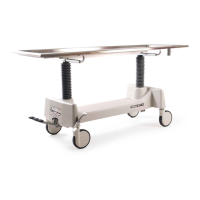
The Ferno Model 101-H Hydraulic Operating Table is a specialized device designed for professional use in mortuary services, providing an adjustable surface for various procedures such as autopsy, embalming, dressing, and transfer. This manual outlines its operation, maintenance, and safety information to ensure proper and safe use.
Function Description
The Model 101-H Operating Table serves as a versatile and adjustable platform for handling human remains in a mortuary setting. Its primary function is to provide a stable, height-adjustable, and tiltable surface, facilitating the work of mortuary professionals. The table is equipped with a stainless-steel top, an extra-deep trough around its perimeter, and a drain, all designed to manage fluids effectively during procedures. The table's base incorporates two hydraulic jacks, which are operated by foot pedals, allowing for precise control over the table top's height and tilt. Additionally, a wheel-locking system, also controlled by a foot pedal, ensures the table remains stationary or allows for straight-line rolling as needed.
Usage Features
The table's design emphasizes ease of use and adaptability to various mortuary procedures.
- Adjustable Height and Tilt: The hydraulic system, controlled by foot pedals, allows operators to raise and lower the table top to a desired working height. This feature is crucial for ergonomic positioning during long procedures, reducing strain on the operator. The left foot pedal is used to raise both jacks simultaneously. To lower the table top, both the center and right foot pedals must be pushed down at the same time. The table also offers a tilting function, allowing the drain end to be lowered to facilitate fluid drainage. This is achieved by pushing down the right pedal a short distance at a time. To return the table to a level position, the center pedal is pushed down. It is important to tilt the table gradually to prevent a body from sliding off.
- Wheel-Locking System: The table is fitted with four locking wheels, controlled by a single wheel-lock pedal located at the operator end. This pedal offers three positions:
- Locked: Pushing the operator-end of the pedal down locks all four wheels, preventing them from rolling or swiveling. This ensures maximum stability during procedures.
- Unlocked: Positioning the pedal in the intermediate position unlocks all four wheels, allowing the table to be freely rolled and swiveled for easy repositioning.
- Straight-Line Rolling: Pushing the drain-end of the pedal down fixes one wheel at the drain end in-line with the table's length. This feature aids in moving the table in a straight line, which can be particularly useful when navigating hallways or confined spaces.
- Table Top Design: The table top is constructed from Type 304 stainless steel, known for its durability, corrosion resistance, and ease of cleaning. The extra-deep trough around the perimeter and the integrated drain are critical for containing fluids, maintaining a hygienic work environment, and simplifying cleanup after procedures.
- Body Positioning: While specific protocols may vary, the general guideline for positioning a body on the table involves placing the head at the operator end and the feet at the drain end. The adjustable features of the table allow for optimal positioning to suit the specific requirements of each procedure.
- Assembly: The table is shipped in two separate cartons (table top and table base with cover) and requires assembly. The process involves securing the table top to the hydraulic jacks on the base using provided hardware. Two people are recommended for lifting the table top during assembly. Prior to attaching the table top, the jacks should be raised to their full height using the left foot pedal to provide easier access.
- Safety and Instruction Labels: The table features a safety and instruction label that provides critical information, including load limits, warnings against improper use, and a visual guide to pedal operation. Users are reminded that this label is not a substitute for reading the full manual.
Maintenance Features
Regular maintenance is essential for the longevity, safe operation, and hygienic condition of the Ferno Model 101-H Operating Table. The manual provides a comprehensive maintenance schedule and instructions for various tasks.
- Maintenance Schedule: A minimum maintenance schedule is provided, recommending disinfecting and cleaning after each use, and inspecting the table as needed and monthly. Maintaining detailed maintenance records is encouraged, with a sample record sheet included in the manual.
- Disinfecting and Cleaning the Table Top:
- Disinfecting: All surfaces of the table top should be wiped with a suitable disinfectant, following the manufacturer's instructions for application method and contact time. Operators are advised to inspect the table top for damage during this process.
- Cleaning: The stainless steel table top should be hand cleaned with warm water and a mild detergent, rinsed well with clear water, and then dried with a towel or allowed to air-dry.
- Important Cleaning Notes: It is crucial to avoid using cleaning solvents on the table-base cover, as these can damage the ABS plastic. Similarly, disinfectants and cleaners containing bleach, phenolics, or iodines should not be used on the table top, base, or base cover, as they can cause damage. Abrasive applicators or cleaners in any form are also prohibited to prevent damage to the table's surfaces.
- Disinfecting and Cleaning the Table-Base Cover:
- Disinfecting: The table-base cover, made of ABS plastic, should be disinfected with a disinfectant suitable for this material.
- Cleaning: The ABS plastic table-base cover should be hand washed with a mild detergent and warm water, rinsed well, and dried with a towel.
- Lubrication: The table is designed with parts that do not require lubrication. It is explicitly stated that no part of the table top, wheels, jacks, or base should be lubricated, as this can lead to dirt and foreign particles accumulating, causing damage.
- Inspecting the Table: Regular inspections by service equipment maintenance personnel are recommended. A checklist is provided to ensure all components are present, free of excessive wear, and securely in place. The inspection also verifies that all moving parts, pedals, and the wheel-locking system operate smoothly and properly, and that the table raises, lowers, and tilts correctly. If any damage or excessive wear is found, the table should be removed from service until repairs are made.
- Troubleshooting: The manual includes a troubleshooting section to address common issues, such as the table not raising to maximum height or hydraulics sticking. Solutions often involve specific pedal operations or contacting customer relations for more complex hydraulic problems.
- Parts and Service: For parts orders or professional repair, users in the U.S.A. and Canada are directed to EMSAR®, the authorized agent. International users should contact their Ferno distributor. The manual emphasizes using only Ferno parts and Ferno-approved service to prevent injury and damage, and warns against modifying the table. Parts diagrams and a parts list are provided to assist with identification and ordering.


 To Next Page
 General