
 Need help?
Do you have a question about the Ferroli RVL 16 Series and is the answer not in the manual?
Covers general operational rules, compliance, and safety precautions for unit installation and use.
Details of the unit's identification plate, including model, serial number, and technical data.
Explains the coding system used to identify different unit models and versions.
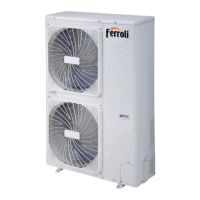
Detailed description of the key physical components of the unit, such as fans and heat exchangers.
Overview of the unit's internal hydraulic and chilling circuit components.
Overview of the unit's internal electrical circuit components and layout.
Technical data and specifications specifically for the IR units operating in cooling mode.
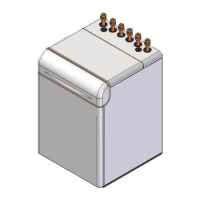
Technical specifications for the Storage and Pumping Module accessory when used with IR units.
Technical data and specifications for the IP units operating as heat pumps.
Technical specifications for the Storage and Pumping Module accessory when used with IP units.
Details on physical accessories like pumps, brackets, and grilles that can be added to the unit.
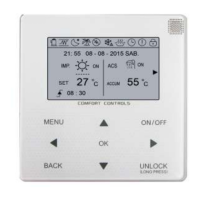
Information on electrical accessories such as remote controls and programmer clocks.
Table showing which accessories are compatible with different unit models.
Procedures for checking the unit upon delivery and adhering to safety guidelines.
Instructions for safely moving, handling, and storing the unit to prevent damage.
Physical dimensions, weights, and connection sizes for the unit and its modules.
Specifies the necessary clearances around the unit for proper ventilation and maintenance.
Overview of the unit's electrical panel, its components, and their layout.
Guidance on making external electrical connections for accessories and power supply.
Detailed wiring diagrams for single-phase unit models.
Detailed wiring diagrams for three-phase unit models.
Best practices for planning and installing the unit's hydraulic circuit, including pipe sizing and support.
Instructions for hydraulic connections when the unit is not used with a pumping module.
Instructions for hydraulic connections when the unit is used with a pumping module.
Visual representation of the hydraulic connections for the unit with and without the pumping module.
Procedures for filling the system with water or brine and preventing freezing during downtime.
Instructions for installing quick wet couplings for connecting the unit to the system.
Instructions for installing flexible wet couplings for connecting the unit to the system.
Graphs illustrating water pressure drop based on flow rate for units without the Pumping Module.
Graphs showing useful head values for models 16-19-24-30 with Storage and Pumping Module.
Graphs showing useful head values for models 38-42-50 with Storage and Pumping Module.
Defines the guaranteed operating conditions for cooling and heating modes.
Information on calculating the total water volume the system can hold under various conditions.
Description of the unit's control interface, display, and status LEDs.
How to read sensor data from probes and view it on the unit's display.
Instructions for selecting operating modes (cool/heat) and turning the unit ON/OFF.
Instructions for adjusting the desired temperature set-points for cooling or heating.
Information on system alarms, fault codes, and procedures for resetting the unit.
Explanation of the unit's menu system structure and how to navigate through it.
Procedures for initial unit setup and commissioning by authorized technicians.
Recommended schedule and tasks for basic user maintenance inspections.
Overview of safety risks, environmental considerations, and pollution control measures.
Guidelines for safe refrigerant handling, leak response, and first aid for exposure.
 General
| Refrigerant | R410A |
|---|---|
| Heating Capacity | 16 kW |
| Cooling Capacity | 14 kW |
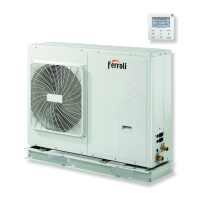
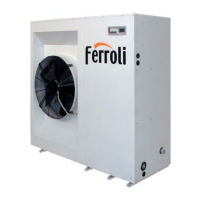
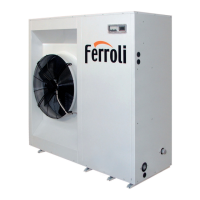
| Type | Air to Water Heat Pump |
| Power Supply | 230V/50Hz |


 To Next Page