registered to the legs, and a Domino mor-
tise and tenon frame-to-leg connection on
both the upper and lower frames to pro-
vide the strength necessary to offset the
leg stress imposed by rolling the unit
around and/or converting it from one
mode to the other.
Let’s see if I can describe and show the
construction details well enough for you
to follow.
We will start with the legs. Like the pre-
vious coffee table, this unit features a
simple cabrio leg that is cut the same way
as the more complicated curved cabrio
leg we saw before. In this case the legs
just flair out in both dimensions so they
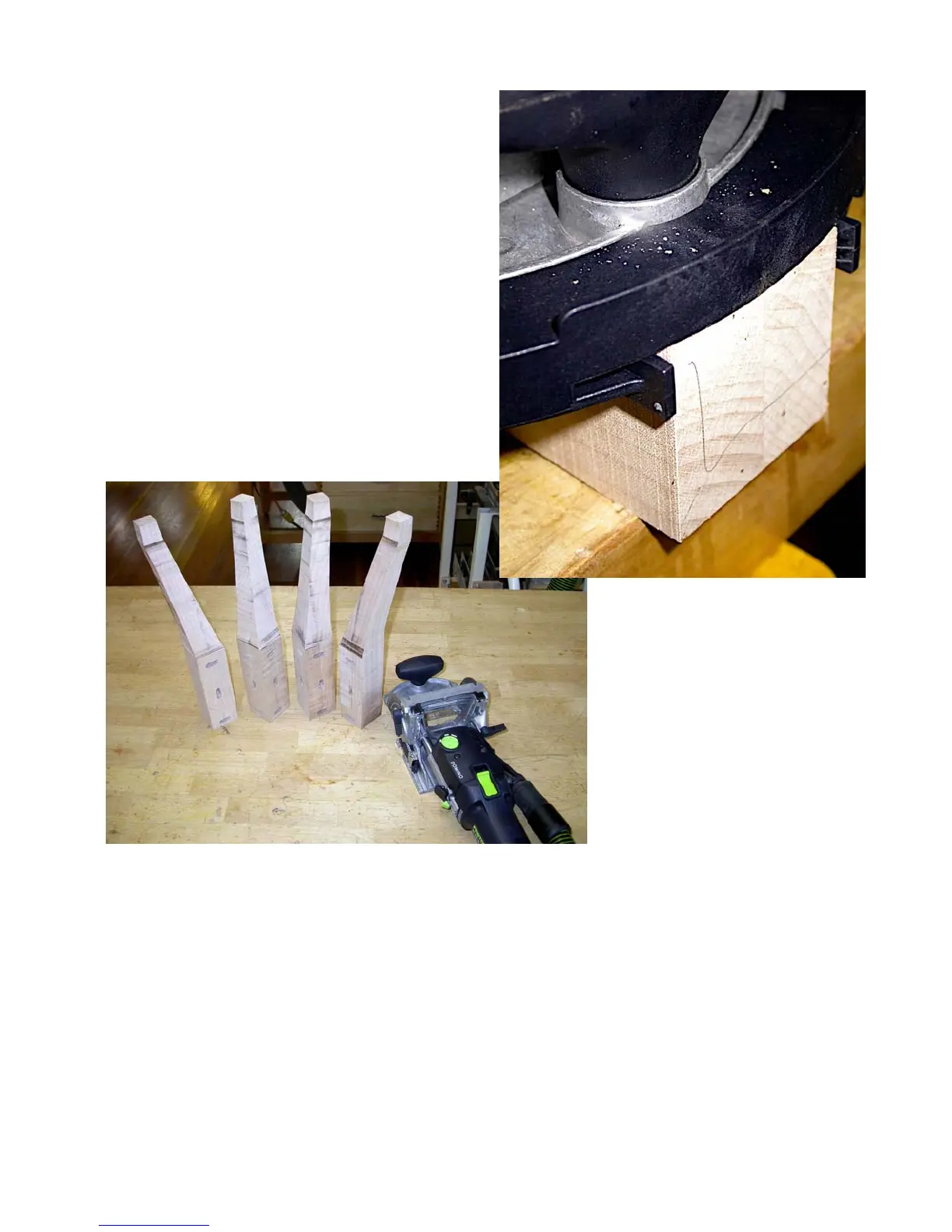
look right in either mode. In this photo
the leg blanks were glued up, a template
used to mark the flair, and a band saw
used to cut the rough shapes shown
here.
This is the same process we used before
except this time I waited to cut the mor-
tises until after the legs were formed be-
cause you can see from the photo that
we need three Domino mor-
tises on each of two sides
of each of four legs. The
upper and lower horizontal
mortises will attach the legs
to the platform frames while
the vertical mortise will at-
tach the skirts to the legs.
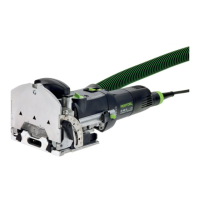
By using the saddle fence
shown in detail above, the
Domino machine can strad-
dle the square part of the leg
to cut the upper mortise from a penciled
reference mark using the same technique
of an adjustable square or story stick to
mark exactly the same distance up from
the end of the legs on both sides of all
four legs.
The lower horizontal mortise is cut with
the leg standing upright on a flat refer-
ence surface and with the Domino base
also sitting on that same flat reference







 To Next Page