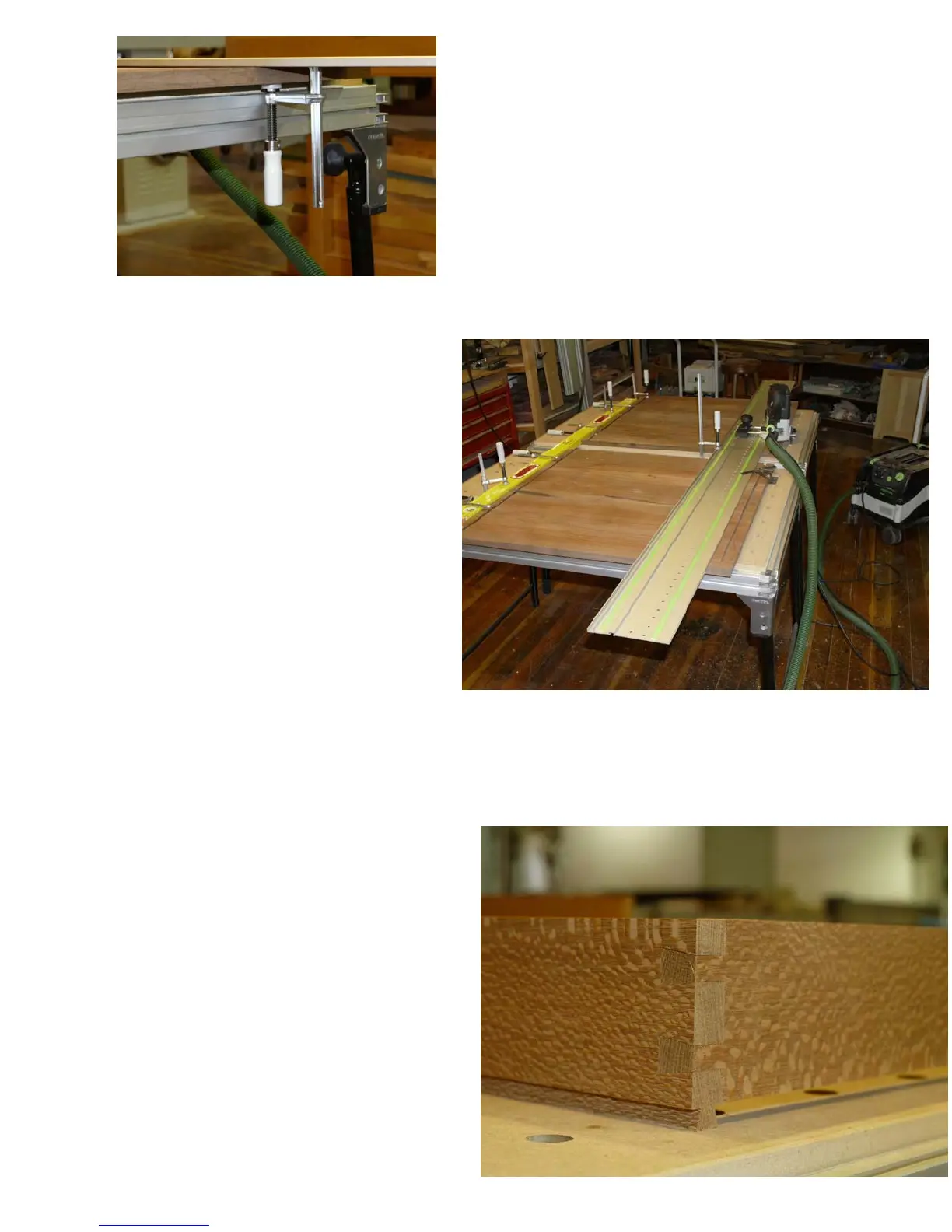
clamp a long Festool guide rail parallel
with my intended line of cut for the slid-
ing dovetail slots that will hold the side
skirts (photo above).
Once the top plates were clamped to
the tables from below, the level was
removed so it would not interfere with
the movement of the router.
After the cuts were made in one side,
the level was replaced to make sure
nothing would move and the guide rail
was repositioned to the other side using
the same adjustable square setting to
insure consistent alignment of the two
skirt sides. They have to be parallel as
will become clear in a moment when we
see how the leg/top plate/skirt assembly
moves relative to the butterfly leaf de-
ployment frame.
The next step is to machine the skirt side
and end pieces from silky oak. Make the
side skirt pieces 10mm taller than you
want the skirt to be to accommodate the
10mm male dovetail you will cut in these
pieces. Match the male to the female
dovetail slot to get a snug, but still easy
slide fit.
The ends of the skirts cannot be affixed
to the top of the table since the top needs
to be able to slide over them as the top
expands and contracts seasonally so
make the end skirt pieces 10mm nar-
rower than the side skirt pieces. Use
through dovetail joints to join the skirt
ends to the sides.
Do not glue these dovetails!
Note that the skirt corner through dove-
tails are cut to be exactly the correct
length. Most books say to cut through
dovetails a bit long and sand them down
later, but in this case the side to side cen-
terline width of the assembled skirt sides
and end must be exactly the same as the
centerline spacing of the two dovetail
Through corner dovetails flushed
at the bottom of skirt (here in-
verted) line up the top of the end
skirt with the bottom of the table


 To Next Page
 Loading...