90) Incorrect fitting of the child restraint
system may result in an inefficient
protection system. In the event of an
accident the child restraint system may
become loose and the child may be
injured, even fatally. When fitting a restraint
system for newborns or children, strictly
comply with the instructions provided
by the Manufacturer.
91) When the child restraint system is not
used, secure it with the seat belt or with
the ISOFIX anchorages, or remove it from
the vehicle. Do not leave it unsecured
inside the passenger compartment. In this
way, in the case of sudden braking or an
accident, it will not cause injuries to the
occupants.
92) Always make sure that the diagonal
section of the seat belt does not pass
under the arms or behind the back of the
child. In the event of an accident the seat
belt will not be able to secure the child,
with the risk of injury, including fatal injury.
Therefore the child must always wear
the seat belt correctly.
93) The figures are only examples for fitting
purposes. Fit the child restraint system
according to the instructions, which must
be included.
94) Car seats for weight groups 0 and 1
feature an anchor in front of the vehicle
safety belts as well as its own belts to
restrain the child. Due to their weight, they
may be dangerous if incorrectly mounted
(e.g. if fastened to the vehicle seat belts
placing a cushion in between). Follow the
assembly instructions carefully.
SETUP FOR
“UNIVERSAL
ISOFIX” CHILD
RESTRAINT SYSTEM
The vehicle is set up for fitting an Isofix
child restraint system.
The ISOFIX system lets you install the
ISOFIX child restraining system quickly,
simply and safely, without using the
car seat belts, but by connecting the
child restrain system directly to the car
seat with three anchors in the vehicle.
Traditional child restraint systems can
be fitted alongside ISOFIX child restraint
systems on different seats in the same
vehicle.
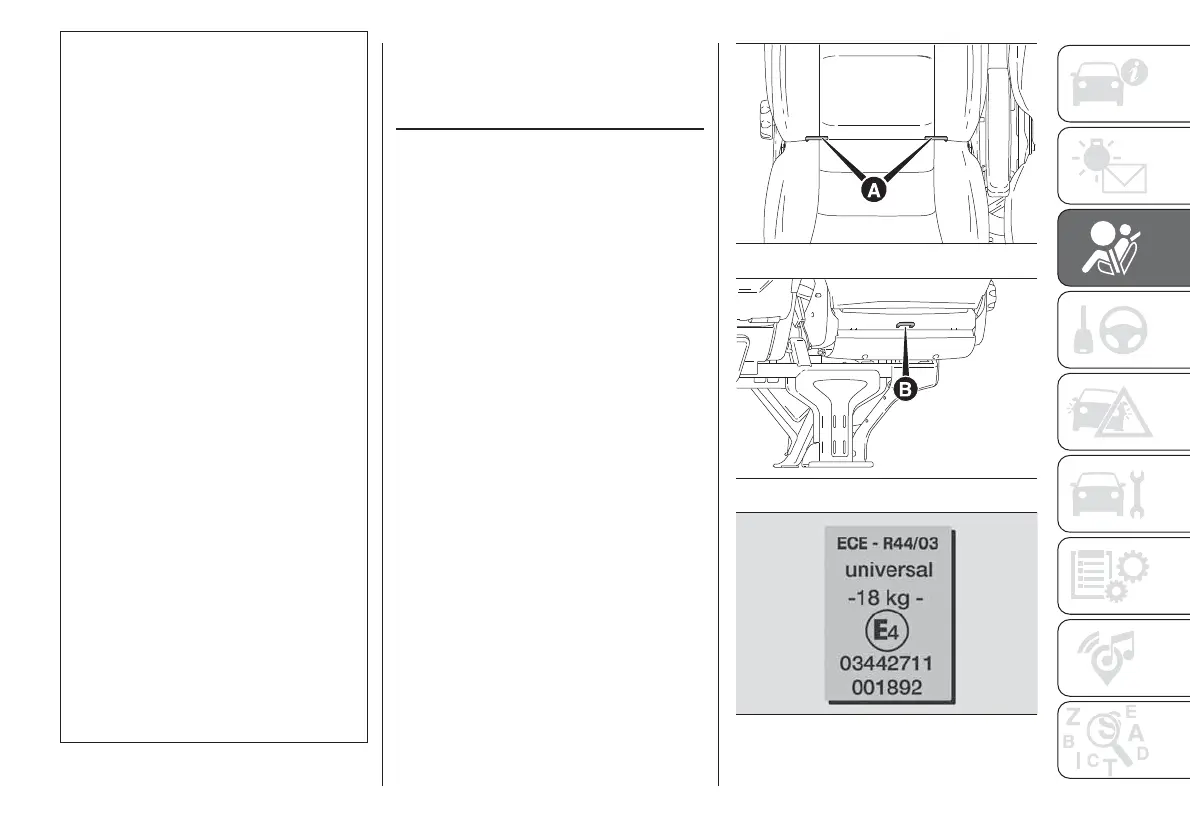
To install an ISOFIX child restraint
system, attach it to the two metal
anchorages A fig. 96 located where the
rear seat cushion meets the backrest,
then fix the upper strap (available
together with the restraint system) to
the dedicated anchorage B fig. 97
located at the bottom behind the
backrest.
As an example, fig. 99 shows an
example of a Universal ISOFIX child
restraint system for weight group 1.
NOTE When a Universal ISOFIX child
restraint system is used, only ECE R44
"ISOFIX Universal” (R44/03 or further
upgrades), type-approved child
restraint systems can be used fig. 98.
96
F1A0156
97
F1A0157
98
F1B0117C
101







 To Next Page