The choice of the most suitable child
restraint system depends on the weight
and size of the child. There are various
types of child restraint systems that can
be secured to the vehicle by means of
the seat belts or with the ISOFIX
anchorages. It is recommended to
always choose the restraint system
most suitable for the child; for this
reason always refer to the Owner
Handbook provided with the child
restraint system, to be sure that it is of
the right type for the children it is
intended for. In Europe the
characteristics of child restraint systems
are ruled by the regulation ECE-R44,
dividing them into five weight groups:
Group Weight groups
Group 0
up to 10 kg in
weight
Group 0+
up to 13 kg in
weight
Group 1 9-18 kg
Group 2 15-25 kg
Group 3 22-36 kg
As you can see, the groups overlap
partly and, in fact, there are devices on
sale that cover more than one weight
group.
All restraint devices must bear the
type-approval data, together with the
control mark, on a label solidly fixed to
the child restraint system which must
never be removed.
Over 1.50 m in height, from the point of
view of restraint systems, children are
considered as adults and wear the seat
belts normally.
Lineaccessori Fiat offers child restraint
systems for each weight group. These
devices are recommended, having
been specifically designed for Fiat cars.
87)
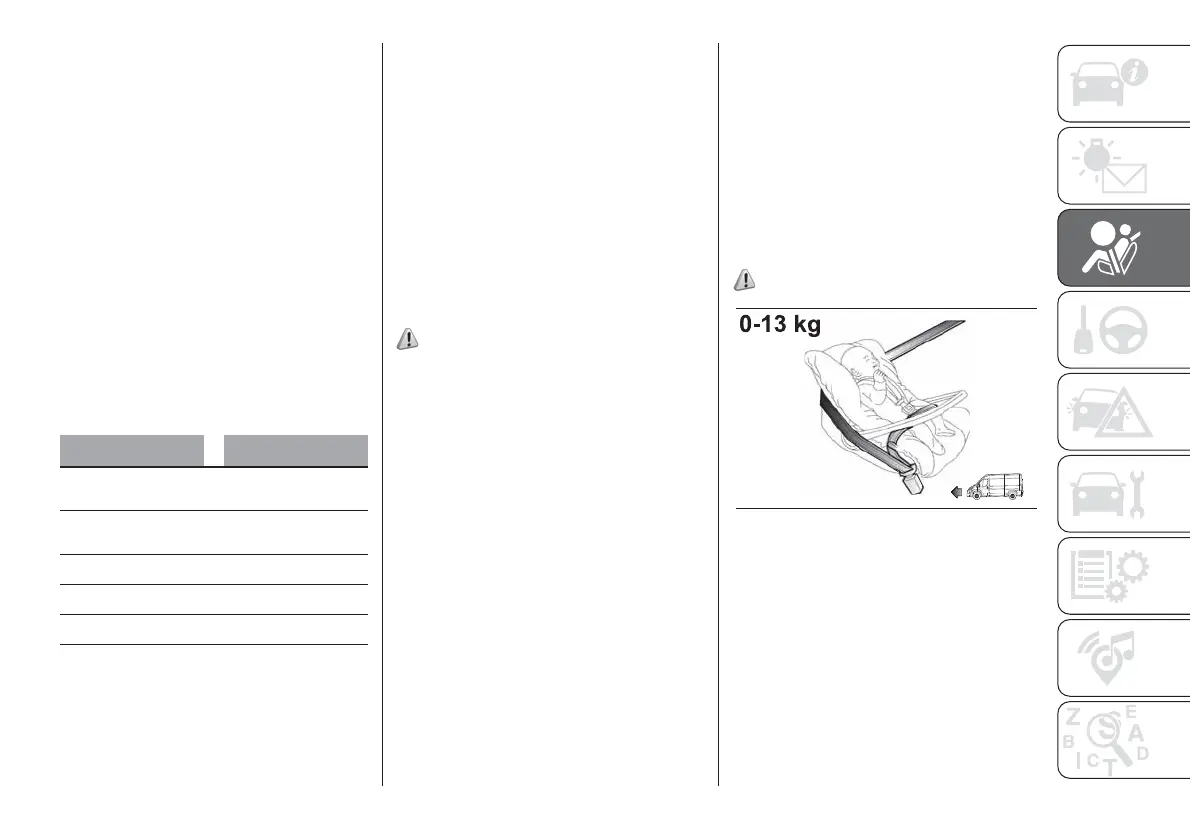
GROUP 0 and 0+
Babies up to 13 kg must be carried
facing backwards on a cradle seat,
which, supporting the head, does not
induce stress on the neck in the event
of sharp decelerations.
The cradle is restrained by the vehicle's
seat belts, as shown in fig. 92 and it
must restrain the child in turn with
its own belts.
88) 89) 90) 91) 92) 93) 94)
92
F1A0151
97







 To Next Page