Need help?
Do you have a question about the Fibocom NL668-EAU-MiniPCIe-10 and is the answer not in the manual?
Provides an overview of the NL668-EAU/EU-MiniPCIe-10 module's capabilities and purpose.
Outlines essential safety guidelines for handling and operating the module to prevent harm and damage.
Lists the industry standards and specifications the product design complies with.
References other relevant documentation for further information on the module and its applications.
Introduces the NL668-EAU/EU-MiniPCIe-10 series as a broadband wireless terminal product.
Details the technical specifications including operating frequency, data transmission, power, and temperature.
Illustrates the main functions and connections of the MiniPCIe module.
Defines the 52-pin PCI express Mini Card interface for module connectivity.
Describes the power supply requirements, design, and consumption characteristics of the module.
Explains the control signals, including the module reset function and its reference circuit.
Details the USB 2.0 interface capabilities, including high-speed and full-speed support.
Covers the (U)SIM card interface, including pin definitions, circuit design, and hot plug functionality.
Describes the main and debug UART serial ports, their definitions, and application circuits.
Explains the module status indication pin and the NET_MODE signal for network status.
Details methods for entering flight mode and various sleep modes for power saving.
Describes the digital audio interface (PCM) including supported models and signal definitions.
Lists the operating frequency bands supported by the module for different technologies.
Specifies the transmission power (dBm) for various bands and modes.
Details the receiving sensitivity (dBm) for different bands and modes.
Describes the GNSS receiver capabilities, current consumption, TTFF, and sensitivity.
Provides guidelines for antenna installation, including RF connector specifications.
Outlines antenna design requirements and reference designs for optimal performance.
Defines the voltage limits for power and GPIO interfaces to prevent product damage.
Specifies the recommended and limited operating and storage temperature ranges.
Details the logic level voltage characteristics for digital interfaces during operation.
Lists test conditions for environmental reliability, including storage, operation, and vibration.
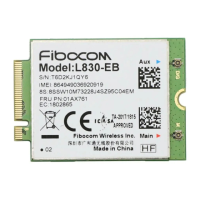
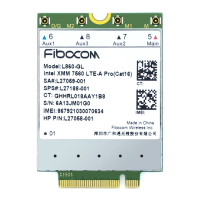
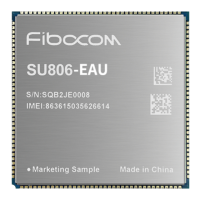
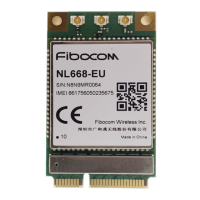
Shows the physical appearance of the NL668-EAU and NL668-EU MiniPCIe modules.
Provides the physical dimensions and layout of the MiniPCIe module.
Describes the tray sealed vacuum packaging and outer box methods for module protection.
 General
| Form Factor | Mini PCIe |
|---|---|
| Data Rate (LTE Uplink) | 50 Mbps |
| Data Rate (WCDMA Downlink) | 42 Mbps |
| Data Rate (WCDMA Uplink) | 5.76 Mbps |
| Operating Temperature | -40°C to +85°C |
| SIM Interface | 1.8V / 3V |
| Module Type | LTE Module |
| Cellular Technology | LTE, WCDMA, GSM |
| Frequency Bands | B1/B3/B5/B7/B8/B20 |
| Interface | PCIe, USB |
| Power Supply | 3.3V |
| GNSS Support | GPS, GLONASS, BeiDou, Galileo |
| Driver Support | Windows, Linux |

 To Next Page