EasyManua.ls Logo

Fibocom L830-EB - User Manual

Fibocom L830-EB
39 pages
Print Icon
To Next Page IconTo Next Page
Loading...
Reproduction forbidden without Fibocom Wireless Inc. written authorization - All Rights Reserved.
L830-EBHardware User Manual Page 1 of 39
L830-EB Hardware User Manual
Version: V1.0.3
Update date: 2017.06.26
Question and Answer IconNeed help?

Do you have a question about the Fibocom L830-EB and is the answer not in the manual?

Summary

1 Preface

1.1 Introduction

Provides an overview of the document's purpose and scope for developers.

1.2 Reference Standard

Lists the industry standards the product design complies with.

1.3 Related Documents

References other documentation relevant to the L830 module.

2 Overview

2.1 Introduction

Introduces the L830 as an integrated 4G cellular module using M.2 interface.

2.2 Specification

Details key technical specifications including bands, data transmission, and physical characteristics.

2.3 Application Framework

Illustrates the peripheral applications and module integration.

2.4 Hardware Framework

Presents the internal hardware architecture including baseband and RF functions.

3 Application Interface

3.1 M.2 Interface

Describes the standard M.2 Key-B interface and its 75 pins.

3.1.1 Pin Map

Provides a detailed pinout map for the M.2 interface.

3.1.2 Pin Definition

Defines each pin of the M.2 interface, including I/O, type, and description.

3.2 Power Supply

Details the power supply requirements and design considerations for the module.

3.2.2 Logic level

Defines the 1.8V and 3.3V logic level parameters for the module.

3.2.3 Power Consumption

Lists the power consumption values under different operating modes.

3.3 Control Signal

Explains the control signals for power on/off and reset operations.

3.3.1 Module Start-Up

Describes the circuits and methods for module start-up.

3.3.2 Module Shutdown

Details the software and hardware methods for shutting down the module.

3.3.3 Module Reset

Explains how to reset the module and the recommended circuit design.

3.4 USB Interface

Covers the USB 2.0 interface compatibility and definition.

3.5 USIM Interface

Describes the USIM card interface, pins, and circuit design.

3.5.3 USIM Hot-Plugging

Explains the SIM card hot-plugging function and its configuration.

3.6 Status Indicator

Details the status indicator signals like LED#1 and WOWWAN#.

3.7 Interrupt Control

Covers interrupt signals such as W_DISABLE1# and Body SAR detection.

3.8 Digital Audio

Explains the I2S and PCM modes for digital audio interface.

3.9 I2 C Interface Description

Describes the I2C master interface for external slave devices.

3.10 Clock Interface

Details the clock interface for outputting a 26MHz clock signal.

3.11 Configuration Interface

Explains the configuration pins for the M.2 module type.

3.12 Other Interfaces

Mentions interfaces not supported by the module.

4 Radio Frequency

4.1 RF Interface

Details the RF connectors, functionality, characteristics, and dimensions.

4.2 Operating Band

Lists the operating frequency bands supported by the module.

4.3 Transmitting Power

Specifies the transmitting power for each supported band.

4.4 Receiver Sensitivity

Provides the receiver sensitivity values for various bands.

4.5 GNSS

States the GNSS support status for the L830-EB-11 module.

4.6 Antenna Design

Outlines the antenna design requirements and considerations for the module.

5 Structure Specification

5.1 Product Appearance

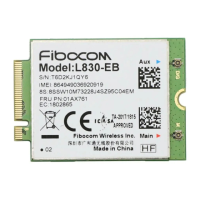
Shows the visual appearance and front/back of the L830 module.

5.2 Dimension of Structure

Provides the detailed physical dimensions of the L830 module.

5.3 M.2 Interface Model

Specifies the M.2 interface model type and pin assignments.

5.5 Storage

Details recommended storage conditions and storage life.

5.6 Packing

Describes the packing methods used for the L830 module.

Summary

1 Preface

1.1 Introduction

Provides an overview of the document's purpose and scope for developers.

1.2 Reference Standard

Lists the industry standards the product design complies with.

1.3 Related Documents

References other documentation relevant to the L830 module.

2 Overview

2.1 Introduction

Introduces the L830 as an integrated 4G cellular module using M.2 interface.

2.2 Specification

Details key technical specifications including bands, data transmission, and physical characteristics.

2.3 Application Framework

Illustrates the peripheral applications and module integration.

2.4 Hardware Framework

Presents the internal hardware architecture including baseband and RF functions.

3 Application Interface

3.1 M.2 Interface

Describes the standard M.2 Key-B interface and its 75 pins.

3.1.1 Pin Map

Provides a detailed pinout map for the M.2 interface.

3.1.2 Pin Definition

Defines each pin of the M.2 interface, including I/O, type, and description.

3.2 Power Supply

Details the power supply requirements and design considerations for the module.

3.2.2 Logic level

Defines the 1.8V and 3.3V logic level parameters for the module.

3.2.3 Power Consumption

Lists the power consumption values under different operating modes.

3.3 Control Signal

Explains the control signals for power on/off and reset operations.

3.3.1 Module Start-Up

Describes the circuits and methods for module start-up.

3.3.2 Module Shutdown

Details the software and hardware methods for shutting down the module.

3.3.3 Module Reset

Explains how to reset the module and the recommended circuit design.

3.4 USB Interface

Covers the USB 2.0 interface compatibility and definition.

3.5 USIM Interface

Describes the USIM card interface, pins, and circuit design.

3.5.3 USIM Hot-Plugging

Explains the SIM card hot-plugging function and its configuration.

3.6 Status Indicator

Details the status indicator signals like LED#1 and WOWWAN#.

3.7 Interrupt Control

Covers interrupt signals such as W_DISABLE1# and Body SAR detection.

3.8 Digital Audio

Explains the I2S and PCM modes for digital audio interface.

3.9 I2 C Interface Description

Describes the I2C master interface for external slave devices.

3.10 Clock Interface

Details the clock interface for outputting a 26MHz clock signal.

3.11 Configuration Interface

Explains the configuration pins for the M.2 module type.

3.12 Other Interfaces

Mentions interfaces not supported by the module.

4 Radio Frequency

4.1 RF Interface

Details the RF connectors, functionality, characteristics, and dimensions.

4.2 Operating Band

Lists the operating frequency bands supported by the module.

4.3 Transmitting Power

Specifies the transmitting power for each supported band.

4.4 Receiver Sensitivity

Provides the receiver sensitivity values for various bands.

4.5 GNSS

States the GNSS support status for the L830-EB-11 module.

4.6 Antenna Design

Outlines the antenna design requirements and considerations for the module.

5 Structure Specification

5.1 Product Appearance

Shows the visual appearance and front/back of the L830 module.

5.2 Dimension of Structure

Provides the detailed physical dimensions of the L830 module.

5.3 M.2 Interface Model

Specifies the M.2 interface model type and pin assignments.

5.5 Storage

Details recommended storage conditions and storage life.

5.6 Packing

Describes the packing methods used for the L830 module.

Fibocom L830-EB Specifications

General IconGeneral
CategoryComputer Hardware
ManufacturerFibocom
ModelL830-EB
Form FactorM.2
Operating Temperature-10°C to +55°C
LTE BandsB1/B3/B5/B7/B8/B20
3G BandsB1/B5/B8
Data RateLTE Cat4: 150Mbps DL / 50Mbps UL
InterfacePCIe, USB 2.0
Operating Voltage3.135V to 4.4V

Related product manuals