
 Need help?
Do you have a question about the FLASHFORGE 3D PRINTER Adventurer 3 and is the answer not in the manual?
Safety guidelines for the working environment.
Safety precautions related to electrical connections and usage.
Safety instructions for the user's well-being during operation.
General warnings and precautions to be observed.
Specifies optimal environmental conditions for printer operation.
Guidelines for physical placement and spacing of the printer.
Recommendations and warnings regarding filament usage.
Best practices for storing filament to maintain quality.
Legal disclaimers and terms of use for the document and product.
Regulatory compliance information regarding FCC rules.
The surface on which the Adventurer 3 builds an object.
Tape on the build plate to help objects stick.
The maximum size of objects the printer can create.
Device that melts and pushes filament onto the build plate.
The part of the extruder where heated filament is squeezed out.
Cools the extruder and gear motor assembly.
A box for placing FlashForge filament.
Tube guiding filament from the box to the intake.
The opening at the top of the extruder for filament.
Adhesive used to improve model adhesion.
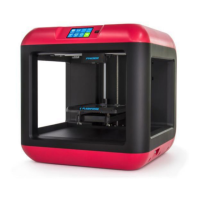
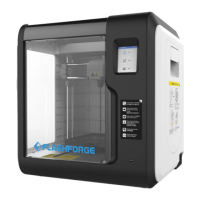
Identifies and labels the physical parts of the Adventurer 3 printer.
Provides technical specifications and details about the Adventurer 3.
Step-by-step instructions for safely removing the printer from its packaging.
Lists and shows all the included accessories with the 3D printer.
Explains the layout and functions of the printer's touch screen interface.
Details how to select and start printing files from various sources.
Accesses printer settings like Network, Preheat, and About.
Guides on connecting the printer via WiFi, Hotspot, or Ethernet.
Instructions for setting the temperature for extruder and build plate.
Accesses printer settings like Status, Language, Calibration, and Move.
How to change the display language of the printer interface.
Process to adjust the initial distance between nozzle and build plate.
Resets the X, Y, and Z axes to their mechanical zero points.
Displays essential printer information like model, serial number, and firmware.
Procedures for loading and changing filament on the printer.
Instructions on initiating and monitoring the 3D printing process.
Step-by-step guide to load filament into the printer.
Methods to transfer 3D model files to the printer (WiFi, Cloud).
Instructions on initiating and monitoring the 3D printing process.
How to safely remove completed prints from the build plate.
Detailed steps for replacing used filament with new filament.
Instructions on using the printer's built-in camera and its modes.
Explains automatic and manual modes for camera and USB stick.
Guide to using the camera via the Polar Cloud platform.
Troubleshooting steps for common camera-related errors.
Methods to clear a clogged 3D printer nozzle.
Step-by-step guide on how to replace the printer's nozzle.
Explains the necessity of recalibration after nozzle replacement.
Troubleshooting steps for abnormal temperature readings post-nozzle change.
Diagnosing and resolving issues when filament fails to extrude.
Instructions for unloading and loading filament.
Steps to remove a finished print from the build plate.
Adjusting nozzle-platform distance for optimal print adhesion.
Information on using third-party filament brands and potential issues.
Details on the printer's AC power input compatibility.
Clarifies if the printer has an auto-shutoff feature after printing.
Lists the supported input and output file formats for the printer.
Information on compatibility with alternative cloud platforms.
Safety considerations for printing with ABS filament.
Solutions for preventing models from warping during printing.
Discusses the necessity and benefits of using rafts for printing.
Troubleshooting a 300°C extruder temperature display after nozzle replacement.
Diagnosing and resolving extruder noise and filament feeding issues.
Clarifies the distinction between filament loading and replacement procedures.
Resolving issues with poor filament adhesion due to incorrect nozzle-plate distance.
Official website for support, solutions, and product information.
Provides phone numbers, QQ, and email addresses for support.
Information on locating and using the printer's serial number for support.
Scannable codes linking to YouTube, Twitter, Facebook, and the official website.
 General
| Build Volume | 150 x 150 x 150 mm |
|---|---|
| Filament Diameter | 1.75 mm |
| Nozzle Diameter | 0.4 mm |
| Print Speed | 10-100 mm/s |
| Printer Dimensions | 388 x 340 x 405 mm |
| Display | 2.8-inch touchscreen |
| Nozzle Temperature | Up to 240°C |
| Connectivity | Wi-Fi, USB |
| Supported Filament Types | PLA, ABS |
| Weight | 9 kg |
| Layer Resolution | 0.1 - 0.4 mm (100 - 400 microns) |

 To Next Page