Camera
Kite
User
Manual
21
Camera Kite Deployment
Safety Rules (in addition to the Kite Safety & Maintenance and General Guidance sections of
this User Manual)
• Always check with your local authority to understand how high and whereabouts your kite may
be fl own since kite fl ying is not permitted everywhere. Kite fl ying regulations are different from
country to country and state to state.
• Your kite reel is supplied with 55 metres (180 feet) of fl ying line as standard. Always fl y in an
open space and ensure your choice of fl ying location is free of buildings, trees, hills and any
other obstacles which can infl uence the wind or get in the path of your kite. Never fl y your kite
near power lines, airports, roads, railway lines etc. Protect fauna and fl ora and do not fl y your
kite on private property unless you have the owner’s permission.
• Be aware of changing weather conditions. Never fl y your kite in the rain or in thunderstorms and
never fl y your kite above water since it will sink and the stabiliser (if installed) will break beyond
repair.
• Spend enough time to become familiar with the use of your kite and remember that you are
responsible for the security and safety of those around you. Never fl y your kite on crowed sites
or where a third party could be injured or feel threatened by the kite and fl ying line. Keep your
kite and fl ying line away from people and other obstacles at all times. When the fl ying line and
the bridle are under tension, they can cut like a knife. Signifi cant heat can result from the line
rubbing. Always wear protective gloves (included with your kite) when touching/handling the
fl ying line and bridle. Never wrap fl ying line around your hands, fi ngers or body.
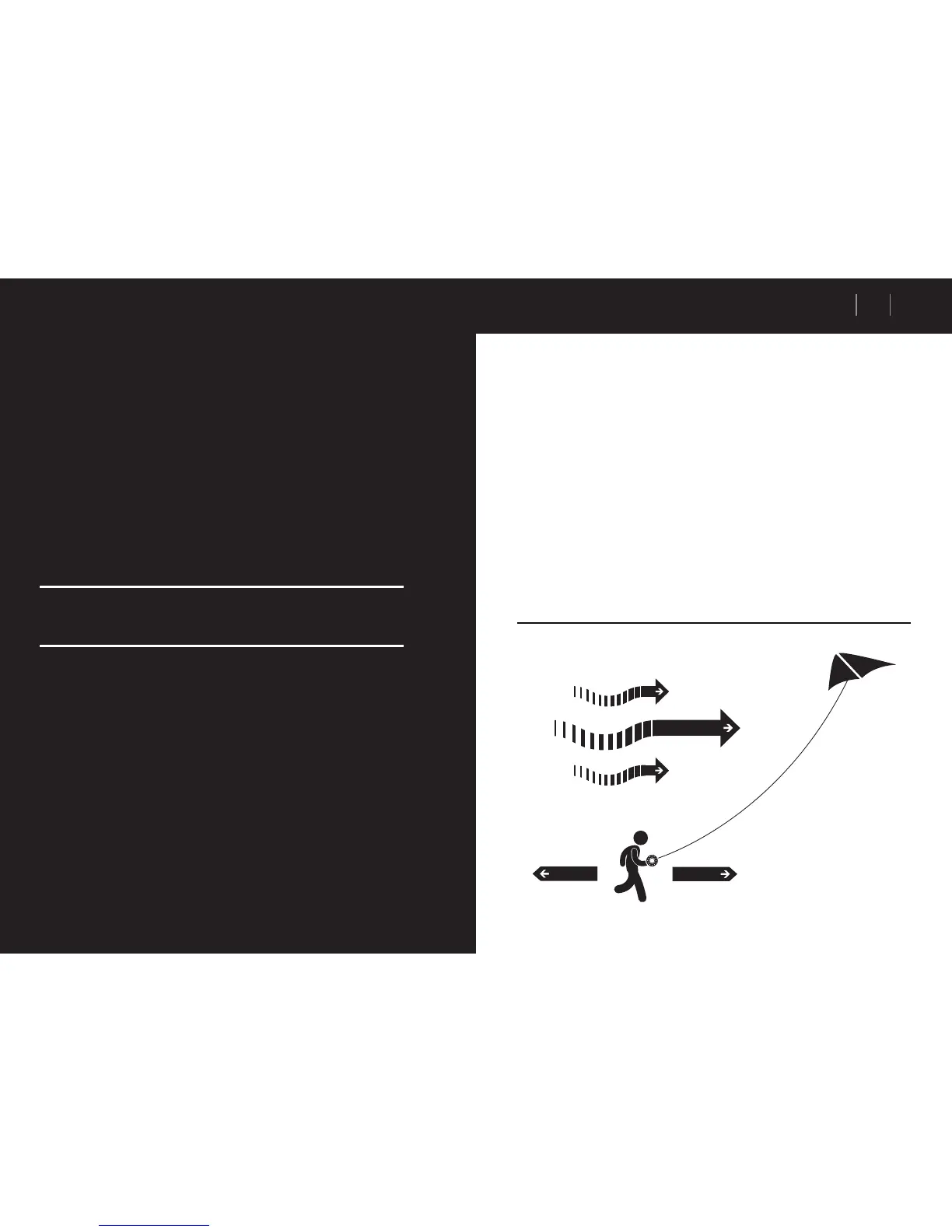
WIND DIRECTION
DOWNWINDUPWIND



 To Next Page