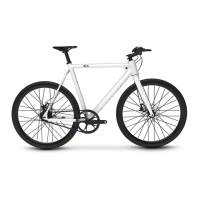
This document is the owner's manual for "The Babymaker" eBike, manufactured by FLX.bike. It provides comprehensive information regarding the assembly, operation, maintenance, and safety of the eBike.
Function Description:
The Babymaker is an electric bicycle designed for general road use. It features a motor that provides assistance, making riding easier, especially for longer distances or uphill climbs. The eBike is equipped with fully operable pedals, allowing it to be ridden like a traditional bicycle, with the added benefit of electric assistance. The manual emphasizes safe and responsible riding, proper assembly, and regular maintenance to ensure optimal performance and longevity.
Important Technical Specifications:
The Babymaker is available in two frame sizes:
- 19" (49cm) Small/Medium:
- Suggested Rider Height: 4'11"-5'8" (150-173 cm)
- Seat Tube Length (Frame Size): 19 Inches (490 mm)
- Reach: 15.2 Inches (388 mm)
- Standover Height: 30.3 Inches (770 mm)
- Wheelbase: 39.2 Inches (996 mm)
- Bottom Bracket Height: 11.7 Inches (296 mm)
- 23" (58cm) Medium/Large:
- Suggested Rider Height: 5'9"-6'4" (175-193 cm)
- Seat Tube Length (Frame Size): 22.8 Inches (580 mm)
- Reach: 16 Inches (405 mm)
- Standover Height: 33 Inches (840 mm)
- Wheelbase: 39.6 Inches (1006 mm)
- Bottom Bracket Height: 11.7 Inches (296 mm)
The eBike comes standard with 700 x 28C (1 1/8" wide) road tires and is fitted with Presta valves. The electric motor is less than 750 watts. The battery charger is rated for 100-240V.
eBike Classifications (based on California Vehicle Code):
- Class 1 Electric Bicycle: Low-speed pedal-assisted electric bicycle. Motor provides assistance only when the rider is pedaling, and ceases assistance at 20 miles per hour.
- Class 2 Electric Bicycle: Low-speed throttle-assisted electric bicycle. Motor can be used exclusively to propel the bicycle, and ceases assistance at 20 miles per hour.
- Class 3 Electric Bicycle: Speed pedal-assisted electric bicycle. Motor provides assistance only when the rider is pedaling (no throttle), ceases assistance at 28 miles per hour, and is equipped with a speedometer.
Usage Features:
- Assembly: The manual provides detailed instructions for installing handlebars, connecting the LCD display, securing the front wheel (with specific instructions for Standard and PRO models), attaching pedals, and installing the seat. It also includes a list of required tools: 2.5mm, 4mm & 5mm Allen Keys, T25 Torx Bit, and a 15mm Wrench.
- LCD Smart Display: After charging, the LCD display can be turned on by pressing and holding the top button for 3 seconds. It shows Pedal Assist (5 Speeds), Current Speed, Distance Traveled, and Battery Life.
- Charging: The battery should be fully charged before the first ride (4-8 hours for the first few cycles, then normally 2 hours). The charger has an indicator light: Green for not charging/fully charged, Red for charging.
- Brakes: The manual describes both C-Brakes (rim brakes) and Disc Brakes. Riders are instructed to identify which brake lever controls the front and rear brakes.
- Tires: The Babymaker uses 700 x 28C road tires with Presta valves. Instructions are provided for inflating tires, including how to unscrew the valve stem nut and depress the stem.
- Touring Package (Optional Add-on):
- Cargo Rack: Can carry up to 25kg (not for passengers). Attaches with four bolts.
- Tail Light: Attaches to the rear part of the frame under the seat for night visibility.
- Headlight/Taillight: Attaches to the front cockpit with an adjustable strap. Operated by an orange button.
- Water Bottle Holder: Easily attaches to the seat tube or down tube.
- Fenders: Keep the rider dry in wet weather.
- Cell Phone Mount: Installs on handlebars for hands-free riding.
Maintenance Features:
- General Maintenance: Regular maintenance is crucial for safety and performance. Users are advised to seek professional assistance if uncomfortable performing tasks themselves.
- Rear Wheel Removal: A video tutorial is available online for this standard maintenance procedure.
- Brake Maintenance: Regular checks for worn brake pads are essential. The manual advises reviewing the brake manufacturer's user manuals.
- Tire Pressure: Check tire pressure frequently (at least weekly) using a high-quality dial gauge. Avoid inflating beyond maximum pressure.
- Battery Care:
- Balancing: For the first initial charge (or after long storage), charge the battery for at least 4 hours. For the first 3 charges, ensure 4 hours of charging for cell balance.
- Storage: When storing for longer than two weeks, keep the battery at least 80% charged. Periodically check and recharge if storing for a month or longer. Store in a cool, dry area (50°F – 77°F / 10°C - 25°C).
- Charging: Only use the supplied FLX charger. Do not leave plugged in for more than 12 hours. Avoid contact with liquids, dirt, and debris.
- Removal: A video tutorial is available online for battery removal through the head-tube for service or replacement.
- Regular Checks:
- Inspect and tighten crank bolts frequently.
- Dry the eBike after wet rides to prevent rust.
- Wipe down the bike with a damp rag, being mindful of electronics.
- Inspect all bolts regularly for tightness.
- Check brake pads for contamination, material less than 0.8mm, or cracks/deformation.
- Properly inflate tires to avoid flats and ensure a smooth ride.
Safety Warnings:
The manual includes numerous warnings, indicated by an exclamation mark symbol, covering potential hazards such as injury, death, or damage to the eBike. These include warnings about:
- Riding an improperly sized eBike.
- Failure to properly tighten the seat adjusting mechanism.
- Depressing brake levers before installing the front wheel.
- Improper assembly of the eBike.
- Riding with an improperly secured wheel.
- Riding with worn or improperly installed brake pads.
- Applying brakes suddenly or with too much pressure.
- Touching hot disc brakes.
- Sharp edges of disc rotors.
- Sudden application of the front brake.
- Inflating tires beyond maximum pressure.
- Using patched inner tubes as a permanent solution.
- Shipping Lithium-ion batteries by air (IATA regulations).
- Using a physically damaged or abnormally performing battery.
- Using non-FLX chargers.
- Covering the charger while in use.
- Opening the charger or altering voltage input.
- Issues with the charger or battery.
- Not having repairs done by a qualified professional.
- Wear and tear leading to component failure.
- Impacts causing premature wear.
- Attaching baby carriages or child carriers to the cargo rack.
The manual stresses that the rider assumes responsibility for the risks associated with eBike riding and must familiarize themselves with the manual and local eBike laws. Parents are held fully responsible for the safety of minor riders, including proper sizing, helmet use, and understanding of safe operation.

 Need help?

 To Next Page
 General