13
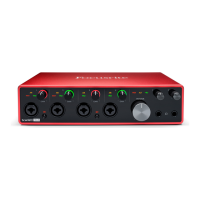
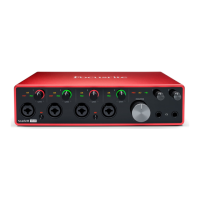
The front panel input sockets are XLR Combo type, which accept either an XLR male connector (you
will probably have one on the end of your microphone cable) or a ¼” (6.35 mm) jack plug. Note the
Scarlett 18i8 has no “Mic/Line” switch – the Focusrite preamplifier stage is automatically configured
for a microphone when you plug an XLR into the input, and for a line or instrument when you connect
a jack plug. Select INST in Focusrite Control (on the Device Settings page) if you are connecting a
musical instrument (like a guitar) via an ordinary 2-pole guitar jack, or LINE if you are connecting a
line level source such as the balanced output of an external audio mixer via a 3-pole (TRS) jack. Note
the Combo connector accepts both types of jack plug.
If you are using capacitor (condenser) microphones, press the 48V button to supply phantom power
to the mics. (In the example, this would be the 48V button for Inputs 3 and 4.) We recommend that
you don’t turn it on if you’re using any other type of mic. As the 48V button enables phantom power at
both inputs of a pair, it is best not to intermix condenser mics and other types (e.g., dynamics) in the
same pair, as the application of phantom power may cause damage to some types of non-condenser
microphones.
Channels 1 to 4 of the Scarlett 18i8 each have a PAD facility, selectable from Focusrite Control
(on the Device Settings page); switching the Pad into circuit reduces the input sensitivity by 10 dB.
You may find this useful if you are feeding the input from a line-level source when the output is
particularly “hot”.
Low Latency Monitoring
You will frequently hear the term “latency” used in connection with digital audio systems. In the
case of the simple DAW recording application described above, latency will be the time it takes for
your input signals to pass through your computer and audio software, and back out again via your
audio interface. While not an issue for most simple recording situations, under some circumstances,
latency can be a problem for a performer who wishes to record while monitoring their input signals.
This might be the case if you need to increase the size of your DAW’s recording buffer, which could
be necessary when you record overdubs on a particularly large project using many DAW tracks,
software instruments and FX plug-ins. Common symptoms of too low a buffer setting include audio
glitching (clicks and pops) or an unusually high CPU overhead within your DAW (most DAWs show
current CPU usage). Buffer size may be increased on Macs from within the DAW application itself,
while on PCs it is usually accessed on the DAW Setup Preferences page.
The Scarlett 18i8, in conjunction with Focusrite Control, allows “low latency monitoring”, which
overcomes this problem. You can route your input signals directly to the Scarlett 18i8’s headphone
outputs. This enables the musicians to hear themselves with ultra-low latency – i.e., effectively in
“real time” – along with the computer playback. The input signals to the computer are not affected
in any way by this setting. However, note that any effects being added to the live instruments by
software plug-ins will not be heard in the headphones in this case, although the FX will still be
present on the recording.




 To Next Page