Need help?
Do you have a question about the Ford Racing 347 Series and is the answer not in the manual?
Key operating clearances and tolerances for engine components.
Inspection criteria for hydraulic valve lifters.
Specification for valve spring installed height.
Information on pushrod lengths used in production engines.
Typical valve seat and cut characteristics for inspection.
List of parts required for the 7MM head conversion.
Chart detailing torque sequence for cylinder heads.
Sequence for torquing intake manifold bolts.
Specific changes introduced in Revision 2010-1.
Specific changes introduced in Revision 2010-2.
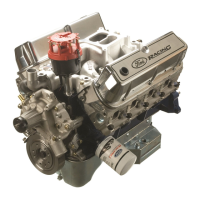
The Ford Racing 347 Series Sealed Engine Handbook provides comprehensive information for the D347SR, D347SR7, and S347JR sealed racing engines. This handbook is designed to serve as a sanctioning body specifications guide, detailing the components, assembly, and maintenance procedures for these high-performance engines.
The Ford Racing 347 Series Sealed Engines are high-performance racing engines designed for circle track applications. These engines are factory-built and sealed to ensure fair competition and adherence to specific technical regulations. The sealing process involves the placement of unique, numbered cap seals at critical points on the engine, including the oil pan rail, front cover, and intake manifold. These seals are a two-piece design, with a base secured by a bolt that encapsulates the head of the bolt, and interlocking fingers with the cap. This design makes any tampering or unauthorized removal easily detectable, ensuring the integrity of the sealed engine program. Ford Racing maintains complete records of each factory original seal number, its location, and the engine to which it belongs. Sanctioning bodies are encouraged to use the Ford Racing factory sealing process for engine teardowns or repairs, although Ford Racing does not issue replacement cap seals.
The engines are built around a robust M-6010-BOSS302 cast iron block, featuring a 4-bolt main design for enhanced durability, particularly in the center three main caps. The crankshaft is a forged steel unit, internally balanced, and manufactured by Scat. Connecting rods are also forged 4340 I-Beam units from Scat, designed for strength and reliability in racing conditions. Mahle forged aluminum pistons are used, featuring forced pin oiling and round wire locks, contributing to the engine's high compression ratio and performance. The timing set utilizes a double roller chain, ensuring precise valve timing.
The cylinder heads are a critical component, with the D347SR and D347SR7 models using Ford Racing aluminum M-6049-Z304DA or M-6049-Z304DA7 heads, while the S347JR uses M-6049-X306 or M-6049-X307 aluminum heads. These heads feature fully machined combustion chambers and stainless steel valves with swirl polished heads. The D347SR and D347SR7 heads utilize specific intake and exhaust valve diameters and lengths, with the D347SR7 offering a 7MM valve conversion option for enhanced performance, which sanctioning bodies may approve for competition. The S347JR heads feature a slightly different valve configuration and use self-aligning roller rockers. All engines use beehive valve springs, identified by their silver or brown finish, with specific installed heights and pressures to optimize valve train stability at high RPMs. Hydraulic roller lifters are employed across the series, with production lifters sourced from various manufacturers, all designed to maintain consistent valve lash.
The Ford Racing 347 Series Sealed Engines are designed for competitive racing, offering a balance of power, durability, and compliance with sealed engine regulations. The handbook provides detailed operating and tune-up information to ensure optimal performance and longevity. Recommended timing settings, maximum RPM limits, and oil pressure ranges are specified to guide teams in engine operation. The use of specific oil pan configurations, oil filters, and recommended oil types (e.g., 15w-50 Mobil 1 or 20w-50 Brad Penn) are outlined to maintain proper lubrication and cooling. Coolant temperature and spark plug recommendations are also provided to ensure efficient combustion and engine health. The specified firing order and fuel pressure settings are crucial for correct engine operation.
The engines are designed to be run within specific clearances for critical components such as main bearings, rod bearings, crankshaft end float, and wrist pin clearances. Piston to deck distance and piston to bore clearance are also specified to ensure proper assembly and operation. Valve lash settings are provided for the hydraulic roller lifters, emphasizing the importance of a precise preload for consistent valve train performance.
For the D347SR and D347SR7 engines, a 7MM valve conversion option is available, which involves replacing the standard valves with smaller stem diameter valves and corresponding valve guides. This modification is intended to improve airflow and performance, subject to sanctioning body approval. The handbook lists the specific part numbers for the 7MM intake and exhaust valves, as well as the required valve guides, to facilitate this conversion.
The handbook includes comprehensive engine rebuild specifications for both the D347SR/D347SR7 and S347JR models, providing critical dimensions and tolerances for various components. This information is essential for engine builders and technicians performing maintenance or repairs. Specifications for crankshaft weight, piston to deck distance, head gasket thickness, and maximum bore size are provided to ensure that rebuilt engines meet factory standards. Valve spring installed height and pressure specifications are detailed, along with valve diameters for both intake and exhaust valves. Combustion chamber volume, compression ratio, and camshaft lift specifications are also included to guide proper assembly and ensure performance consistency.
Detailed torque specifications are provided for all critical fasteners, including main studs, main nuts, rod bolts, head studs, head nuts, rocker studs, intake manifold bolts, flywheel bolts, and oil pump fasteners. The handbook also recommends specific lubricants for each fastener type (e.g., Loctite 242 for studs and bolts, engine oil for main nuts, ARP Moly for rod bolts), which is crucial for achieving correct clamping loads and preventing loosening during operation. Torque charts for cylinder heads and intake manifolds illustrate the proper tightening sequences, which are vital for preventing warping and ensuring even clamping pressure.
Tech inspection information is included to assist sanctioning bodies in verifying engine compliance. This section details specifications for hydraulic valve lifters, including inner plunger diameter, preload, and plunger travel. Valve spring installed height is also a key inspection point, with allowances for valve locks or shims to achieve the correct height. Pushrod length variations are noted to accommodate different roller rocker arm manufacturers used in production. The handbook also describes typical Ford Racing production valve job characteristics, such as seat angles, concentricity to the valve stem centerline, and the extension of the top cut into the combustion chamber, providing clear guidelines for inspection. Furthermore, specific dimensions for the intake and exhaust bowl cuts in the Z304DA and Z304DA7 cylinder heads are provided, along with instructions on how to measure them, ensuring that porting modifications remain within legal limits. The maximum intake port opening dimensions are also specified for the M-6049-Z304DA heads used on D347SR engines, serving as a critical reference for technical inspectors.
 General
| Engine Type | V8 |
|---|---|
| Cylinder Block Material | Cast Iron |
| Cylinder Head Material | Aluminum |
| Displacement | 347 cubic inches |
| Recommended Fuel | 91 Octane |

 To Next Page