EasyManua.ls Logo

Fostex 250 - Interface Details; Levels and Signal Amplitude

Fostex 250
28 pages
Print Icon
To Next Page IconTo Next Page
To Previous Page IconTo Previous Page
Loading...
sections
INTERFACE
DETAILS
This
section
of
the
manual
is
written
for
the
non-engineer,
who
may
have
only
a
vague
idea
of
the
meaning
of
levels
(whether
expressed
in
dBV,
volts
or
millivolts),
and
who
prob¬
ably
understands
even
less
about
impedance
(expressed
in
ohms
or
kilohms).
The
following
subsections
are
written
to
impart
a
greater
understanding
of
level
and
impedance,
with
specific
regard
to
the
Model
250.
LEVELS
AND
DECIBELS
(dB)
Level
is
a
term
loosely
used
to
describe
the
amplitude
of
a
signal
or
a
sound.
More
precisely,
“level”
is
the
value
of
a
sound
or
signal
relative
to
a
given
reference
and
usually
ex¬
pressed
in
dB
SPL
(DeciBels,
Sound
Pressure
Level)
dBV
(DeciBels,
Volts).
The
relationship
between
dB
and
volts
(or
dynes,
when
discussing
sound
pressure)
is
not
a
1:1
because
the
“dB"
value
expresses
a
ratio,
one
which
is
based
on
logarithms.
NOTE:
An
understanding
of
the
following
few
paragraphs
can
be
very
helpful,
but
is
not
necessary
for
connecting
the
Model
250
to
other
equipment.
We
have
avoided
formulas
and
highly
technical
language
to
the
extent
possible.
If
the
voltage
level
is
doubled,
the
number
of
dB
is
not
doubled—it
is
increased
by
6.
This
means
that
whether
the
voltage
goes
from
30
millivolts
to
60
millivolts
(a
30
mV
in¬
crease),
or
from
5
volts
to
10
volts
(a
5
volt
increase),
the
level
increases
by
the
same
6
dB.
By
the
same
rules,
if
the
voltage
goes
up
by
a
factor
of
10,
the
level
increases
20
dB.
The
same
relationship
applies
to
sound
pressure
level
(doubling
the
number
of
dynes
is
an
increase
of
6
dB
SPL).
dBV
values
can
be
converted
to
specific
voltages,
and
vice-
versa;
a
special
slide
rule
or
scientific
calculator
is
usually
employed.
In
simple
terms,
however,
the
key
to
the
conver¬
sion
is
the
"reference”
value
for
dBV.
The
large
“V”
in
dBV
means
that
the
0
dB
value
is
related
to
a
specific
Voltage,
1
volt
in
this
instance.
Given
that
1
volt
is
0
dBV,
the
following
table
can
be
readily
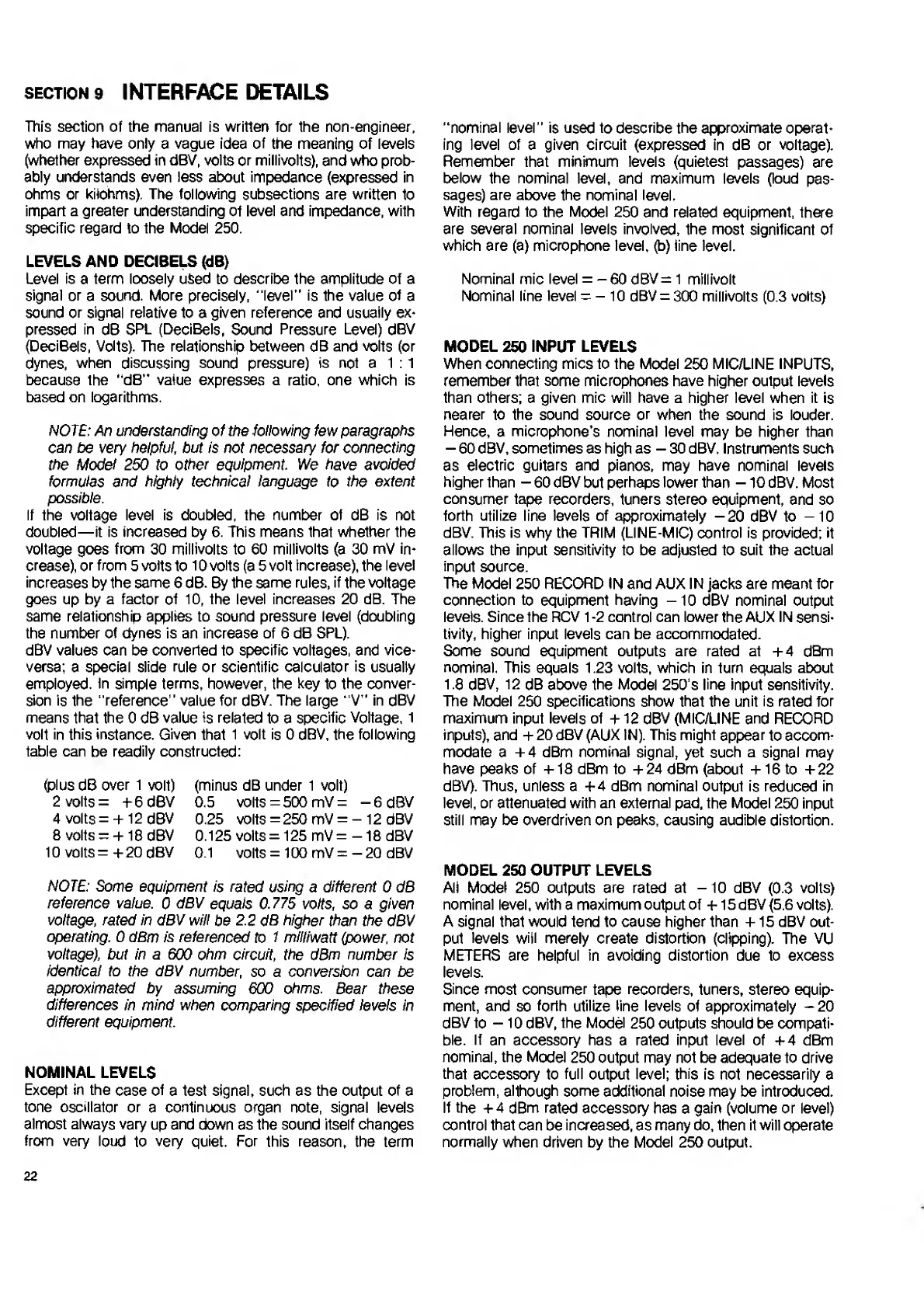
constructed:
(plus
dB
over
1
volt)
2
volts
=
+6
dBV
4
volts
=
+
12
dBV
8
volts
=
+
18
dBV
10
volts
=
+20
dBV
(minus
dB
under
1
volt)
0.5
volts
=
500
mV
=
-
6
dBV
0.25
volts
=
250
mV
=-12
dBV
0.125
volts
=125
mV
=
-18
dBV
0.1
volts
=
100
mV
=
-
20
dBV
NOTE:
Some
equipment
is
rated
using
a
different
0
dB
reference
value.
0
dBV
equals
0.775
volts,
so
a
given
voltage,
rated
in
dBV
will
be
2.2
dB
higher
than
the
dBV
operating.
0
dBm
is
referenced
to
1
milliwatt
(power,
not
voltage),
but
in
a
600
ohm
circuit,
the
dBm
number
is
identical
to
the
dBV
number,
so
a
conversion
can
be
approximated
by
assuming
600
ohms.
Bear
these
differences
in
mind
when
comparing
specified
levels
in
different
equipment.
NOMINAL
LEVELS
Except
in
the
case
of
a
test
signal,
such
as
the
output
of
a
tone
oscillator
or
a
continuous
organ
note,
signal
levels
almost
always
vary
up
and
down
as
the
sound
itself
changes
from
very
loud
to
very
quiet.
For
this
reason,
the
term
"nominal
level"
is
used
to
describe
the
approximate
operat¬
ing
level
of
a
given
circuit
(expressed
in
dB
or
voltage).
Remember
that
minimum
levels
(quietest
passages)
are
below
the
nominal
level,
and
maximum
levels
(loud
pas¬
sages)
are
above
the
nominal
level.
With
regard
to
the
Model
250
and
related
equipment,
there
are
several
nominal
levels
involved,
the
most
significant
of
which
are
(a)
microphone
level,
(b)
line
level.
Nominal
mic
level
=
-
60
dBV
=
1
millivolt
Nominal
line
level
=
-
10
dBV
=
300
millivolts
(0.3
volts)
MODEL
250
INPUT
LEVELS
When
connecting
mics
to
the
Model
250
MIC/LINE
INPUTS,
remember
that
some
microphones
have
higher
output
levels
than
others;
a
given
mic
will
have
a
higher
level
when
it
is
nearer
to
the
sound
source
or
when
the
sound
is
louder.
Hence,
a
microphone's
nominal
level
may
be
higher
than
-
60
dBV,
sometimes
as
high
as
-
30
dBV.
Instruments
such
as
electric
guitars
and
pianos,
may
have
nominal
levels
higher
than
-
60
dBV
but
perhaps
lower
than
-10
dBV.
Most
consumer
tape
recorders,
tuners
stereo
equipment,
and
so
forth
utilize
line
levels
of
approximately
-20
dBV
to
-10
dBV.
This
is
why
the
TRIM
(LINE-MIC)
control
is
provided;
it
allows
the
input
sensitivity
to
be
adjusted
to
suit
the
actual
input
source.
The
Model
250
RECORD
IN
and
AUX
IN
jacks
are
meant
for
connection
to
equipment
having
-10
dBV
nominal
output
levels.
Since
the
RCV
1
-2
control
can
lower
the
AUX
IN
sensi¬
tivity,
higher
input
levels
can
be
accommodated.
Some
sound
equipment
outputs
are
rated
at
+4
dBm
nominal.
This
equals
1.23
volts,
which
in
turn
equals
about
1.8
dBV,
12
dB
above
the
Model
250’s
line
input
sensitivity.
The
Model
250
specifications
show
that
the
unit
is
rated
for
maximum
input
levels
of
+12
dBV
(MIC/LINE
and
RECORD
inputs),
and
+
20
dBV
(AUX
IN).
This
might
appear
to
accom¬
modate
a
+4
dBm
nominal
signal,
yet
such
a
signal
may
have
peaks
of
+18
dBm
to
+24
dBm
(about
+
16
to
+22
dBV).
Thus,
unless
a
+4
dBm
nominal
output
is
reduced
in
level,
or
attenuated
with
an
external
pad,
the
Model
250
input
still
may
be
overdriven
on
peaks,
causing
audible
distortion.
MODEL
250
OUTPUT
LEVELS
All
Model
250
outputs
are
rated
at
-10
dBV
(0.3
volts)
nominal
level,
with
a
maximum
output
of
+15
dBV
(5.6
volts).
A
signal
that
would
tend
to
cause
higher
than
+15
dBV
out¬
put
levels
will
merely
create
distortion
(clipping).
The
VU
METERS
are
helpful
in
avoiding
distortion
due
to
excess
levels.
Since
most
consumer
tape
recorders,
tuners,
stereo
equip¬
ment,
and
so
forth
utilize
line
levels
of
approximately
-
20
dBV
to
-
10
dBV,
the
Model
250
outputs
should
be
compati¬
ble.
If
an
accessory
has
a
rated
input
level
of
+4
dBm
nominal,
the
Model
250
output
may
not
be
adequate
to
drive
that
accessory
to
full
output
level;
this
is
not
necessarily
a
problem,
although
some
additional
noise
may
be
introduced.
If
the
+4
dBm
rated
accessory
has
a
gain
(volume
or
level)
control
that
can
be
increased,
as
many
do,
then
it
will
operate
normally
when
driven
by
the
Model
250
output.
22

Related product manuals