
 Need help?
Do you have a question about the Fraser EX715 and is the answer not in the manual?
Explains warning and caution symbols used in the manual to indicate potential hazards or damage.
Lists the items included with the EX715, such as the carry case, Declaration of Conformity, and Calibration Certificate.
Provides guidelines for accurate electric field measurements, emphasizing avoiding contact with other objects or machines.
Outlines typical static voltage levels and their associated phenomena, such as dust attraction and danger levels.
Details the measurement ranges of the EX715, including voltage limits and their respective resolutions.
Specifies approved battery types and their impact on the instrument's hazardous area certification and temperature rating.
Explains the ATEX/IECEx certification mark and its components, defining the equipment's suitability for hazardous environments.
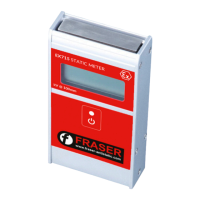
The Fraser EX715 Static Meter is a specialized instrument designed for the analysis and measurement of industrial static electricity problems. It serves as an invaluable tool for professionals in various industries, aiding in the scientific investigation of static issues throughout production and quality control processes. The meter helps operators to understand the presence and levels of static, establish acceptable static standards, identify static-generative materials, pinpoint the sources of static generation, and assess the effectiveness and optimal positioning of static eliminators.
The primary function of the EX715 Static Meter is to measure the surface voltage of static charges in kilovolts (kV). It is engineered to provide accurate readings of electric fields, which are crucial for diagnosing and resolving static electricity concerns. The device is particularly notable for its certification for use in certain hazardous areas, making it suitable for environments where explosive gases, vapors, or mists may be present. This certification underscores its robust design and safety features. The meter automatically selects between two ranges: up to ±20kV with a resolution of 10V, and from ±20kV to ±200kV with a resolution of 100V, ensuring versatility across a wide spectrum of static levels.
Operating the EX715 Static Meter involves a straightforward procedure designed for ease of use and accuracy. Before any measurement, it is essential to connect the instrument to a suitable grounded point using the provided earth lead. This prevents charge buildup on the meter itself, which could distort readings or cause a discharge. The ring end of the earth lead clips to the bottom of the meter, while the crocodile clip/4mm stud should be connected to a bare metal part of the machine or another appropriate earth point.
To begin a measurement, the user holds the EX715 in the palm of their hand, pointing it away from the static charge. A single click of the button turns the device ON and simultaneously sets the zero level for readings. This initial zeroing is critical for accurate measurements and must be performed when the meter is not influenced by a static charge. Once zeroed, the instrument is held approximately 100mm from the object to be measured. The LCD display will then show the surface voltage of the static charge in kilovolts. The polarity of the charge is indicated by a negative sign if present; otherwise, it is positive.
For convenience, the EX715 features a HOLD function. Clicking the button again while a reading is displayed will freeze the measurement on the screen, indicated by the reading blinking or flashing. To take a new measurement, the user must re-zero the instrument by pointing it into free air away from the charge and clicking the button. This action releases the HOLD function and prepares the EX715 for another reading. The device is designed for energy efficiency, automatically turning itself OFF after approximately 60 seconds of inactivity.
It is important to note specific guidelines for accurate readings. Measurements should ideally be taken when the object is in free air and away from machine parts, as adjacent machinery can distort the electric field lines and lead to under-measurement. The material should never be measured while touching another body. Additionally, measurements should not be taken within 300mm of a static eliminator, as the ionized air produced by such devices can interfere with and distort the reading.
The EX715's hazardous area certification is dependent on the type of battery used. For a T4 rating with an ambient temperature range of -20°C to +59°C, Duracell Industrial MN1604 or Duracell Coppertop MN1604 batteries are required. For a T5 rating with an ambient temperature range of -20°C to +40°C, a Panasonic 6F22R battery must be used. This flexibility allows the meter to be adapted to different environmental conditions while maintaining its safety certification.
Maintaining the EX715 Static Meter is relatively simple, focusing primarily on keeping the device clean and ensuring proper battery function. The charge plate located at the top of the meter is a critical component for accurate readings and must be kept clean and free from dust and fluff. It is equally important not to touch this area during operation, as doing so can affect the measurement accuracy.
Apart from battery replacement, the EX715 contains no user-serviceable parts. This design philosophy ensures the integrity of the instrument, especially given its certification for hazardous areas. If the device malfunctions, it should be returned to the manufacturer for repair. Attempting to take the instrument apart will void its guarantee.
Battery replacement is necessary when the "Battery Low" indicator appears on the display. Access to the 9V PP3 battery is gained through a removable plate located at the bottom of the instrument. Users must ensure they replace the battery with one of the approved types (Duracell Industrial MN1604, Duracell Coppertop MN1604, or Panasonic 6F22R) to maintain the device's hazardous area certification and specified temperature rating. It is a critical safety warning that the EX715 must not be opened to replace the battery or for any other reason when in a hazardous area.
For instruments used in hazardous areas, an annual recalibration is recommended to ensure continued accuracy and compliance. The EX715 is calibrated as standard using a 150mm x 150mm or other sized plate. Should users require further information regarding static electricity problems or the device itself, they are encouraged to contact the manufacturers or authorized distributors. The EX715 comes complete with a carry case, a Declaration of Conformity, and a Calibration Certificate, ensuring its readiness for professional use.
 General
| Type | Digital Multimeter |
|---|---|
| Diode Test | Yes |
| Continuity Test | Yes |
| Operating Temperature | 0°C to 40°C |
| Power Supply | 9V battery |
| AC Voltage Range | 200V/600V |
| DC Current Range | 0.1μA to 10A |
| Measurement Range | Depends on function |
| Accuracy | ±(0.5% + 2 digits) |

 To Next Page