eTower Installation Manual Revision 0
Page 19 | 23
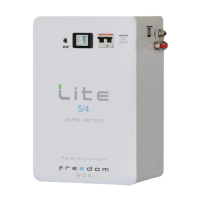
The BMS inside the Freedom Lite will deal with an excessive spread of cell voltages by
balancing them out using the cell tap wires attached to each cell and its internal circuitry. If
a cell voltage does reach its limit the BMS will be forced to intervene by internally
disconnecting the cells from the terminals. The breaker will remain ON. Once the problem is
cleared the eTower module may reconnect.
Frequent occurrences of this situation is not desirable so the voltages should be set to the
following to reduce this occurrence to abnormal circumstances:
• Minimum (cut off) – 49V
• Low Battery Voltage Warning (if applicable) – 51V
• Max Charge Voltage – 55.5V
A voltage can also be set according to user requirements on the inverter depending on how
much battery power may be used before grid power will take over from the battery (if it is
available). It should be determined based on how much battery SoC is desired at all times as
a minimum to ensure adequate capacity to handle a grid outage or load shedding. The daily
cycling depth is also a consideration for the user in terms of battery service life.
The recommended voltage for forcing the inverter back to grid power in a self-consumption
setup without communication is:
• 52,0V for approximately 60% DoD
• 51,0V for approximately 70% DoD
In non-CAN/R485 systems fitted with DC solar charge controllers (SCC) the AC charger
should stop charging at 53.5V to allow the remainder of the charge to be performed by the
SCC.
The SCC voltage set point would be set to 55,8V if BMS control is functional and 55,5V
without BMS control. Note that it may be necessary to use a slightly lower voltage initially if
the cells have not had sufficient balancing time – if the battery trips prior to reaching 55,5V
it is because one cell has reached its maximum too early. Try starting with 54,5V and then
after several days of balancing increasing it to 55,5V.
Note: For applications where voltages are measured during high current discharge it might
be necessary to adjust slightly the values given above to cater for cell internal resistance.
Note: For systems with an interface between the battery and the rest of the system it is
advisable to use SoC for controlling charge and discharge algorithms as this is the only
accurate method – using voltage as described above is only an approximation.


 To Next Page
 Loading...